The Breakup of Civil Society in Post–War Azerbaijan
1 Leiden University, The Netherlands
2 Vytautas Magnus University, Lithuania
3 University of Zurich, Switzerland
Abstract. In the backdrop of devastating war(s) between Armenia and Azerbaijan, rising authoritarianism in the country and the shrinking space for civic participation, Azerbaijan’s civil society has undergone various moments of contestation and transformation. In this article, we argue that the 2020 Karabakh war was one of those moments – a turning point which led to the rupture, if not breakup, of civil society from within. Most of the civil society strongly supported the war, exceptionally aligning itself with the autocratic government. A minority – made up of liberals, leftists and feminists – opposed the war, becoming stigmatised as “traitors” by society and the government alike. We argue that the 2020 Karabakh war catalysed disagreements within the civil society regarding its identity, normative role and positionality vis-à-vis the state, eventually leading to its fragmentation into mutually isolated circles. No scholarly article has yet analysed in depth these post–2020 developments of Azerbaijani civil society. The article is based on semi-structured interviews collected from forty-three anti-war activists. Notably, we find that “no–war” civil society actors began to view the pro-war actors as less legitimate, if not illegitimate, members of the society. Having (in)directly supported the autocratic regime and further autocratisation, they failed to play their role qua civil society as counterbalance to the state. We conclude by discussing government’s recent reaction to these developments, especially in light of the ongoing peace negotiations between Armenia and Azerbaijan.
Keywords: civil society, Azerbaijan, autocratisation, war, anti-war.
Index
Background History of Civil Society in Azerbaijan
Azerbaijan’s defeat against Armenia in the 1988–1994 first Karabakh war left a deep imprint of national humiliation (Sotieva 2021; Kösen and Erdoğan 2023; Musavi 2024), fostering a psychology of defeat (Ergun 2022). This shared experience of suffering, marked by the traumatic loss, struggles of displacement and perceived unjust occupation of Azerbaijan’s de jure territories (Samadov 2023), became a unifying force for the Azerbaijani national identity. Armenians were increasingly essentialized in popular discourse with “enemy” images, and depicted as “evil, cunning, and non–negotiable” adversaries (Samadov and Grigoryan 2022, 102). After the first Karabakh war, Azerbaijani government(s) gradually institutionalized these “essentialist and ethnonationalist” conflict narratives – framed by an ethnic-turkic understanding of nationhood and its enemies – rendering them hegemonic throughout society (Gamaghelyan and Huseynova 2024, 269).1 For example, official government rhetoric became confrontational and dehumanizing toward Armenians (Sahakyan 2023), mass media perpetrated narratives of victimhood and incomplete sovereignty without Karabakh (Rumyantsev 2019), school textbooks portrayed Armenians as historical and existential enemies of the Azerbaijani nation (Abbasov and Rumyantsev 2012; Ghazaryan and M. Huseynli 2022; Akhundov 2025; Georges 2025); and even cultural products – such as films and poetry – dehumanized the “enemy” (Gamaghelyan and Rumyantsev 2021; Aslanov and Abbasov 2023).
Nonetheless, civil-society driven peace-building initiatives – which sought to foster more reconciliatory narratives and solutions to the conflict – did take place. Professionalised and liberal NGO actors believed that peace could be achieved through democratization. They sought to promote liberal–democratic norms and values, which in turn would help achieve a diplomatic settlement of the Karabakh issue (Gamaghelyan and Huseynova 2024).
However, when in September 2020 the Azerbaijani government launched the second Karabakh war, many from Azerbaijani opposition and civil society – including those who had previously been involved in peace-building efforts – fervently supported the government and its military offensive. It can be argued that these individuals had been caught in the very “essentialist and ethnonationalist” narratives of the conflict they once opposed. This had significant consequences for political contestation within Azerbaijan. Indeed, as Gamaghelyan and Rumyantsev (2021, 12) argue, by supporting the war “civil society contributed to the creation of a new source and reserve of legitimacy for authoritarianism”.
Nonetheless, a small minority of civil society actors – primarily independent activists unaffiliated with any institutions – openly expressed their anti–war stance on social media (Pfeilschifter and Figari Barberis 2023; Gamaghelyan and Huseynova 2024). As will be discussed in this paper, many of these anti-war activists held strong political-ideological positions and could be categorised into three main groups: feminists; liberals; and leftists (Huseynli 2021a). Notwithstanding their differences, they were collectively recognized as the “no-war movement”. Because of their anti-war positions, they faced enormous societal stigmatization, being labelled as ‘traitors to the homeland’ (vətən xainilər) and ‘Armenian lovers’ (ermənipərəstlər) (Pfeilschifter and Figari Barberis 2023; Figari Barberis and Huseynli 2025)). Even pro-war civil society members condemned them for their anti-war positions, deepening ruptures within civil society itself.
The 2020 second Karabakh war ultimately marked a turning point for Azerbaijani civil society, reshaping their identities and normative positions. More than four years after the war’s end, this anti-war positionality remains relevant, at least for part of civil society and the government. Such that, the government continues to repress and publicly stigmatize as “traitors” and “foreign agents” these anti-war activists, who are pejoratively referred to by the media as “ultra–liberals, radical leftists and radical feminists”.2
This article, thus, explores the internal ruptures, if not outright breakup, of Azerbaijani civil society during and after the second Karabakh war. It does so within the context of “shrinking” or “closing” space for civil society and democratic forces in the country, as government surveillance and crackdowns continue to operate (Luciani 2023; Kamilsoy 2023, 2025; Balfour et al. 2020; Toepler et al. 2020; Sander 2023). Methodologically, it is based on interviews conducted between 2021-2024 with forty-three anti-war civil society actors. The article tends to analyse the latter developments through the prism of our no–war interviewees’ ideological landscape and their normative assessment regarding the purpose of what constitutes “genuine” civil society in authoritarian countries.
There has been several studies unpacking challenges and activities of Azerbaijani civil society actors in the pre-2020 era (Shirinov 2015; Ismayil and Remezaite 2016; Goyushov and Huseynli 2019; Luciani 2023; Kamilsoy 2023). Nevertheless, little is known about Azerbaijani civil society in its post-war epoch. Indeed, Luciani (2023, 1739) concludes her research by emphasizing a limitation of her analysis, as “it did not take into account developments unfolding during and after the second Karabakh war, though civil society identities shifted significantly over that period”. Gamaghelyan and Rumyantsev (2021) and Gamaghelyan and Huseynova (2024) do notice that the majority of Azerbaijan’s civil society supported the war in 2020, but do not analyse this dynamic any further. Therefore, our article – based on interviews conducted between 2021–2024 with forty-three anti-war civil society interviewees – is novel for its analysis of Azerbaijani civil society’s internal ruptures, if not breakup, during and after the 2020 second Karabakh war. We contribute to the Caucasus Studies scholarship by filling this empirical gap.
The article’s structure is as follows. First, we introduce the theoretical debate concerning the conceptualization and normative role of civil society. Then we discuss the developments of Azerbaijani civil society in the pre-2020 period. This is followed by the section outlining the methods and sample we used to design our research. Afterwards, in the empirical section of the article, we unpack and analyse Azerbaijani civil society’s internal crisis in the backdrop of the 2020 second Karabakh war. We especially explain the rupture along the pro-war and no-war cleavages. Finally, we discuss how the post–war new identities of civil society keep being relevant as we write in 2025, both for intra-civil society debates and the government’s propaganda against no-war actors.
The idea of civil society has proven very elusive, escaping conceptual grasps and evading sure-footed definitions. Nonetheless, civil society is generally understood as a network of organizations operating between the state, the individual, and the economic production system (Kopecký and Mudde 2003). It serves as a space for voluntary citizen self-organization, distinct from both the government and the market, while maintaining a degree of relative autonomy from the state (Young 2000). Within these “free zones” or spaces, individuals collaborate in various informal associations, fostering horizontal networks of communication and solidarity from below (Spasić 2003; Chandhoke 2007, 609–10).
Scholarly debates persist over whether civil society plays or should play a normative role, by (in)directly promoting “good” norms and values – such as democracy, justice, tolerance and trust. This scholarly position, known as Neo–Tocquevillian approach, argues that the promotion of “good” values serves as a democratic counterbalance to state power (Pishchikova and Izzi 2011). To use Booth and Richard’s dictum (1998, 780), “civil society may contribute to democratization by mediating between citizen and state, conveying citizens’ interests to government, constraining government behaviour by stimulating citizen activism, and inculcating democratic values”.
Conversely, the scholarly position known as Gramscian approach, rejects the assumption that civil society must serve a normative role. Rather than viewing it as a democratic counterbalance to state power, this approach views civil society as an area of ideological contestation and hegemonic struggle, where ideological conflicts unfold (Lewis 2001; Chandhoke 2007; Shirinov 2015). Civil society, thus, encompasses a broad range of organizations and groups which may not only resist, but also reinforce and legitimise the existing order – even if autocratic and illiberal (Lewis 2013). This is particularly relevant in autocratic states, where “principled” civil society actively opposes the state, while “pragmatic” civil society remains neutral or even collaborates with the state to ensure its survival (Stuvøy 2020). Authoritarian governments can constrain civil society’s ability to articulate anti-hegemonic narratives, while simultaneously supporting those civil society organizations that reinforce the legitimacy of the state (Lewis 2013). Moreover, in conflict afflicted countries, civil society can fuel conflict, sustain the status quo or work to promote peace (Marchetti and Tocci 2009)
For our article on Azerbaijan, drawing on Shirinov (2015) and Luciani (2023)’s analyses, we define civil society as an area of hegemonic struggle. We thus make no a priori distinction between “principled” (or “genuine”) and “pragmatic” (or “co-opted”) civil society. Indeed, especially after the Azerbaijani government’s crackdown of 2014, various civil society actors have been supportive of government policies and initiatives in both domestic and foreign affairs. This includes GONGOs, co-opted intelligentsia and think tanks, but also moderate and extreme nationalist groups (Goyushov 2021; F. Barberis 2024; Storm 2024). Nonetheless, it is important to note that after the 2014 crackdown, a distinct cleavage was formed between independent and neutral/pro-government civil society, as the independent side tended to perceive itself as more genuine civil society (Luciani 2023, 1733). Beyond the conceptual disagreements of the academic scholarship, post–2014 Azerbaijani civil society itself was engaged in internal debates about its normative role and position vis-à-vis the state. And the 2020 second Karabakh war would become another turning point for intra–civil society debates about their identity and role qua civil society.
Background History of Civil Society in Azerbaijan
Azerbaijani civil society emerged as a driving force after serious seatbacks of the traditional opposition political parties in the 2003 presidential and 2005 parliamentary elections. Civil society started organizing itself as the new opposition, made of independent youth organizations, student networks and intellectual circles led by young political entrepreneurs, political activists, writers and many diverse groups. Many of them operated through horizontal associations and informal networks, in contrast to more traditional and formal NGOs structures (Altstadt 2017; Goyushov and Huseynli 2019). However, most of early Azerbaijani civil society was organized in formal NGOs. An estimated 150–200 NGOs worked on politically sensitive topics, such as citizens’ rights, gender equality, election observation and media freedom (Gahramanova 2009; Namazov 2021). Azerbaijani NGOs were also heavily reliant on western financial support, with over 90% of their funding coming from abroad (Kamilsoy 2023). This structure inevitably resulted in excessive bureaucratization and top-down imposition of agendas by western donors (Gamaghelyan and Huseynova 2024). Peace–building initiatives were also mainly organized and led by the institutionalized, somewhat elitist NGO professionals (Gamaghelyan and Huseynova 2024, Gadimova-Akbulut and Petrosyan 2024). These liberal peacebuilders believed that achieving peace between Armenia and Azerbaijan required a process of liberal democratization.
Overall, many informal movements and formal NGOs became essential supporters of freedom, democratic values and justice in Azerbaijan. They de facto acted as a counterbalance to the state and as normative promoters of “good” values and norms. However, in the backdrop of increasing youth activism on the one hand, and sharp decline of oil prices in global markets on the other, the Azerbaijani government decided to launch unprecedented crackdown and large-scale repressions against the civil society in 2013–14. New regulations against NGOs were also introduced, including tougher registration and financial reporting requirements, which made obtaining donations from abroad extremely complicated. In addition to governmental repression and illiberal regulations, the mediatic apparatus also stigmatized oppositional figures as “fifth columns” (Pearce 2024, 4). This became a turning point for youth movements and NGOs alike. The mass arrests pushed many to continue their activism from exile, while remaining actors were confronted with strategic conundrum concerning how to move ahead (Kamilsoy 2023).
Nonetheless, new youth movements (e.g. “Democracy–18”, “EcoFront” environmentalists, “Tələbə Tələbi” student movement, “İşçi Masası” trade union, “FEMM Project” feminist movement etc.) continued to emerge in the post-crackdown period (Figari Barberis and Mammadli 2024). In contrast to the pre-2014 civil society groups which were marked by their ideological shortcomings, the post–2014 period saw the gradual formation of more ideologically-politically radical civil society groups (Kornsten and Kobzeva 2023). Due to strict regulations imposed on NGOs after 2014, these new groups were less formal and less institutionalized than their predecessors. They preferred unstructured, non-hierarchical modes of association, and could not solely rely on foreign donors (Kamilsoy 2023). This situation – known as “shrinking” space for the civil society (Balfour et al. 2020; Toepler et al. 2020; Sander 2023; Luciani 2023, 1721) – reflects Azerbaijan’s “deepening authoritarianism” (Delcour and Wolczuk 2021, 12). The post-2014 period also saw the increasing emergence of GONGOs and co-optation by the government, which tried to legitimize itself by moulding the civil arena (Alieva and Aslanov 2018; Goyushov and Huseynli 2019; Huseynli 2021b; Figari Barberis 2024).
Despite the weakened position of liberal civil society organizations following the 2014 crackdown, they continued their normative role by promoting progressive values and norms – such as freedom, democracy, civil rights and gender equality. This normative aspect, however, would be questioned during the 2020 Karabakh war, as most of civil society passionately supported President Aliyev’s military actions and war discourse. As mentioned in the introduction, this support contributed to “the creation of a new source and reserve of legitimacy for authoritarianism” (Gamaghelyan and Rumyantsev 2021, 12). The second Karabakh war would thus, like the 2014 crackdown, act as another turning point of contestation and transformation within Azerbaijani civil society. New identities were formed – such as being “no war” – and anti-war actors articulated their own (new) vision of what “genuine” civil society is or should be.
The analysis draws upon forty–three semi–structured interviews with “no war” civil society actors. The first people to be interviewed were identified through social media, as many individuals openly expressed their anti–war stance online. Through snowball sampling, less publicly outspoken “no war” individuals were contacted. Thus, the sample includes both outspoken and more cautious (or self-censoring) “no war” civil society actors. In terms of political–ideological affiliation, our interviewees self-categorized as: leftists, liberals, and feminists. These political-ideological groupings were not internally homogenous. The “leftist” group, for example, ranged from progressives to communists. Nonetheless, these three self-categorizations were recognized as relevant and valid by interviewees themselves. Ten interviewees described themselves as politically non–aligned to any specific ideology. The age of our interviewees ranged from eighteen to sixty, with most being between twenty and thirty-five. As for the gender, the sample is composed of fourteen females, twenty-six males and three non-binary persons.
Interviews were conducted between November 2021 and March 2024, though most were conducted in the year 2022. Thirteen of the interviews were conducted in Azerbaijani while the remaining thirty in English. Almost all interviews were conducted in one-on-one settings, although two were conducted in group settings at the discretion of participants. Twelve of the interviews were conducted online, while the remaining thirty-one in person in Azerbaijan. The average length of the interviews was forty–five minutes. The semi–structured interviews were designed and conducted by the first author whose research covers civil society activism in Azerbaijan. The discussions addressed both the individual’s perception of wars per se, and their own positionality in Azerbaijani civil society with regards to the second Karabakh war. The second author complemented with theoretical, contextual and analytical insights due to his positionality as an insider to civil society dynamics. Given the sensitivity of the topic and the repressive character of the Azerbaijani government, interviews were fully anonymized. Therefore, the second author had access solely to fully anonymized and selected extracts of the interviews.
A limitation to the research was focusing solely on the “no war” camp. This constrains the empirical data as the perspectives of the “pro-war” camp are overlooked. Another limitation may also be interviewees’ social desirability bias to appear as “genuine” civil society to a European researcher. Nonetheless, even with these limitations, the research offers valuable insights into the breaking up of Azerbaijani civil society seen from the perspective of the “no war” camp.
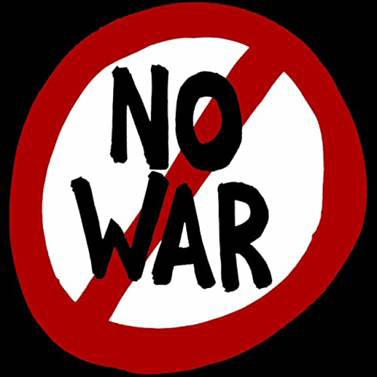
When the war started in September 2020, many of our interviewees expected it to be akin to the so-called 2016 four-day war, a conflict of relatively small proportions in terms of casualties and duration. However, as the fighting persisted, it became manifest to all interviewees that this was, in fact, “a real war”. It was mostly at this point that many individuals of civil society began expressing their position on the war more openly. The articulation of the antiwar position took various forms, from individual posts on social media to collective antiwar statements. For example, in late September a group of seventeen Azerbaijani leftists signed a “no war” manifesto, while in early October other civil society actors published and signed a peace statement calling for the cessation of hostilities. Additionally, members of the anti-war camp designed a new “no war” logo, shown below, specifically for the occasion (Figure 1).
But as the antiwar positions were voiced by only a fringe minority of Azerbaijani civil society, the majority openly expressed the pro-war positions. Thus, many of our interviewees expressed shock and disbelief upon realizing that friends, colleagues and many in the civil society were staunchly supporting the war. This reaction was driven, on the one hand, from the incoherence between the political-ideological belonging of certain civil society actors and their pro-war position. On the other hand, from normative expectations that civil society should serve as a counterbalance to the state and promote liberal-progressive values.
The first case relates especially to pro-war civil society actors who also belonged to certain political-ideological groups. For example, held assumption by the no-war leftists was that their ideological belonging would have refrained them from supporting this war effort. While our leftists interviewees did not a priori exclude the need for a war under certain circumstances, such as a class war against injustice, they firmly condemned this particular one for: being a capitalist war that instrumentalized nationalism; serving the interests of the autocratic Azerbaijani ruling elites and imperialist Russia against the real interests of the masses; and that would reinforce, if not perpetuate, further injustice without solving the root causes of the conflict. To exemplify through the words of an interviewee, “This war between Azerbaijanis and Armenians, this ethnic war, was indeed also a bourgeois war. One bourgeois force against another […] The class war, on the other hand, has as objective the end of all wars, so the class war is the last of wars” (interviewee Y, leftist). Similarly, liberal interviewees did not aprioristically oppose war, but opposed this specific war as it: relied on forced conscription; was not a “just war” since it would gravely violate the rights of Karabakh Armenians; and had been launched in an authoritarian context absent of popular deliberation. In contrast, our feminist interviewees tended to oppose all wars, especially on humanitarian grounds, and because wars reinforced patriarchy and gendered norms. Nonetheless, some leftist and liberal members of civil society did support the war, which left many of our interviewees in disbelief, since they perceived this stance as ideologically contradictory. The sense of disbelief can be captured through the words of two interviewees:
There were a few leftists supporting the war. They said that the war would remove injustice […] But I don’t think this is the case. This war was not about injustice… Opposition had shrunk to such an extent that even people from our side [communists] supported Aliyev. Could you have imagined in Italy communists supporting Mussolini?! (interviewee Z, leftist).
Vegans and eco-activists, like Fuad [pseudonym], were absurd for being pro–war. Ideologically they cannot be pro-war! I am angry at the government and ordinary people, but I am especially angry at civil society. Because they had responsibility, but [they] were pro-war! (interviewee X, feminist).
The second case relates to to normative expectation regarding the very purpose of civil society per se. In a neo-Tocquevillian way, it binds a sense of responsibility to civil society as a democratizing force. As discussed in earlier paragraphs, with post-independent Azerbaijan having been ruled under a consolidated authoritarian regime for more than two decades, civil society has, indeed, been historically formed as a democratizing force in the country, and as “watchdogs” of good governance (Goyushov and Huseynli 2019; Kamilsoy 2025, 8). Hence, many of our interviewees expressed a sense of disbelief and shock with regards to various civil society individuals and actors aligning with a war effort launched by the authoritarian government, as it was seen as reinforcing the current president’s reign, leading to further autocratisation. Many interviewees feared that President Aliyev would have exploited the war to his advantage, by gaining increased popularity through victory. Supporting the war, therefore, was equivalent to (in)directly contributing to the further autocratisation of the country and tightening of his hold on power. And since civil society is expected to function as a counterbalance to the (authoritarian) state, this (in)direct support to the regime was perceived as irreconcilable with their role qua civil society. This concern was widely shared by leftists, feminists and liberals alike. Ex-post, their fears about increased autocratisation because of war would prove to be true. This sense of fear and disbelief are exemplified in the words of two of our respondents:
I had friends and acquaintances in the civil society, but many of them became militaristic [...] They thought that after victory, Azerbaijan could have democratized. Us No-War people, on the other hand, knew that this war and victory would make Aliyev even stronger. And we were right! (interviewee F, liberal).
The president simply used the war to be perceived as amazing. People criticized me, but I told them: how can you not see what Aliyev gains from the war?! Even people in opposition started talking about how amazing the president is! I was shocked, I could not believe my eyes. (interviewee V, feminist).
Beyond their disbelief for (the majority of) civil society’s support for the war, many interviewees expressed even greater disappointment toward prominent civil society figures. Names of opposition figures and activists like Khadija Ismayilova, Tofig Yagublu and Ilgar Mammadov were frequently repeated during our interviews. These public figures had been seen as role models for their investigative journalism, political activism, and political opposition respectively. All three had already served political arrests, for sentences based on arbitrary charges, either due to their political advocacy or their stance against the autocratic rule. Ismaliyova as one of the few middle-aged women in a patriarchal society like Azerbaijan venturing into investigative journalism against such a repressive government, had been heralded as a symbolic role model by some female interviewees. As spearheads of civil society, according to many of our interviewees, these figures shared a larger responsibility in taking a righteous position, if not action, vis-à-vis the authoritarian government. Since the war would have inevitably reinforced the regime, it was their ethical duty to stand up against the war and the regime. Despite the expectations, all three of the public figures were straightforward in their pro-war positions. Ismayilova even voiced utter solidarity with the president by saying “We [the president and her] are in solidarity” during the 2020 war, a position that sparked a heated debate on social media.3 This sense of disbelief and disappointment with prominent civil society members, such as Ismayilova, can be captured through one of our interviewees:
I was super disappointed by Khadija. As a woman, she was, for me, a symbol of courage and bravery. She was a strong female voice challenging the patriarchy and the autocracy… But she shared [on social media] a photo of Aliyev! […] I look at her now differently. She lost respect also from other people. So many people showed their true colours, that they are full of hatred. (interviewee U, feminist).
The results of our interviews also reveal that ruptures within the civil society led to many of our interviewees breaking ties with friends, acquaintances and alike. The breakup occurred in both directions, while in some cases our interviewees initiated them, in others, it was the pro–war individuals who distanced themselves. For both camps (pro-war and anti-war) each position was simply deemed unacceptable. Some of our interviewees were even branded as “traitors to the homeland” (vətən xaini) by their friends or acquaintances for their anti-war position. This breakup seems to have particularly affected the leftist and feminist political–ideological groupings, while it was less so in the case of the liberals. Despite some ties being eventually restored in later periods, the interviews demonstrate that the war marked a turning point for civil society, where even close friendship ties were severed owing to irreconcilable positions vis-à-vis the war.
Aside from the general rupture of Azerbaijani civil society along no-war/pro-war lines, we also observed cleavages within the no–war camp. Indeed, the no–war camp was by no means a united movement with some form of leadership Far from this, some interviewees emphasized the political-ideological variety within the no-war movement. Indeed, as mentioned earlier, the latter included individuals from mainly three political-ideological groupings – leftists, liberals, and feminists – which didn’t necessarily get along well.
But besides from internal ideological diversity, two forms of self-criticism emerged within the no-war camp. The first one was related to the perceived disinterest towards Azerbaijani IDPs from Karabakh. As per one of our interviewees, “I also started self–distancing from the no-war movement […] And I’m not sure if they cared about, for instance, the trauma of internally displaced persons. “No war” rather became a figure or discourse in whose name many conducted their activism . While people were literally dying in the war. I don’t think this was ethical” (interviewee T, leftist). This criticism was further articulated by a few interviewees who voiced discontent against certain no-war activists for their self-centred indulgence, if not for self-proclaimed righteous opposition to authoritarian rule. This indulgence, according to some critical interviewees, was also evident in the fact that some anti-war activists focused their advocacy primarily on western audiences, while neglecting their own domestic society. In other cases, marginalized activists found refuge in safe bubbles, which, in return, generated a sense of condescension vis-à-vis the “ignorant” Azerbaijani mass. The no-war bubbles, according to internal critiques, should have moderated their radical positionality when engaging with ordinary people, particularly Azerbaijani IDPs who were certainly the real victims (rather than marginalized anti-war activists).
The second form of self-criticism revolved around civil society’s failures in properly addressing the Karabakh conflict, let alone coming up with viable solutions. In fact, many of our interviewees acknowledged that they had never publicly articulated workable diplomatic solutions to the Karabakh conflict. In the words of one of our interviewees: “People who joined the “no war” party, previously had no good alternative for solving the NK issue. We didn’t talk about this issue so much […] We said that our main objective was democracy and human rights, we’ll talk about Karabakh later” (interviewee J, liberal). On the one hand, they did not believe in a diplomatic solution, since both the Armenian and Azerbaijani governments were conducting talks in closed doors. On the other hand, the Karabakh conflict was not civil society’s priority, since issues of democracy, civil rights and equality took precedence over it. The assumption, especially held by liberals, was that it would have been possible to reach a diplomatic and peaceful solution over Karabakh only once Azerbaijan (and Armenia) had democratized. Therefore, civil society had to focus on normatively promoting progressive values and norms – such as democracy and civil rights. This prioritisation of progressive values over finding solutions to the Karabakh conflict can be exemplified by another of our interviewees: “Civil society was saying that the government is using the Karabakh topic to manipulate people, so we should not talk about that. Let’s talk about human rights because we have much bigger problems like democracy. That is how we totally put aside the Karabakh issue” (interviewee K, liberal).4
To conclude, our analysis – generated from semi–structured interviews with forty-three anti–war Azerbaijani civil society actors – substantiates how the 2020 Karabakh war was yet another turning point for Azerbaijani civil society. It created new identities – that of “no war” – as well as new internal cleavages and breakups. Compared to post-2014 civil society, however, post-2020 civil society underwent a greater wave of fragmentation, if not outright atomization, from within. This fragmentation was conditioned chiefly upon two factors. First, civil society’s political action which was expected to correspond to their political-ideological positions. Especially for leftist and feminists, the pro-war positions of much of civil society contradicted their stated political ideologies. Second, the expectations about the normative role that civil society actors – as a democratizing force and counterbalance to the state – were supposed to play but failed to do so. These failures are exemplified not only by the pro-war stance of civil society individuals – which de facto legitimized the autocratic government – but also by the co-optation and even U–turn of some civil society actors, who after the war aligned themselves with the government’s political discourse. Five years after the 2020 Karabakh war and the breakup of Azerbaijani civil society, heated debates over who constitutes “genuine” civil society continue to persist.
Even though anti-war activism may be regarded as a thing of the past by some of the remaining civil society, the Azerbaijani government appears not to have forgotten it. The post-2020 period proceeded with even increased government surveillance and crackdowns. Events of the last years demonstrated that the government utilized the anti-war identity to delegitimize these ideological groupings through a smear campaign aimed at the Azerbaijani public (Meydan TV 2023). The smear campaign became most apparent in 2023 when the government-sponsored media outlets singled out participants of a public discussion on peace in the region (Yeni Musavat 2023). The government-sponsored media especially resorts to public stigmatization by branding civil society activists as “traitors” and “foreign agents” or using pejorative epithets such as “ultra-liberals, radical leftists and radical feminists” (APA 2025). Between 2024-2025, as part of a larger crackdown against critical voices, the government even arrested civil society members engaged in peace dialogues with Armenians (Amnesty International 2024; Voice of America 2024a, 2024b; Baku Tv 2024). Participating in independent peace talks with Armenians can now cost 15 years of jail under the charge of “treason” (UNHR 2025). In bitter irony, as official peace negotiations between Armenia and Azerbaijan develop, it is mostly government affiliated organisations that are now conducting peace talks with Armenians counterparts.
Abbasov, Ilham, and Sergey Rumyantsev. 2012. “Ways to perpetuate the past: Analyzing the images of ‘others’ in Azerbaijani history textbooks”. In Contemporary history textbooks in the South Caucasus, edited by Luboš Veselý, 33–56. Prague: Association for International Affairs.
Alieva, Leila, and Bakhtiyar Aslanov. 2018. “How autocracy impedes desecuritization, or why democracy matters: The case of Nagorno–Karabagh in the eyes of Azerbaijanis”. Caucasus Survey.
Altstadt, Audrey L. 2017. Frustrated democracy in post–Soviet Azerbaijan. Washington, DC: Woodrow Wilson Center Press; New York: Columbia University Press.
Amnesty International. 2024. “Azerbaijan. Academics arrested on fabricated charges: Igbal Abilov and Bahruz Samadov”. https://www.amnesty.org/en/documents/eur55/8554/2024/en/.
APA. 2025. “Hrach Topalyanın Bakıda ‘no war’çı fabriki [‘No–War’ fabric of Hrach Topalyan in Baku]”. https://apa.az/iii-sektor/hrach-topalyanin-bakida-no-warci-fabriki-faktlar-885621?fbclid=PAY2xjawH9-9lleHRuA2FlbQIxMAABpmuVJwdxRxMi-VAGe9_ymHlGNH16oIHC7j0CqMZXLdqsoiDFQ70HQO_dfQ_aem_wPWZjNsTxRPL6mi1HhwvrA.
Aslanov, Leon, and Togrul Abbasov. 2022. “Conceiving Armenian–Azerbaijani relations through the lens of cinema: From Perestroika until the present day”. Caucasus Edition: Journal of Conflict Transformation 5 (2): 96–128.
Baku TV. 2024. “Bəhruz Səmədov niyə ermənilərə işlədi [Why Bahruz Samadov spied for the Armenians]”. https://www.youtube.com/watch?v=PrtGQuakSCgandt=402s.
Balfour, Rosa, Laura Gelhaus, and Marta Matrakova. 2020. “The changing landscape of civil society in the Eastern Partnership”. German Marshall Fund, October 12. https://www.gmfus.org/news/changing-landscape-civil-society-eastern-partnership.
Barberis F., Cesare, and Mirkamran Huseynli. 2025. “Obliged to Hate: The Successful Stigmatisation of Anti-War Voices in Azerbaijan.” Review of International Studies 51(3): 431–48.
Barberis F., Cesare, and Ahmad Mammadli. 2024. “The emergence of democratic movements and their systematic repression in Azerbaijan”. Istituto per gli Studi di Politica Internazionale (ISPI), February 6. https://www.ispionline.it/en/publication/the-emergence-of-democratic-movements-and-their-systematic-repression-in-azerbaijan-162642.
Barberis F., Cesare. 2024. “The Baku Research Institute (BRI): An Independent Think Tank in Azerbaijan”. In The Palgrave Handbook of Non-State Actors in East-West Relations, edited by Marton, Peter, and Gry Thomasen, Csaba Békés, and András Rácz. Palgrave Macmillan, Cham.
Booth, John A., and Patricia Bayer Richard. 1998. “Civil society and political context in Central America”. American Behavioral Scientist 42 (1): 33–46.
Chandhoke, Neera. 2007. “Civil society”. Development in Practice 17 (4–5): 607–14.
Delcour, Laure, and Kataryna Wolczuk. 2021. “Mind the gap: Role expectations and perceived performance of the EU in the South Caucasus”. Eurasian Geography and Economics 62 (2): 156–77.
Ergun, Ayça. 2022. “Citizenship, national identity, and nation–building in Azerbaijan: Between the legacy of the past and the spirit of independence”. Nationalities Papers 50 (4): 813–30.
Gadimova-Akbulut, Nazrin, and Anush Petrosyan. 2024. “Perceptions at War: Exploring Public Attitude Formation in the Armenian-Azerbaijani Conflict”. Caucasus Survey 13(2): 163-190.
Gahramanova, Aytan. 2009. “Internal and external factors in the democratization of Azerbaijan”. Democratization 16 (4): 777–803.
Gamaghelyan, Philip, and Sevil Huseynova. 2024. “Challenges to building a viable alternative to ethnonationalism in the Armenia–Azerbaijan conflict setting”. Caucasus Survey 12 (3): 265–93.
Gamaghelyan, Philip, and Sergey Rumyantsev. 2021. “The road to the Second Karabakh War: The role of ethno-centric narratives in the Nagorno–Karabakh conflict”. Caucasus Survey 9 (3): 320–36.
Georges, Laurie. 2025. “Knowledges That Cannot Be Known: Structuring Azerbaijani Attachment to Nagorno-Karabakh.” Nationalities Papers: 1–23.
Ghazaryan, Flora, and Mirkamran Huseynli. 2022. “Armenian and Azerbaijani history textbooks: Time for a change”. Caucasus Edition: Journal of Conflict Transformation 5 (1).
Goyushov, Altay, and Ilkin Huseynli. 2019. “Halted democracy: Government hijacking of the new opposition in Azerbaijan”. In Politik und Gesellschaft im Kaukasus: Eine unruhige Region zwischen Tradition und Transformation, edited by O. Leiße. Wiesbaden: Springer Fachmedien Wiesbaden.
Goyushov, Altay. 2021. “A brief description of Azerbaijani nationalism from its inception to today”. Baku Research Institute, September 6. https://bakuresearchinstitute.org/en/a-brief-description-of-azerbaijani-nationalism-from-its-inception-to-today/.
Huseynli, Ilkin. 2024a. “A Complaint About Potential Ziyali”. Baku Research Institute, June 10. https://bakuresearchinstitute.org/en/a-complaint-about-potential-ziyali/
Huseynli, Ilkin. 2021b. “Academic freedom and university: The case of Azerbaijan”. In La liberté académique: Enjeux et menaces, edited by V. Frangville, A. Merlin, J. Sfeir, and -E. Vandamme, 133–43. Brussels: Éditions de l’Université de Bruxelles.
Ismayil, Zohrab, and Ramute Remezaite. 2016. “Shrinking space for civil society in Azerbaijan”. Caucasus Civil Initiatives Center, July 13. http://www.caucasusinitiative.org/en/researchs/2.
Kamilsoy, Najmin. 2023. “Unintended transformation? Organizational responses to regulative crackdown on civil society in Azerbaijan”. Southeast European and Black Sea Studies: 1–20.
Kamilsoy, Najmin. 2025. “Precarious Organizational Professionalization and Civic Engagement in the South Caucasus”. Problems of Post-Communism: 1–13.
Kopecký, Petr, and Cas Mudde. 2003. “Rethinking civil society”. Democratization 10 (3): 1–14.
Korsten, Thijs, and Viktoria Kobzeva. 2023. “‘We often scream to a wall and no one hears us’: Activists struggle for justice in post-war Azerbaijan”. Lossi 36, March 2. https://lossi36.com/2023/03/02/we-often-scream-to-a-wall-and-no-one-hears-us-activists-struggle-for-justice-in-post-war-azerbaijan/.
Kösen, Mustafa Gökcan, and Emre Erdoğan. 2023. “‘Now we are whole’: Humiliation, shame and pride in Aliyev’s discourse on the 2020 Nagorno–Karabakh War”. Southeast European and Black Sea Studies 23 (3): 571–88.
LeftEast. 2022. “Anti-War Statement of Azerbaijani Leftist Youth.” LeftEast, September 18, 2022. https://lefteast.org/anti-war-statement-of-azerbaijani-leftist-youth/.
Lewis, David. 2001. “Civil society in non-Western contexts: Reflections on the ‘usefulness’ of a concept”. Civil Society Working Paper Series. London: Centre for Civil Society, London School of Economics and Political Science.
Lewis, David. 2013. “Civil society and the authoritarian state: Cooperation, contestation and discourse”. Journal of Civil Society 9 (3): 325–40.
Luciani, Laura. 2023. “Navigating a ‘shrinking space’: Selective in/visibilities and EU engagement with civil society in Azerbaijan”. Europe–Asia Studies 75 (10): 1720–43.
Marchetti, Raffaele, and Nathalie Tocci. 2009. “Conflict Society: Understanding the Role of Civil Society in Conflict”. Global Change, Peace & Security 21(2): 201–17.
Meydan TV. 2023. “Qarabağ müharibəsinə yox. ‘No-war’çılar niyə belə düşünür [No to the Karabakh war. Why ‘No-War’ supporters think like that]”. https://www.youtube.com/watch?v=IGECxsk84Ug.
Musavi, Nika. 2024. “The psychological consequences of the Karabakh wars in Azerbaijan: The womanly face of trauma”. Heinrich Böll Stiftung, May 10. https://ge.boell.org/en/2024/05/10/psychological-consequences-karabakh-wars-azerbaijan-womanly-face-trauma.
Namazov, Khayyam. 2021. “Emerging political feminism in Azerbaijan: The most visible other”. Heinrich Böll Stiftung South Caucasus, October 25. https://feminism-boell.org/en/2021/10/25/emerging-political-feminism-azerbaijan-most-visible-other.
Pearce, Katy E. 2024. “Managing the visibility of dissent: Stigma, social media, and family relationships among Azerbaijani activists”. Convergence: The International Journal of Research into New Media Technologies.
Pfeilschifter, Veronika, and Figari Cesare Barberis. 2023. “State dominance and its discontents among Azerbaijani youth”. Centre for East European and International Studies (ZOiS), December 13. https://www.zois-berlin.de/en/publications/zois-spotlight/state-dominance-and-its-discontents-among-azerbaijani-youth.
Pishchikova, Kateryna, and Valeria Izzi. 2011. “Engaging civil society in peacebuilding”. In Conflict society and peacebuilding: Comparative perspectives, edited by Raffaele Marchetti and Nathalie Tocci. New Delhi: Routledge India.
Sahakyan, Naira. 2022. “The rhetorical face of enmity: The Nagorno–Karabakh conflict and the dehumanization of Armenians in the speeches of Ilham Aliyev”. Southeast European and Black Sea Studies 23 (4): 863–82.
Samadov, Bahruz, and Mane Grigoryan. 2022. “Formation of discourses of national identity in Armenia and Azerbaijan: From the path to independence to nationalist hegemony”. Caucasus Edition: Journal of Conflict Transformation 5 (1).
Samadov, Bahruz. 2023. “The memory of the Second Karabakh War and the future of the national lack in Azerbaijan”. Caucasus Analytical Digest 133.
Sander, Alena. 2023. “Rethinking shrinking civic space in the Global Souths—How development donors contribute to the restriction of civil society in Jordan”. Democratization 30 (1).
Shirinov, Rashad. 2015. “Civil society in Azerbaijan: Testing alternative theories”. Caucasus Analytical Digest 73.
Sotieva, Larissa. 2021. “Collective wounds: Societal trauma and the Karabakh conflict”. Independent Peace Associates, December. https://indiepeace.org/wp-content/uploads/2021/12/societal-trauma-karabakh_ENGLISH.pdf.
Spasić, Ivana. 2003. “Civil society in Serbia after Milošević: Between authoritarianism and wishful thinking”. Polish Sociological Review: 445–61.
Toepler, Stefan, Annette Zimmer, Christian Fröhlich, and Katarina Obuch. 2020. “The changing space for NGOs: Civil society in authoritarian and hybrid regimes”. VOLUNTAS: International Journal of Voluntary and Nonprofit Organizations 31 (4).
United Nationa Human Rights (UNHR). “Azerbaijan: UN experts urge release of researchers Igbal Abilov and Bahruz Samadov, charged with treason.” https://www.ohchr.org/en/press-releases/2025/10/azerbaijan-un-experts-urge-release-researchers-igbal-abilov-and-bahruz.
Voice of America. 2024a. “İctimai fəal və yazar Səməd Şıxının polis tərəfindən saxlanıldığı bildirilir [An activist and a writer Samad Shiki is reported to be detained by the police]”. https://www.amerikaninsesi.org/a/7221094.html.
Voice of America. 2024b. “Müstəqil tədqiqatçı Cavid Ağa saxlanıldıqdan sonra sərbəst buraxıldığını, ölkədən çıxışına məhdudiyyət qoyulduğunu bildirib [An independent researcher Cavid Agha reported that after being released, he received a travel ban]”. https://www.amerikaninsesi.org/a/7758739.html.
Yeni Musavat. 2023. “no war”çıların dosyesi. Onlar harada və necə yetişiblər? [The dossier of No-War supporters. Where and how were they brought up?]”. https://musavat.com/news/no-war-cilarin-dosyesi-onlar-harada-ve-nece-yetisibler_1001622.html?d=1.
Young, Iris Marion. 2000. Inclusion and democracy. Oxford Political Theory. New York: Oxford University Press.
1 Gamaghelyan and Huseynova (2024) argue that conflict narratives in Armenia too – at least until Armenian prime minister Nikol Pashinyan changed his rhetoric following the 2020 second Karabakh war – could be described as “essentialist and ethnonationalist”. However, given the limited space at our disposal, we focus exclusively on Azerbaijan in this article.
2 See, e.g., “Hrach Topalyanın Bakıda ““no war”çı fabriki” – FAKTLAR”. APA, January 22, 2025. https://apa.az/iii-sektor/hrach-topalyanin-bakida-no-warci-fabriki-faktlar-885621?fbclid=PAY2xjawH9-9lleHRuA2FlbQIxMAABpmuVJwdxRxMi-VAGe9_ymHlGNH16oIHC7j0CqMZXLdqsoiDFQ70HQO_dfQ_aem_wPWZjNsTxRPL6mi1HhwvrA. Accessed on January 26, 2025.
3 Full statement written by Khadija Ismayilova on Facebook: “I don’t know if he (President Aliyev) is in solidarity with me, or if I am with him, but we are in solidarity”. Original: “Bilmirəm, o mənlə həmrəydir, ya mən onunla, amma həmrəyik”. https://www.facebook.com/khadija.ismayil/posts/pfbid031Yfyh993rZCERJC9DJgKAFMXXyvmHDZeZDN2EHyyXomzJPm2xWrsusxejTueH7sql. Accessed on February 09, 2025.
4 Notwithstanding this second form of self-criticism over civil society’s lack of interest in finding a solution to the Karabakh issue, peace-building activities between Azerbaijanis and Armenians did take place prior to 2020. However, they mainly operated within the closed-doors confines of professionalized and elitist NGO structures, with donor-dependent seasonal projects, which arguably stripped them of their local agency (Gadimova-Akbulut and Petrosyan 2024).