The Politics of the Past: Reconsidering the Socio-Political Tensions of 1950s-1970s Baku
1 University of Binghamton, USA
2 Independent researcher
Abstract. Due to the demise of the Soviet Union and the Armenian-Azerbaijani conflict over Karabakh, Azerbaijani history has often been viewed through the lens of ethnic conflict. This lens has also impacted scholarly interpretations of Soviet migration, particularly of rural-urban migration in late Soviet Azerbaijan. As a corrective, this paper examines how rural-to-urban migration shaped Azerbaijani national and social life and the goals and social orientation of rural and urban inhabitants, resulting in tensions and fissures that were not necessarily ethnic in nature. To make sense of the reasons for and outcomes of rural-to-urban migration, this paper first undertakes a comprehensive survey of the social conditions prevalent in Azerbaijani villages and cities during the 1950s and 1960s. This opening section explores the state’s exploitative wage system and fiscal policies, environmental degradation, and their collective impact on rural gender norms, sex demographics, and power structures. Turning to cities, this study then examines the migratory patterns that brought rural inhabitants to urban areas, where they experienced significant social marginality. Through this, the paper demonstrates that the migration of Azerbaijanis from rural to urban areas during the post-Stalin period was driven by the socio-economic marginalization of the Azerbaijani countryside, coupled with significant shifts in the distribution of industry and opportunity across the Soviet Union as a whole, and that the migration sparked intergenerational tensions in the village and friction between rural migrants and city dwellers.
Keywords: village, Azerbaijan, demography, cities, urbanization, migration.
Index
The Azerbaijani Village in the post-Stalinist Era
Reconstructing the Azerbaijani Village
Moving to the City in Post-War Azerbaijan
The Long Legacy of Russian Cultural Dominance in Industry
New Space for Migrant Labour in Urban Areas: Changes in the Distribution of Soviet Industry
Conflicts Between Long-Term City Dwellers and Newcomers
Impressions of Leaving the Village
Due to the break-up of the Soviet Union and the conflict over Karabakh, Azerbaijani history tends to be written and remembered through the lens of ethnic conflict. Historian Audrey Altstadt speaks of Azerbaijanis’ “demographic reconquest” of their capital (Altstadt 1992 165, 184). Similarly, many of Azerbaijani’s intellectual leaders regard the 1950s as the era of the “Azerbaijani renaissance,” something tied in Jamil Hasanli’s scholarship to Azerbaijani in-migration (Hasanli 2014, ix, 74, 425-427). These terms – conquest and renaissance – frame post-WWII demographic changes in Baku in anticolonial terms, begging the question of what the popular experience of the era was and what the hurdles to integration and Azerbaijani belonging in the Azerbaijani capital were. In fact, as this study indicates, the movement of people from rural to urban areas often provoked tension within ethnic communities and sparked debates about the compatibility of rural migrants with urban culture and traditions. Lacking any feeling of anti-colonial victory, increased migration by Azerbaijanis into cities deepened class, geographic, and social fissures in Azerbaijanis society.
To explain these dynamics, the following paper examines how rural-to-urban migration impacted both village and city in Soviet Azerbaijan after World War Two. Our method here examines out-migration (push factors) as well as in-migration (pull factors), while highlighting how state policies, particularly the state’s non-investment into rural areas, exacerbated geographic and cultural inequalities – not only between city and village, but also between long-term city dwellers and migrant arrivals. To understand the reasons for rural out-migration in Azerbaijan, this paper surveys social conditions in the Azerbaijani village during the 1950s-1960s, discussing exploitative wage system and fiscal policies, environmental degradation, and the impact of both on gender norms, sex demographics, and power. It then turns to migration, highlighting the significance of “stepped migration” and small city growth in Azerbaijan, as well as the role of small cities and urban settlements in migrants’ mobility strategy. It outlines the cultural “otherness” of migrants, particularly those in Baku, whose premier cultural goods and education exercised a powerful draw. The paper then deploys survey data to examine former migrants’ own assessment of their experience, using this to underscore the complex interrelationship of social processes in the city and the village and the social conflict prompted by migratory processes.
While there is new global scholarship on how internal migration policies have challenged local and native societies both socially and nationally and about how rural out-migration affects the social makeup of the countryside, we lack such literature on Azerbaijan (Caulfield, Bouniol, Fonte, and Kessler 2019; Alex de Sherbini et al., 2008; Milbourne 2007; Rybakovskii and Churakov 1978, 96; Perevedentsev 1975; Zaslavskaia and Ryvkina 1980). In general, scholarship on migration in the Soviet Union flourished in the 1970s and then again in the early 2000s, with findings indicating that Soviet migration controls aimed to regulate the labour market, facilitate the planning of production and services, and ensure system-wide surveillance (Light 2012; Zaionchkovskaia 2005; Buckley 1995; Gang and Stuart 1999; Garcelon 2001; Siegelbaum and Moch 2015). Such scholarship has also grappled, by necessity, with exploitative collective and state farm management policies and the impact of migration restrictions imposed on villagers (Stone 2008; Podol’skii and Voloshinova 2019; Bruisch and Gestwa 2016; Bruisch and Mukhamatulin 2017). In the copious literature dating to the late Soviet period, rural-urban migration was largely seen as desirable—in demographic terms, as a way of relocating workers from sites of surplus to sites of need while training and “universalizing” the labour force, though admittedly risking the further impoverishment of the village, and scholars grappled with how best to theorize unplanned migration in a regime that sought to control movement (Stuart and Gregory 1977). Only limited work addresses in-migration from the non-Russian hinterland to formerly Russian-speaking urban centers – a phenomenon widespread across the Soviet South (Sahadeo 2007; Crews 2003; Stronski 2010; Ackermann 2016; Laszczkowski 2016).
The Azerbaijani Village in the post-Stalinist Era
The extant scholarship on the social challenges related to rural-to-urban migration suggests that, in general, urbanization leads to a reduction in farm employment and an increase in the profitability of farm households through the modernization of agriculture (Liu, Fang, and Li 2014; de Haas 2016: Bhandari and Ghimire 2016). This phenomenon is evident in countries with capitalist economies and even in socialist China. However, it was not observed in the Soviet Union, where economic reforms aimed to dissolve the peasantry as a distinct social class. Bearing this in mind, this section assesses the social upheavals faced by rural residents in the context of Soviet agricultural reforms. It explores how these upheavals impacted both the rural residents themselves and the geographic space in which they resided.
Under the Soviet system of governance, the Azerbaijani Republic’s central administration regulated all matters concerning the use of land, the allocation of equipment, crop projections, and rural living standards. Despite – or perhaps due to – such state (ir)responsibility, rural areas were not attractive to young people; they suffered a high rate of unemployment, low salaries, a lack of modern technical equipment, and the widespread use of manual labour (Hasanli 2014, 425-427; Mămmădova 2022, 294-296).
The absence of tap water, hot water, gas, electricity, sewage systems, roads, appropriate educational institutions, and entertainment further contributed to this unattractiveness. As a result, the rural population felt alienated from its land and homes. Those who left the village had no intention of investing in their home region and instead sought to bring their relatives to the city. As young adults – mostly males – departed, inter-generational conflicts emerged, with the village population becoming older and more conservative, which in turn did little to advance the status of women in such village communities.
The roots of such alienation can be traced to Soviet agricultural policy in the 1930s, which destroyed the traditional system of social relations without providing the income, technological support, or facilities that would represent an improvement in socio-economic and cultural life in the Azerbaijani village. In the 1960s, over half of the republic’s population lived in rural areas – regions that were often viewed as backwards, illiterate, and deeply religious by the political leadership and the Soviet intelligentsia. State efforts to educate and modernize rural communities through a cultural revolution had little impact. By the end of the 1950s, less than 40% of rural inhabitants had completed secondary school, and half of the younger generation had not even attended primary school (Itogi 1963, 12, 18-19). Although the Soviet government implemented a strict anti-religious policy in the 1920s and 30s, it failed to completely eradicate the influence of religious institutions on Azerbaijani peasants. At times, in fact, the Soviet administration manipulated religious belief to its advantage. For example, in 1960, a report prepared by the Council for the Affairs of Religious Cults at the Council of Ministers of the Azerbaijan SSR revealed that the head of the District Executive Board encouraged the local population to donate to the burial place of Imamzadeh (a holy site) in Barda City. The district head knew that this site, constructed in the 18th century, was a historical landmark with no connection to the Shi’a Imams, as the locals believed. However, he encouraged people to donate to the so-called “pir” by appealing to religious sentiments (ARDA, coll. 411, folder 34. file 66, p. 30).
Despite the introduction of new Soviet technology on collective farms, it was still a rare luxury in the post-war period. Only 30% of agrarian specialists trained to work with modern technology returned to rural areas after completing their vocational education due to the abysmal living conditions in the village (ARDA, coll. 2692, folder 2, file 52, pp. 16-17). During party meetings in the late 1960s, Văli Akhundov, the party leader, acknowledged that only 20% of the cotton fields in the republic were mechanized (Akhundov 1969, 6). Meanwhile, highly toxic fertilizers like potassium cyanide and sodium arsenate were widely used to increase the long-term productivity of collective farms’ lands (ARDA, coll. 2692, folder 2, file 84, pp. 2-6).
Abuse of the Soviet government’s taxation policy in the agricultural sector became a major cause of complaints and protests in Azerbaijani villages. Resolution #102 of the Council of Ministers of the Azerbaijan SSR, adopted on January 28, 1954, stated that, in some districts of the republic (namely Gusar, Mir-Bashir [now Terter], Kariagin [now Fuzuli], Gadabay, etc.), peasants were being charged higher taxes than what was legally prescribed. Moreover, the local authorities did not grant the tax breaks provided by government policy (ARDA, coll. 2878, folder 2, file 164, pp. 89-90). The head of the financial department was accused of implementing incorrect and unlawful tax policies towards the agrarian population.
The Second World War left a tragic social impact, leaving over 58,000 Azerbaijani men dead and over 20,000 captured and unable to return home (Rossiia i SSSR 2001, 238, 463). In Azerbaijani culture, widowed women were and still are often pressured by their close relatives to remarry. With food in short supply in the post-war years, the children of these post-war widows were typically left in the care of their grandparents or other relatives. However, often, these children were sent to orphanages. The archives do not contain any statistics on the number of workers who grew up in orphanages. However, 10 of the 80 respondents interviewed for this study (see the final section below) confirmed that they grew up in orphanages, though their mothers were alive. All were from the southern Azerbaijani regions, which were the rather poor districts.
Azerbaijani peasants protested and objected to what, in their view, were non-socialist conditions and farm management, expressing their dissent in letters. In 1960, over 22,000 letters of complaints and objections were sent to various parties and government structures in Moscow and Baku (ARDA, coll. 411, folder 48, file 247, pp. 19-22). Corruption, nepotism, tribalism, and the forcible suppression of basic human rights were the main objections of Azerbaijani peasants (ARDA, coll. 411, folder 45, file 10, pp. 35-37). Peasants complained of hunger. Their households were plundered by local authorities in the name of socialism. They stated that they had not received “labour days” (payments for labour on collective farms) for over a year (ARPİİİSSA, coll. 1, folder 52, file 377, pp. 32-38).
Reconstructing the Azerbaijani Village
In September 1953, a few months after Stalin’s death, the new Soviet leadership issued a resolution titled, “Measures for the further development of agriculture in the USSR” (Khrushchev 1953). Peasants expected the resolution to create a new direction for Soviet agricultural enterprises and provide them with some degree of independence. However, in December 1959, the Soviet government decided that the use of personal plots by collective farmers had lost its significance. As a result, state authorities were obliged to buy livestock from state and collective farm workers within two to three years (Chernenko and Smirtiukov 1968, 92; Zaslavskaya and Korel 1984, 231).1 In 1965, Gambay Mammadov, the prosecutor of Soviet Azerbaijan, reported that the local administration in the mountainous regions of the republic had confiscated all the livestock from the peasants’ subsidiary plots as part of the implementation of this resolution (ARPİİİSSA, coll. 1, folder 52, file 124, pp. 41-43).
The consolidation of farms and villages constituted the next stage of the Soviet authorities’ development of the agrarian sector and their modernization of rural settlements. This process involved the liquidation of so-called “unpromising villages.” Villages with a small population that lacked developed infrastructure were deemed unprofitable and unattractive. Their liquidation was carried out in two ways. First, the population of these villages was forcibly evicted to larger rural settlements. Second, collective farms were transformed into state farms. Upon resettlement, villagers discovered that they had not been given housing or been permitted to take their “khoziaistvo” (household effects and livestock). Rural settlements with small populations constituted a significant challenge for Azerbaijan. By the 1960s, before the elimination of such small villages, almost 2.5 million people resided in 4,359 settlements and were governed by sixty administrative units in Azerbaijan. The leaders of Azerbaijan declared that mergers would enable economies of scale.
The enlargement policy resulted in long-term, increased social tension in rural areas and deepened inter-village strife and significantly hindered agricultural production. Tensions erupted in 1965 in the Fizuli region, where there was an armed confrontation between government agencies and the villagers. The residents of Gazakhlar and Mirzanaghyly villages demanded that their land, which the state transferred to another kolkhoz (collective farm), be returned to them. When their demands were denied, they attempted to cross into Iran, only to be stopped by border guards. The villagers refused to comply with Soviet laws and rejected their daily food rations. The authorities perceived the peasant protest movement as an attempt to discredit Soviet power on an international scale. An attempt by Soviet peasants to cross the border into capitalist Iran would raise serious questions about the effectiveness of the socialist system. To prevent a violent conflict, the police units eventually retreated from the villages (ARPİİİSSA, coll. 1, folder 52, file 124, pp. 72-74). The villagers were unable to regain their kolkhoz land. Seven million Soviet people left their villages in the first half of the 1960s because of the policy of consolidating farms and villages (Popov 1994, 35).
Moving to the City in Post-War Azerbaijan
Although Soviet cities suffered from a paucity of sanitary services and quality housing, migration to an urban region promised rural residents a wider selection of jobs, higher pay, and life in a settlement with better food, sanitation, and housing, along with improved medical, education, and cultural provisions (Filtzer 2010; Perevedentsev, 1975, 135, 138). The resulting rural-urban migration changed the ethnic composition of Azerbaijani urbanity, which had largely been defined by the Russians and Russified minorities whom state and economic leaders had deployed as the regional “vanguard” of industrial expansion. Villagers from the Azerbaijani countryside moved to cities, even as Russian and Russian-speaking urban dwellers often left in response to rising regional competition for jobs and new opportunities elsewhere. The outflow of these non-Azerbaijani residents, coupled with rural-urban migration, made Azerbaijanis a majority of the republic’s urban population in the 1970s (Khorev and Kiseleva 1982, 41; Clem 1980, 149-150). However, disparities between urban dwellers and rural newcomers lingered, even among members of the same ethnic group, and rural migrants struggled to find optimal housing, work, and a sense of belonging in urban areas.
The Long Legacy of Russian Cultural Dominance in Industry
The Russian colonial heritage made a heavy imprint on urban cultures in Azerbaijan, particularly Baku. From the Russian imperial period until the 1950s, Soviet industrial enterprises preferred to hire Russian or Russian-speaking workers from the European parts of the Soviet Union (Kozlov 1982, 87). Their choices resulted in a highly Russified urban milieu that proved attractive to Russians and other Russian-speaking groups considering migration to the region, while discouraging Azerbaijani migration into cities (Kozlov 1982, 80-81). As a result, in Azerbaijan in 1926, Russians and Armenians constituted 27% and 15.9% of the urban population, respectively, despite being only 9.5% and 12.2% of the population in the republic. By contrast, Azerbaijanis constituted only 37.6% of urban dwellers, despite being 62.1% of the republic’s total population (Kozlov 1982, 91). Further, in Baku, the best pay and housing (located in the central parts of Baku) typically went to non-indigenous groups, and Azerbaijanis settled in the less desirable outer perimeter of the Baku metropolitan region, which were also home (before the late 1930s) to impoverished, low-skilled and low-paid workers from northern Iran (Baberovski 2010, 362, 365-369; Amiraslanov and Ibadoglu 2009, 190). Heavy investment in technological innovation after 1926 resulted in lowered rates of urbanization in Azerbaijan, reducing available jobs for which the indigenous population might apply (Table 2).
| 1926 Republic |
1926 Cities |
1959 Republic |
1959 Cities |
1970 Republic |
1970 Cities |
|
|---|---|---|---|---|---|---|
| Azerbaijani | 61.2 | 37.6 | 67.4 | 51.3 | 73.8 | 60.8 |
| Russian | 9.5 | 27.0 | 13.6 | 24.8 | 10.0 | 18.3 |
| Armenian | 12.2 | 15.9 | 12.0 | 15.2 | 9.4 | 13.4 |
| Year | 1926 | 1939 | 1959 | 1970 | 1979 | 1989 | |||||||||||||
|---|---|---|---|---|---|---|---|---|---|---|---|---|---|---|---|---|---|---|---|
| Russian | 159,491 | 343,064 | 223,242 | 351,090 | 337,959 | 295,500 | |||||||||||||
| Azerbaijani | 118,737 | 215,482 | 211,372 | 586,052 | 854,386 | 1,184,160 | |||||||||||||
| Armenian | 76,656 | 118,650 | 137,111 | 207,464 | 215,807 | 179,950 | |||||||||||||
| Jew | 22,045 | 31,050 | 26,623 | 29,712 | 26,442 | 22,826 | |||||||||||||
| Tatar | 9,239 | 24,285 | 10,745 | 26,379 | 26,438 | 24,331 | |||||||||||||
| Lezgin | 3,708 | 12,304 | 6,913 | 23,650 | 28,995 | 38,100 | |||||||||||||
| German | 6,357 | 11,638 | 626 | 380 | 645 | 506 | |||||||||||||
| Ukrainian | 7,882 | 10,494 | 9,168 | 14,406 | 15,042 | 18,311 | |||||||||||||
| Georgian | 2,558 | 3,375 | 2,634 | 3,283 | 3,065 | 2,870 | |||||||||||||
| Poles | 1,931 | 1,643 | 829 | 891 | 742 | 548 | |||||||||||||
| Tat | 2,980 | --- | 5,396 | 7,524 | 8,620 | 8,438 | |||||||||||||
| Talysh | 56 | 516 | 49 | ---- | ---- | 284 | |||||||||||||
| Total | 879,192 | 787,623 | 642,507 | 1,265,515 | 1,533,235 | 1,794,874 | |||||||||||||
| 1 This table combines different Jewish and Tatar populations into single “Jewish” and “Tatar” categories, and it does not label Azerbaijanis as “Turks” in the 1926 census, as per the original. In assessing these population tallies, readers should note that the 1926 count included foreign nationals (over 27,000 of them) and Baku’s factory regions, the 1939 census numbers were inflated across the Soviet Union, and the 1959 Baku city count with nationality data excluded the broader metropolitan region, where Azerbaijanis were concentrated. This artificially deflated their numbers. For details on these various census counts, see Schwartz 1986 and Davies 2018. | |||||||||||||||||||
The post-WWII period initially seemed to replicate these trends of both minimalizing workforce expenditure and available work, while privileging non-native populations (Kozlov 1982, 87). According to Soviet historian El’darov, a mere 76,000 industrial jobs were created from 1940 to 1958, and over 57,000 of these positions were filled by demobilized soldiers, most of whom were not originally from Transcaucasia (El’darov 1971, 29-30, 36-37). For instance, in Sumgait’s synthetic rubber factory, which commenced operations in 1952, the workforce was 50% Russian, 22% Azeri, and 20% Armenian. As it grew, Sumgait came to host 40 different nationalities (El’darov 1971, 60). Given these dynamics, by 1957, Azerbaijanis constituted merely 35.8% of workers within their own republic – a number that rises to 43.6% of workers if we exclude women (who were only 24.6% of all women workers and only 21.6% of working women) (El’darov 1971, 49, 62–63). Technological upgrades in these years further diminished the number of available positions and increased the skills required to perform successfully in an industrial workplace (El’darov 1971, 8–11, 37–38). Meanwhile, Baku’s oil industry underwent massive restructuring after the war. Despite hosting the first offshore drilling platform in the world (the Baku “Oil Rocks”), Baku ceased to be the leading site for Soviet oil production, serving instead as a premier location for the education and training of oil workers, as well as the manufacture of oil equipment. The best high-tech jobs in the industry moved elsewhere (Hastings 2020, 214-215, 219-220, 225-226, 229; Blau and Rupnik 2018, 162-163).
These changes prompted a serious debate in Azerbaijan over the potential role of rural recruits in industrialization. At the time, industrial leaders preferred to recruit from within urban areas – both because of this population’s greater skill and, after 1954, because of pressures to reduce urban unemployment (El’darov 1971, 32–35, 60). For this reason, state-organized labour recruitment (orgnabor), which was particularly important in bringing rural labour into urban enterprises prior to 1954, never exceeded 17.5% of the total new workforce. Further, most rural labour recruited in this fashion worked at large-scale new projects, such as the building of Sumgait (a new city), the Mingechaurskaia Hydro-Electric Station, or one of the other new cities and industrial sites founded to diversify and more broadly distribute Azerbaijani industry (El’darov 1971, 10-12; Ismailov 2006, 127-130).
This phenomenon fostered concern among Azerbaijani cultural and government leaders. Azerbaijani journalist and author Mehdi Huseyn reproduced these leaders’ debates in fictionalized form in his 1947 production novel, Absheron, whose narrative clearly advocated for greater state support – particularly for improved mentorship systems – for village youths seeking to forge industrial careers (Gusein 1968, 8, 15, 73, 104). While Huseyn’s novel critiqued widespread urban disdain for “country bumpkins” (Gusein 1968, 8, 50-51), Azerbaijani policymakers sought to address high urban unemployment and crime among Azerbaijanis. To provide a wider range of job opportunities for Azerbaijanis, while fostering greater respect for their language, republican leaders mounted a campaign to further augment the status and use of the Azerbaijani language in many urban cultural and administrative settings, particularly in Baku (Hasanli 2014, 74, 87-140, 425-427).
New Space for Migrant Labour in Urban Areas: Changes in the Distribution of Soviet Industry
Despite the above-discussed failures in labour recruitment (orgnabor), major transformations in urban demographics followed within a decade after WWII – not because of a sudden assertion of the Azerbaijani national rights or affirmative action, as Terry Martin called the Soviet policy of indigenizing republican administrations, but because of massive shifts in the Soviet economy (Martin 2001). In the 1940s, Soviet authorities needed labour in formerly war-torn regions, recruiting Azerbaijanis to work elsewhere in the Soviet Union. By the 1950s, they were recruiting workers for Khrushchev’s Virgin Lands Program and the development of Siberia (Ismailov 2006, 128–129). These dynamics, combined with the restructuring of the Soviet oil sector mentioned above, wrought a slight decline in Azerbaijan’s Russian population in the 1950s. Minimal growth among Russian and other “European” groups followed until 1970, after which further decline ensued (Kozlov 1988, 91; Rowland 1982, 559, 566).
Demographic data from Baku indicates that rural migration to urban areas began to expand in the 1950s despite automation, limited industrial growth, and industry’s lingering preference for non-local specialists. According to population numbers sent from the Azerbaijani Supreme Soviet to the equivalent organ of the Soviet Union in preparation for the 1955 elections, Baku’s population surged from 724,700 in 1951 to 850,700 in 1955 – a growth of 126,000 individuals in four years (Ismailov 2006, 127). By 1959, the census counted 993,300 people in the Baksoviet area, including areas deemed “rural” but under the Baku administration (Chislennost’ naseleniia 1959). Growth rates for Kirovabad (Ganja), Mingechaur, and Sumgait together amounted to just 39,000 people in that same four-year period (Ismailov 2006, 127-128). According to historian El’dar Ismailov, the lack of growth in the 1950s rural population, despite its high birth rate, indicates that Azerbaijani urbanization was driven at least in part by rural-urban in-migration (Ismailov 2006, 127-128).
Several factors would have facilitated such rural-urban migration, despite limited industrial jobs and the historic privilege of Russians in hiring. First, Soviet authorities granted passports to inhabitants of border regions in 1953 – in effect, permitting villagers to migrate without permission from rural community leaders. Soviet leaders also legalized worker-initiated change in place of work (Grandstaff 1980, 119). Although Azerbaijanis cities such as Baku and neighboring Sumgait were “regime” (or closed) cities – that is, locations in which residence was limited to those with a “propiska” (resident permit) – workers creatively found ways to circumvent these restrictions (Buckley 1995, 906). What would have assisted them in this was their eagerness to accept low-paid jobs in transport and construction, positions typically not desired by the established urban population (Itogi vsesoiuznoi perepisi 1973, 96, 201, 527).
Baku’s in-migration in the 1970s far outpaced that of Tbilisi and Yerevan (French 1979, 78, 81), yet in Azerbaijan from 1950 to 1970, small cities of fewer than 50,000 people grew more quickly and constituted well over half of the urban population (Khorev and Kiseleva 1982, 39). Rural migrants used such small cities and “settlements of an urban type” as places to garner skills and pursue education that would enable them to move to a better-paying position, often in a larger urban center (Rybakovskii and Churakov 1978, 96). Data on migration suggests that this was a common strategy: in 1968-1970, 42% of migration within Azerbaijan involved inter-city rather than village-to-city mobility (Korovaeva 1976, 248-249, 258). Given that many villages were, in fact, within metropolitan regions, the volume of city-to-city movement was likely around half of all movement (Rybakovskii and Churakov 1978, 94-95).
Conflicts Between Long-Term City Dwellers and Newcomers
For those moving from villages or small provincial cities to Baku, the premier city in terms of political power and cultural privilege, migration required adjustment to a new way of life. Baku was famed for its multinational identity, which had been strongly shaped by Russian colonialism and the intermingling of its three dominant ethnicities: Russian, Azerbaijanis, and Armenian. In the 1950s to 1960s, a Russian-speaking, multi-ethnic festiveness defined the core districts of Baku (Mamedov 2019, 1013). In his short memoir essay, artist Tair Salakhov flagged the cultural distance between these multiethnic central regions and the more heavily Azerbaijani oil-working districts on the outskirts of Baku, contrasting the privilege of the former to the hard-working atmosphere of the latter (Salakhov 2012, 57). Despite the influx of rural Azerbaijanis in the 1960s, the Russian language remained the city’s lingua franca, and many non-Russians in the capital (particularly those in the central part of the capital) gave up their mother tongue. By 1970, 22,400 (4%) of Azerbaijanis and 66,000 (32%) of Armenians spoke Russian as their first language (Itogi vsesoiuznoi perepisi 1973, 265, 269). Little wonder that, to her surprise, future architectural historian Giul’chokhra Mamedova encountered a Russian-speaking city when she moved to Baku from Yerevan in 1970 (Mamedova 2012, 250-251).
But differences went beyond language alone. As in all Soviet cities, long-term city dwellers retained better jobs, posts, and housing (Perevedentsev 1975, 139, 141; Rybakovskii and Churakov 1978, 93, 100-101, 104, 108). Illegal migrants, on the far end of the spectrum of privilege, lacked stable access to housing, education, healthcare, and work (Buckley 1995, 900, 908). Even legal migrants struggled: for instance, technical terminology tended to be Russian, and Azerbaijani-language students therefore often needed assistance in translation, even when not formally obtaining Russian-language education (Bagirzade 2012, 218; Ibragimov 1993, 46-47). Meanwhile, many city youths spurned rural newcomers because of their awkward manners, different clothing, and alternative leisure preferences and value systems (Khorev and Kiseleva 1982, 183; Gasimov 2018, 253; Mirzoev 2012, 406-407). The places where migrants settled were regarded as stagnant, disordered sites (Roth 2020, 51). Fitting in could involve costs, too: upon arriving in Baku, for instance, Sakit Mamedov pursued the purchase of jeans, a new jacket, suit, and the pursuit of a Finnish Tiklas coat – all things perceived to have a “Bakuvian” flare (Mamedov 2012, 188-189). Integration was further complicated by the workplace, which played an important role in migrants’ adaptation to city life; for obvious reasons, migrants’ workplaces were relatively marginal, less desired, and separated from elite culture, though even here newcomers would have been exposed to a more diverse and Russian-speaking urban milieu (Khorev and Kiseleva 1982, 194).
Impressions of Leaving the Village
Despite these challenges, many villagers successfully made the transition to the city, including to Baku. Their relocation did not transform the agricultural policies and administrative principles under which villagers suffered, even though, in the mid-1960s, Soviet authorities altered rural agricultural policy with an eye to stemming the outflow of rural citizens (Zaslavskaia and Korel 1984, 232). Still, city living standards remained superior, and migrants to the city joined a mobile population – one seeking both geographic and socio-economic mobility; by contrast, rural communities remained immobile, and the large-scale and largely male departure from the village left behind a disproportionate number of women (Rybakovskii and Churakov 1978, 96; Khorev and Kiseleva 1982, 124). Meanwhile, despite the loss of the best and most fit young men, rural farm managers did not reduce the area under tillage, the use of harmful fertilizers, or the extent of environmental damage. Instead, as the following interviews with successful migrants show, young people left their hometowns and opted against providing financial support to those who remained in the village. They focused their efforts on assisting relatives who sought to relocate to cities.
To test the sentiments toward this village and the goals of migrants (an understudied subject, even in the Soviet period), Dr. Mammadova conducted interviews with adults who migrated to Baku before the demise of the Soviet Union. Dr. Mammadova chose subjects randomly from among individuals met on Baku Boulevard while playing backgammon or sitting on park benches. She also approached neighbors and individuals in Ganja, Shamkir, and Gazakh during trips to these regions in the summer. By these methods, from 2018 to 2022, she conducted interviews with 80 male (N=80) respondents who were born between 1935-1945 – a sample reflecting how seldom women were permitted by parents to leave their villages and move to cities. Most of the interviews (seventy) were conducted in Baku, while the remaining ten were conducted in Ganja, Shamkir, and Gazakh.
Out of the total number of respondents (eighty), 75% (sixty) had special vocational education while the remaining 25% (twenty) had a university degree. Almost all of them left their homes due to the high level of unemployment and lack of normal wages. However, a few respondents born in the 1940s indicated that they left the village to obtain higher education and access a better social life, including – in their words – “running water, modern bathrooms, passable roads, cinema clubs,” and “what they saw on screen.” Ten respondents were raised in orphanages and had no connection with their relatives after reaching adulthood, and they therefore decided to stay in the cities where they grew up. One of the respondents stated that his family was forced to leave the village due to bullying from fellow villagers.
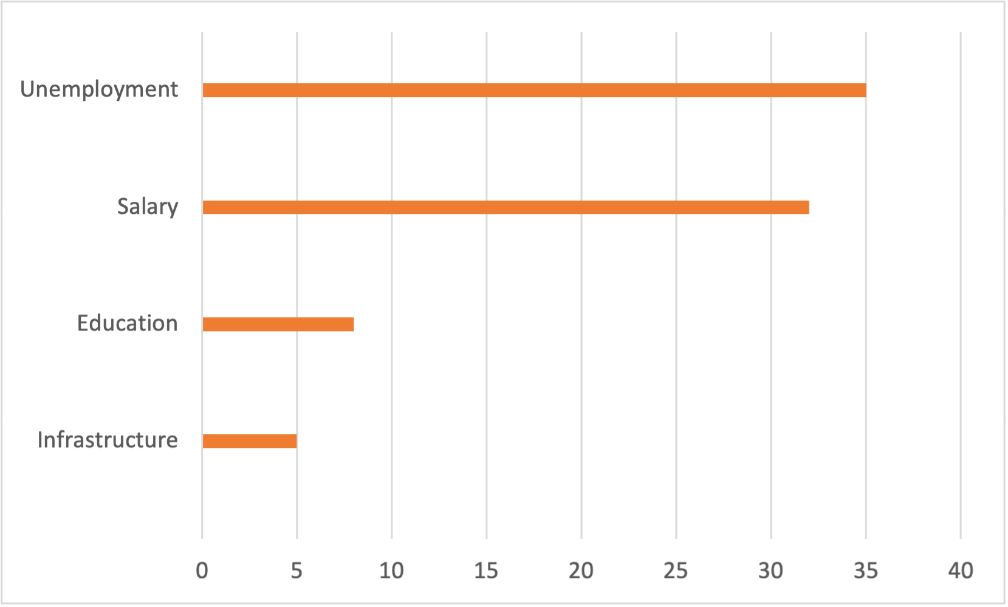
All the respondents confirmed that, while they did not provide financial assistance to relatives who remained in the village, they did provide all possible support to help their family members and relatives relocate to the cities. Initially, they provided housing and helped them find suitable jobs, and sometimes even supported them financially so that their siblings could pursue higher education. The respondents admitted that they primarily helped the male members of the family; however, if a sister was unable to get married on time or continue her studies, they would assist her in moving to the city as well. A group of respondents (n=37) formed families by marrying women they met in the cities. However, during the 1950s, a considerable number of respondents (n=43) chose to marry either relatives or fellow villagers. Three of the respondents were married to representatives of a different nationality.
The respondents believed that leaving their village was the right decision since, even by the late 1980s, the regions had only undergone minor infrastructure changes. Though good stone houses began to emerge in the villages in the mid-1960s, issues with a shortage of water, gas, and electricity supply, road, transportation, and schooling persisted. Thirty-one respondents stated that the knowledge that they obtained from their rural school was useful and allowed them to obtain professional classification. However, the majority noted the shortage of professional schoolteachers and opportunities for practical training in rural schools, which led to a deficiency in their level of knowledge and limited their options during and after migration to the city.
Meanwhile, village leaders poorly adapted to the changing demographic situation. The annual reports of Soviet enterprises in Azerbaijani villages show that despite a significant outflow of men from rural areas and labour shortages in the 1950s and 60s, there was no reduction in the cultivated area or in damage to the environment. In fact, from the early 1950s to the mid-1970s, the cultivated area increased by 243 thousand hectares, reaching a total of 1,310,000 hectares (Narodnoe khoziaistvo SSSR 1971, 291). To compensate for a shortage of agricultural labour, officials mobilized educational staff, the staff of medical institutions, students, and even schoolchildren to work in the fields. The rural population regarded this as the exploitation of child labour and a violation of their rights. Village residents sent letters of complaint to the Central Committee of the Communist Party, complaining that their children only attended school for six months, whereas the academic year was nine months long. The peasant children were required to work in cotton fields during the fall and in orchards during the spring (ARPİİİSSA, coll. 1, folder 52, file 118, p. 8).
The migration of Azerbaijanis from rural to urban areas during the post-Stalin period was prompted by the socio-economic marginalization of the Azerbaijani countryside and further enabled by changes in the distribution of industry and opportunity across the Soviet Union. The Soviet government’s conflicting agrarian policies alienated villagers, while producing a long-term cultural, income, and value divide between rural and urban communities. Migrants seeking urban opportunities found themselves struggling to overcome their lesser education and lack of urban know-how and Russian-language knowledge, and their departure emptied the village of many of its best young male workers. The migration of the younger generation from the village widened the gap between those who stayed (the old) and those who left (the young), resulting in a more culturally conservative village. For every male who left for the city, there was an unsettled female fate, trapped in a strongly patriarchal rural space. Child labour replaced the work of the grown men who left. Migration was a complex process that generated dramatic social and cultural change in both city and village, resulting in hardship and alienation for many migrants and for the communities that they left behind.
Ackermann, F. 2016. “Autosovietization: Migration, Urbanization, and Social Acculturation in Western Belarus.” Jahrbücher für Geschichte Osteuropas 64(3): 409–436.
Akhundov, V. 1969. Azărbaycan Kăndinin Sabahkı Günü. Baku: Azernăshr.
Altstadt, A. L. 1992. The Azerbaijani Turks: Power and Identity under Russian Rule. Stanford: Hoover Institution Press.
Archive of Socio-Political Documents of the Presidential Administration of the Republic of Azerbaijan (Azărbaı̐jan Respublikasy Prezidentinin İshlăr İdarăsi İjtimai-Siı̐asi Sănădlăr Arkhivi, ARPİİİSSA). Collection 1. Central Committee of the Communist Party of Azerbaijan.
Baberovski, I. 2010. Vrag est’ vezde: Stalinizm na Kavkaze. Trans. V. Altukhov. Moscow: ROSSPEN.
Bagirzade, S. 2012. “Tsety radosti.” In B. Bagirzade (ed.) Gorod moei molodosti, 211–219. Baku: Sharg-Garb.
Bhandari, P., and D. Ghimire. 2016. “Rural Agricultural Change and Individual Out-migration.” Rural Sociology 81(4): 572–600.
Blau, E., and I. Rupnik. 2018. Baku: Oil and Urbanism. Zurich: Park Books.
Bruisch, K., and K. Gestwa. 2016. “Introduction: Expertise and the Quest for Rural Modernization in the Russian Empire and the Soviet Union.” Trans. B. Templer. Cahiers du Monde russe 57(1): 7–30.
Bruisch, K., and T. Mukhamatulin. 2017. “Coming to Terms with the Village: Stalin’s Death and the Reassessment of Rural-Urban Relations in the Soviet Union.” Jahrbücher für Geschichte Osteuropas 65(3): 401–422.
Buckley, C. 1995. “The Myth of Managed Migration: Migration Control and Market in the Soviet Period.” Slavic Review 54(4): 896–911.
Caulfield, M., J. Bouniol, S. Fonte, and A. Kessler. 2019. “How Rural Out-migrations Drive Changes to Farm and Land Management: A Case Study from the Rural Andes.” Land Use Policy 81: 594–603.
Chernenko, K., and M. Smirtiukov (eds.). Resheniia partii i pravitel’stva po khoziaistvennym voprosam: sbornik dokumentov za 50 let. Moscow: Politicheskoe izdatel’stvo.
Chislennost’ naseleniia SSSR po perepisi na 15 ianvaria 1959 goda… 1960. Moscow: Tsentral’noe statisticheskoe upravlenie pri Sovmin SSSR.
Clem, R. S. 1980. “Regional Patterns of Population Change in the Soviet Union, 1959–1979.” Geographical Review 70(2): 137–156.
Crews, R. 2003. “Civilization in the City: Architecture, Urbanism and the Colonization of Tashkent.” In J. Cracraft and D. Rowland (eds.) Architectures of Russian Identity: 1500 to the Present, 117–132. Ithaca and London: Cornell University Press.
Davies, R. W., et al. (eds.). 2018. “The Soviet Population and the Censuses of 1937 and 1939.” In The Industrialization of Soviet Russia, vol. 7. London: Palgrave Macmillan.
de Haas, H. 2006. “Migration, Remittances, and Regional Development in Southern Morocco.” Geoforum 37(4): 565–580.
de Sherbinin, A., L. Vanwey, K. McSweeney, R. Aggarwal, A. Barbieri, S. Henry, L. M. Hunter, and W. Twine. 2008. “Rural Household Demographics, Livelihoods, and the Environment.” Global Environmental Change 18(1): 38–53.
El’darov, A. M. 1971. Rost rabochego klassa Azerbaidzhana v gody poslevoennogo sotsialisticheskogo stroitel’stva. Baku: Maarif.
Filtzer, D. A. 2010. The Hazards of Urban Life in Late Stalinist Russia: Health, Hygiene, and Living Standards, 1943–1953. New York: Cambridge University Press.
French, R. A. 1979. “The Individuality of the Soviet City.” In R. A. French and F. E. I. Hamilton (eds.) The Socialist City: Spatial Structure and Urban Policy, 73–104. London: John Wiley & Sons.
Gang, I., and R. Stuart. 1999. “Mobility Where Mobility Is Illegal: Internal Migration and City Growth in the Soviet Union.” Journal of Population Economics 12: 117–134.
Garcelon, M. 2001. “Colonizing the Subject: The Genealogy and Legacy of the Soviet Internal Passport.” In J. Caplan and J. Torpey (eds.) Documenting Individual Identity: The Development of State Practices in the Modern World, 83–100. Princeton, NJ: Princeton University Press.
Gasimov, Z. 2018. “The Languages of Caucasian Cosmopolitanism: Twentieth Century Baku at the Crossroads.” In D. Gusejnova (ed.) Cosmopolitanism in Conflict, 247–269. London: Palgrave Macmillan.
Grandstaff, P. J. 1980. Interregional Migration in the USSR: Economic Aspects, 1959–1970. Durham: Duke University Press.
Greiner, C., and P. Sakdapolrak. 2013. “Rural–Urban Migration, Agrarian Change, and the Environment in Kenya: A Critical Review of the Literature.” Population and Environment 34(4): 524–553.
Gusein, M. 1968. “Apsheron.” In M. Gusein and M. Ibragimov. Apsheron and Sliianie vod. Moscow: Izvestiia.
Hasanli, J. 2014. Khrushchev’s Thaw and National Identity in Soviet Azerbaijan, 1954–1959. Lanham: Rowman & Littlefield.
Hastings, R. L. 2020. “Oil Capital: Industry and Society in Baku, Azerbaijan, 1970–Present.” PhD diss., University of Oregon.
Ibragimov, I. 1993. O moem vremeni. Baku: Azgosizdat.
Ismailov, E. 2006. Azerbaidzhan, 1953–1956 gg. Pervye gody “ottepeli”. Baku: Adil’oglu.
Itogi vsesoiuznoi perepisi naseleniia 1959 goda. 1963. Azerbaidzhanskaia SSR. Moscow: Gosudarstvennoe statisticheskoe izdatel’stvo.
Itogi vsesoiuznoi perepisi 1970 goda. 1973. Vol. VI. Natsional’nyi sostav naseleniia SSSR, soiuznykh respublik, kraev, oblastei, i natsional’nykh okrugov. Moscow: Statistika.
Khorev, B., and G. Kiseleva. 1982. Urbanizatsiia i demograficheskie protsessy. Moscow: Finansy i Statistika.
Khrushchev, N. 1953. “O merakh dal’neishego razvitiia sel’skogo khoziaistva SSSR.” Speech to Plenum of the CPSU Central Committee, 3 September 1953. Moscow: Gosudarstvennoe izdatel’stvo politicheskoi literatury.
Korovaeva, V. 1976. “Migratsiia naseleniia.” In G. Maksimov (ed.) Vsesoiuznaia perepis’ naseleniia 1970 goda. Sbornik statei, 246–259. Moscow: Statistika.
Kozlov, V. 1982. Natsional’nosti SSSR: Etnodemograficheskii obzor. Moscow: Finansy i Statistika.
Laszczkowski, M. 2016. City of the Future: Built Space, Modernity and Urban Change in Astana. New York: Berghahn Books.
Light, M. A. 2012. “What Does It Mean to Control Migration? Soviet Mobility Policies in Comparative Perspective.” Law and Social Inquiry 37(2): 395–429.
Liu, Y., F. Fang, and Y. Li. 2014. “Key Issues of Land Use in China and Implications for Policy Making.” Land Use Policy 40: 6–12.
Martin, T. 2001. The Affirmative Action Empire: Nations and Nationalism in the Soviet Union, 1923–1939. Ithaca, NY: Cornell University Press.
Mamedov, M. 2019. “A Lost World: Evgeniy Voyskunskiy’s Maiden Dreams, the Karabakh Crisis, and the End of Old Baku.” Nationalities Papers 47(6): 1013–1029.
Mamedova, G. 2012. “Baku – Moia gordost’.” In B. Bagirzade (ed.) Gorod moei molodosti, 249–260. Baku: Sharg-Qarb.
Mămmădova, Sh. 2022. I̐addashymyzdaky Tarikh. Stalindăn Sonraky Azărbaı̐jcan. Baky: Elm vă Tăhsil.
Milbourne, P. 2007. “Re-populating Rural Studies: Migrations, Movements and Mobilities.” Journal of Rural Studies 23(3): 381–386.
Mirzoev, T. 2012. “Pokolenie predtechi.” In B. Bagirzade (ed.) Gorod moei molodosti, 392–407. Baku: Sharg-Qarb.
Narodnoe khoziaistvo SSSR v 1970 godu. 1971. Statisticheskii ezhegodnik. Moscow: Statistika.
Perevedentsev, V. 1975. Metody izucheniia migratsii naseleniia. Moscow: Nauka.
Podol’skii, S., and I. Voloshinova. 2019. “Dlia pol’zy goroda Ia gotov poklonit’sia khot’ chertu: Glava Lensoveta N.I. Smirnov v period ottepeli (1954–1962 gg.).” Noveishaia istoriia Rossii (3): 697–709.
Popov, V. 1994. “Vtoroi i vazhneishii etap (ob ukrupnenii kolkhozov v 50-e – nach. 60kh gg.).” Otechestvennye arkhivy (1): 27–50.
Roth, S. 2020. Politics of Representation: Housing, Family, and State in Baku. Berlin and Zurich: Lit Verlag.
Rowland, R. H. 1982. “Regional Migration and Ethnic Russian Population Change in the USSR, 1959–1979.” Soviet Geography: Review and Translation 22(8): 557–583.
Rybakovskii, L., and V. Churakov (eds.). 1978. Sotsial’nye factory i osobennosti migratsii naseleniia SSSR. Moscow: Nauka.
Sahadeo, J. 2007. Russian Colonial Society in Tashkent, 1865–1923. Bloomington: Indiana University Press.
Salakhov, T. 2012. “Baku – Gorod-Truzhennik, Gorod-Geroi.” In B. Bagirzade (ed.) Gorod moei molodosti, 48–57. Baku: Sharg-Qarb.
Schwartz, L. 1986. “A History of Russian and Soviet Censuses.” In R. S. Clem (ed.) A Research Guide to the Russian and Soviet Censuses. Ithaca and London: Cornell University Press.
Siegelbaum, L., and L. P. Moch (eds.). 2015. Broad Is My Native Land: Repertoires and Regimes of Migration in Russia’s Twentieth Century. Ithaca, NY: Cornell University Press.
Stone, A. 2008. “‘Overcoming Peasant Backwardness’: The Khrushchev Antireligious Campaign and the Rural Soviet Union.” The Russian Review 67(2): 296–320.
Stronski, P. 2010. Tashkent: Forging a Soviet City, 1930–1966. Pittsburgh, PA: University of Pittsburgh Press.
Stuart, R. C., and P. R. Gregory. 1977. “A Model of Soviet Rural-Urban Migration.” Economic Development and Cultural Change 26(1): 81–92.
Zaionchkovskaia, Zh. 2005. “Chetvertaia volna: Migratsionnyi obmen Rossii so stranami Dal’nego Zarubezh’ia.” In O. Glezer and P. Polian (eds.) Rossiia i ee regiony v XX veke: territoriia – rasselenie – migratsiia, 545–551. Moscow: OGI.
Zaslavskaia, T., and L. Korel. 1984. “Rural-Urban Migration in the USSR: Problems and Prospects.” Sociologia Ruralis 24(3–4): 229–242.
Zaslavskaia, T., and R. Ryvkina. 1980. Metodologiia i metodika sistemnogo izucheniia Sovetskoi derevni. Moscow: Nauka.
1 This went together with the 1958 Soviet state decree that private livestock should be sold within a two-year period.