https://doi.org/10.36253/caryologia-2954
Received: November 20, 2024; Accepted: June 9, 2025; Published: October 1, 2025
Distribution pattern, ecology and cytology of a globally threatened South indian endemic fern Elaphoglossum nilgiricum Krajina ex Sledge (Lomariopsidaceae: Pteridophyta)
1 Department of Botany, Nesamony Memorial Christian College, Marthandam, India-629165
2 Department of Botany, St. Xavier’s College (Autonomous), Palayamkottai, India-627002
3 Western Regional Centre, Botanical Survey of India, 7, Koregaon Road, Pune, India-411001
Corresponding author. E-mail: abenniamin@bsi.gov.in
Abstract. The Lomariopsidoid deer tongue fern genus Elaphoglossum, with about 600 epilithic species, is with either monomorphic or partially dimorphic simple fronds having acrostichoid sori. Due to the rare occurrence of fertile fronds, chromosome number reports are rarely available with the presence of maximum number of diploid species with n=41. Out of seven species of Elaphoglossum from India, five species are present on the Western Ghats of South India itself with three South Indian endemic species. The present study shows that the globally threatened endemic fern Elaphoglossum nilgiricum Krajina ex Sledge from the type locality Nilgiris, India is a tetraploid sexual with 2n=164 chromosomes. This is the first chromosome count for this globally threatened South Indian endemic fern E. nilgiricum Krajina ex Sledge.
Key words: Pteridophyte, Elaphoglossum, cytology.
Contents
Introduction
Pteridophytes, the primitive vascular plants, are the dominant group of terrestrial plants on the earth next to flowering plants. India, with varied habitats and climate, is with about 1200 species of pteridophytes (Fraser-Jenkins et al. 2017, 2018, 2021). The Lomariopsidoid deer tongue fern genus Elaphoglossum, with about 600 epilithic species, is with either monomorphic or partially dimorphic simple fronds having acrostichoid sori. There are only seven species of Elaphoglossum (Elaphoglossum angulatum (Blume) T. Moore, E. beddomei Sledge, E. commutatum (Mett. ex Kuhn) Alderw., E. marginatum T. Moore, E. nilgiricum Krajina ex Sledge, E. stelligerum (Wall. ex Baker) T. Moore ex Salom and E. stigmatolepis (Fee) T. Moore) in India (Fraser-Jenkins et al. 2021). Maximum number (six) of Elaphoglossum species are present in South India, where three species {E. beddomei Sledge, E. nilgiricum Krajina ex Sledge, E. stigmatolepis (Fee) T. Moore} are endemic. All the above three South Indian endemic Elaphoglossum species are present in Nilgiris, Tamilnadu (India) itself (Manickam and Irudayaraj 2003). From India, chromosome number reports are available under four names of Elaphoglossum (E. beddomei Sledge – n=82 (4x), E. conforme Sw. n=41 (2x), n=82 (4x), E. laurifolium (Thours) Moore n =82 (4x), E. stelligerum (Wall. ex Bak.) Moore ex Alston & Bonner – n=82 (4x), n=164 (8x) (Bir and Verma 2010). Out of three South Indian endemic species of Elaphoglossum, only one species (E. beddomei Sledge n=82, 4x Irudayaraj and Manickam 1991) is cytologically known. The globally threatened endemic species E. nilgiricum Krajina ex Sledge is cytologically unknown. Next to morphology, cytology plays an important role in plant taxonomy as recently proved in Sonchus species from Punjab (Sidhu & Singh 2021). Usually diploid ferns are rare when compared to polyploid ferns (Benniamin et al. 2008) and thus, for conservation program cytological knowledge is also important. In the present study cytological study has been made on this endemic fern in order to know the chromosome number and ploidy level.
Materials and methods
For general ecological and taxonomical studies, herbarium specimens housed in St. Xavier’s College Herbarium (XCH) Palayamkottai, India were observed. For cytological study materials were collected from the shola forest in Naduvattom, Nilgiris, India. The leaf tips from young 1-2cm length leaves were directly fixed in the fixative (Mixture of Ethyl Alcohol: Chloroform: Acetic Acid in 6:3:1 ratio) without any pretreatment. For the observation of mitotic chromosomes, simple acetocarmine squash technique was followed. Specimens were identified based on the book ‘Pteridophyte Flora of the Western Ghats, South India’ by Manickam and Irudayaraj (1992) and confirmed with Dr. V. Irudayaraj.
Results and discussion
The globally threatened South Indian endemic deer tongue fern Elaphoglossum nilgiricum Krajina ex Sledge is restricted in distribution (Kerala, Tamilnadu - India) on the Globe. The observation on herbarium specimens preserved in St. Xavier’s College Herbarium, Palayamkottai, India, shows the presence of only nine gatherings (Table 1) from South India (Six from Tamilnadu-Akkamalai Forest, Valparai, Naduvattom Forest, Nilgiris; three from Kerala-Around Kakki Hills and Silent Valley). Out of nine gatherings, six are epiphytes two are terrestrials and one is lithophyte. The present gathering from Naduvattom forest, Nilgiris (Fig. 1A,B) is also an epiphyte on large moist tree trunk along with another fern Hymenophyllum gardneri Bosch. Thus the endemic fern E. nilgiricum Krajina ex Sledge is restricted to southern Western Ghats (Kerala, Tamilnadu), India.
| S. No. | Voucher Number | Date of collection | Altitude | Collectors | Locality | Habitat ecology | |||||||||||||
|---|---|---|---|---|---|---|---|---|---|---|---|---|---|---|---|---|---|---|---|
| 1 | RHT 33400 | 25.08.85 | 950M | VSM & KMM | Kerala, Pathanamthitta, Peermedu, Vandiperiyar Hills, Kakki dam. | Terrestrial; roadside; fully shaded. Fronds covered by imbricate shining scales; first record. | |||||||||||||
| 2 | RHT 33678 | 03.09.85 | 1000M | VSM & KMM | Kerala, Pathanamthitta, Muzhiar-Kakki Hills, Muzhiar-Kakki road. | Moist mud slopes along the road. | |||||||||||||
| 3 | XCH 284 | 13.10.91 | 2300M | VSM | tamilnadu, nilgiris, pykara stream. | Occasional epiphyte on partially exposed roadside. | |||||||||||||
| 4 | XCH 588 | 28.10.91 | 2300M | VSM | Tamilnadu, Nilgiri, shola short cut from the T.R. Bazaar to Naduvattum. | Epiphyte, abundant on trees on the shola interior; sori are rare in frond. | |||||||||||||
| 5 | XCH 1917 | 05.05.92 | 1700M | VSM | Tamilnadu Coimbatore, Valparai, Akkamalai forest. | Epiphyte in the interior of shola. Rare. Sterile. First record for the Anamalais. | |||||||||||||
| 6 | XCH 2139 | 22.05.92 | 1700M | VSM | Tamilnadu, Coimbatore, Valparai, Akkamalai to grass Hill, path forest. | Epiphyte on stream banks in the evergreen forest. Rare. Sterile. | |||||||||||||
| 7 | XCH 3180 | 04.05.93 | 850M | VSM | Kerala, Palghat, Silent valley forest. | Rare, on fully shaded in vallicolic open forest. Sterile. Lithophyte. | |||||||||||||
| 8 | XCH 3447 | 27.05.93 | 1800M | VSM | Tamilnadu, Coimbatore, Valparai, Akkamalai forest stream. | Epiphyte, on fully shaded the evergreen forest; rare, sterile. Collected previously form the same stream. | |||||||||||||
| 9 | XCH 3455 | 27.05.93 | 1800M | VSM | Tamilnadu, Coimbatore, Valparai, Akkamalai forest. | Epiphyte, on fully shaded in stream, the stream banks in evergreen shola; occasional, sterile. | |||||||||||||
| XCH = St. Xavier’s College Herbarium, Palayamkottai; VSM = V.S.Manickam; KMM=K.M.Matthew. | |||||||||||||||||||
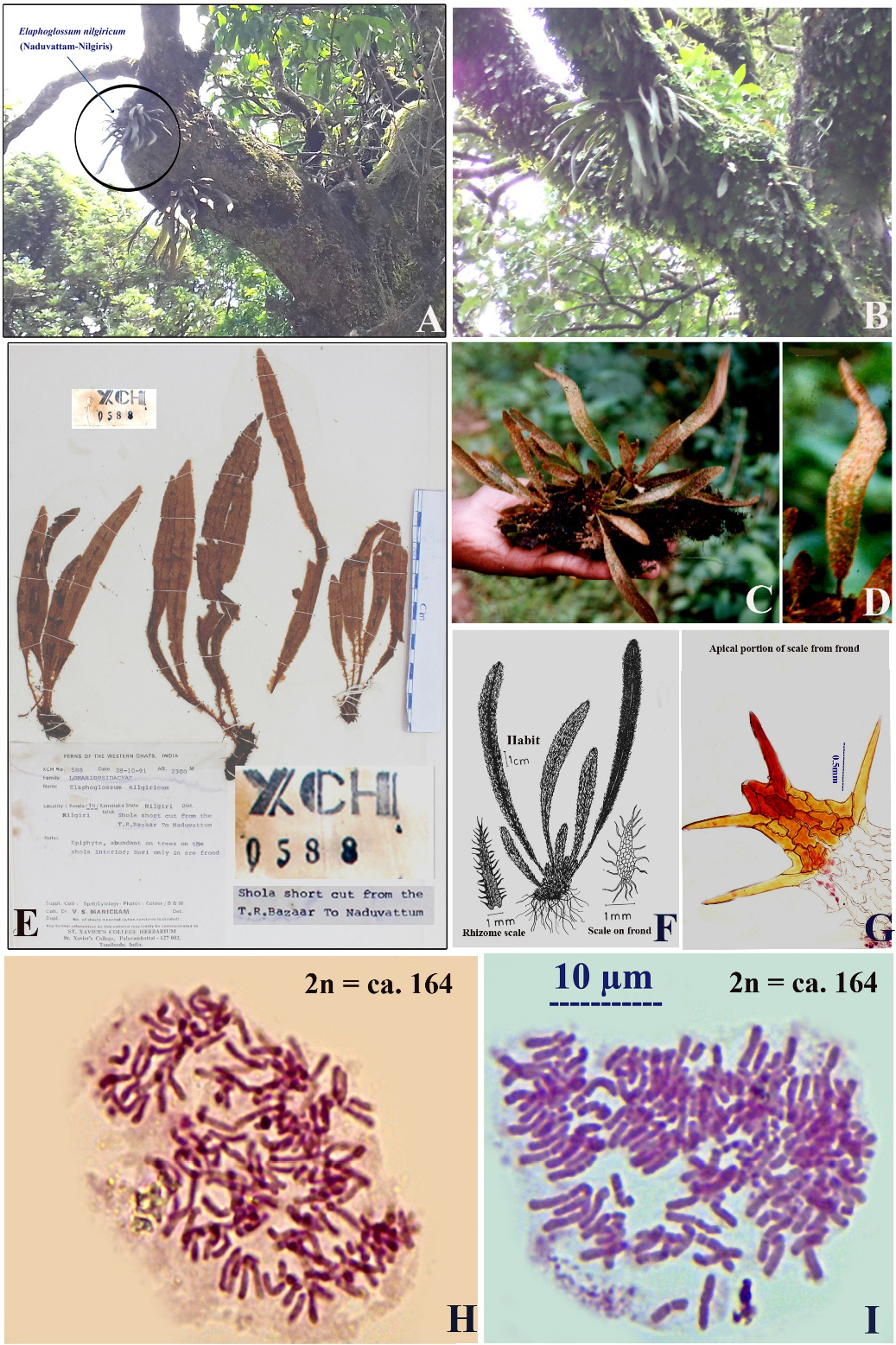
Elaphoglossum nilgiricum Krajina ex Sledge is a small epilithic or terrestrial fern with short creeping rhizome bearing simple fronds of about 15-25 cm. The distinguishing feature of this deer tongue fern is the absence of cartilaginous border of the lamina and the presence of shining, imbricate scales densely on the whole fronds (Fig. 1C-G). Fertile fronds are very rare and they are with slightly longer stipe. Sori on fertile fronds are acrostichoid.
The cytological study on the gathering from Naduvattom, Nilgiris shows the presence of ca. 164 chromosomes in the cells of leaf tip (Fig. 1H,I). Since the fertile fronds are very rare, meiotic chromosome count could not be made. This endemic fern E. nilgiricum Krajina ex Sledge is a tetraploid sexual (2n=ca.164) species like another South Indian common endemic fern E. beddomei Sledge (n=82) (Irudayaraj and Manickam 1991). Since, this fern is globally threatened one, before its extinction, it is important to know the chromosome number and ploidy level of this fern. The chromosome number of another endemic fern E. stigmatolepis (Fee) T. Moore is still unknown. It is important to find out the reason for the rare occurrence of the tetraploid endemic fern E. nilgiricum Krajina ex Sledge and the common occurrence of the tetraploid endemic fern E. beddomei Sledge in South India. Usually diploid epilithic ferns like Grammitidaceious species with erect rhizome and chlorophyllous spores are rare in contrast to terrestrial polyploid species with achlorophyllous spores (Benniamin et al. 2008). The above two deer tongue epilithic ferns are polyploid with short creeping rhizome and achlorophyllous spores (Manickam and Irudayaraj 1992). The size of the spores in the above tetraploid species are more or less similar without much of difference. i.e 45 x 30 µm in E. nilgiricum Krajina ex Sledge and 50 x 35 µm in E. beddomei Sledge (Manickam and Irudayaraj 1992).
The tetraploid E. beddomei is very common on southernmost part of the Western Ghats, Tirunelveli Hills in contrast to E. nilgiricum which is rarely distributed towards the northern part of the Southern Western Ghats (Anamalais, Nilgiris, Silent Valley) (Manickam and Irudayaraj 1992, 2003). Thus, although these two species are tetraploids with achlorophyllous spores, they require specific ecological niches with specific atmospheric temperature and moisture. Thus, the species E. beddomei with the requirement of more maritime moisture and less land moisture, is commonly present on Tirunelveli Hills, the extreme tip of the Western Ghats in the extreme southern part of Peninsular India with the sea surface on three sides (East, West and South). In contrast, E. nilgiricum Krajina ex Sledge occurs in northern part of the southern Western Ghats (Anamalais, Kakki Hills, Silent Valley) with more or less equal proportion of maritime and land moisture. Thus, each and every fern will require optimum temperature which is controlled by the proportion of maritime and land moisture depends upon the topography of the locality (Ramesh et al. 2020). In the meantime fronds of E. beddomei Sledge is sparsely covered by minute scales in contrast to densely scaly fronds of E. nilgiricum with the indication of high degree of drought tolerance in the later species (Manickam and Irudayaraj 1992). From the present study, it is clear that apart from morphology and cytology, ecology of specific niche plays an important role for the survival of the above two endemic deer tongue ferns. Both in situ and ex situ conservation measures should be adapted to conserve this globally threatened deer tongue fern Elaphoglossum nilgiricum Krajina ex Sledge.
Acknowledgements
The first author S. Jeya Kumar is thankful to Dr. K. Paulraj Principal, Nesamony Memorial College, Marthandam, India for his encouragements.
References
Benniamin, A., Irudayaraj, V. and Manickam, V . S. 2008. How to identify rare and endangered ferns and fern allies. Ethnobotanical Leaflets 12: 108-117.
Bir, S. S and Verma, S. C. 2010. Chromosome Atlas of the Indian Pteridophytes (1951-2009). Bishen Singh Mahendra Pal Singh, Dehra Dun, India.
Fraser-Jenkins, C. R., Gandhi, K. N,, Kholia, B. S and Benniamin, A. 2017. An annotated checklist of Indian Pteridophytes. Part 1. (Lycopodiaceae to Thelypteridaceae). Bishen Singh Mahendra Pal Singh, Dehra Dun, India.
Fraser-Jenkins C R, Gandhi K N & Kholia B S. 2018. An annotated checklist of Indian Pteridophytes. Part 2. (Woodsiaceae to Dryopteridaceae). ). Bishen Singh Mahendra Pal Singh, Dehra Dun, India.
Fraser-Jenkins C R, Gandhi K N, Kholia B S & Kandel D R. 2021. An annotated checklist of Indian Pteridophytes. Part 3. (Lomariopsidaceae to Salviniaceae). Bishen Singh Mahendra Pal Singh, Dehra Dun, India.
Irudayaraj, V. and Manickam, V, S. 1991. Cytology of an endemic fern- Elaphoglossum beddomei Sledge from South India. Indian Fern J. 8: 93-94.
Manickam, V. S. and Irudayaraj, V, 1992. Pteridophyte Flora of the Western Ghats, South India. BI Publications, Pvt Ltd. New Delhi.
Manickam, V. S. and Irudayaraj, V. 2003. Pteridophyte Flora of Nilgiris, South India. Bishen Singh Mahendra Pal Singh, Dehra Dun, India.
Ramesh, V., Vasudevan, N., Suresh, K., Amirtham, A. and Irudayaraj, V. (2020). Phytogeographical analysis on Lindsaeaoid ferns of India. Indian Fern J. 37(1&2): 321-333.
Sidhu, M. C. & R. Singh, R. (2021). A cytomorphological investigation of three species of the genus Sonchus L. (Asterales: Asteraceae) from Punjab, India. Journal of Threatened Taxa 13(11): 19640–19644.