https://doi.org/10.36253/caryologia-3356
Received: March 1, 2025; Accepted: September 30, 2025; Published: December 20, 2025
Karyological data of five autumn-flowering Crocus L. species from Iran
Plant Bank, Iranian Biological Resource Centre (IBRC), Iranian Academic Centre for Education, Culture & Research (ACECR), Tehran, Iran
alirezadolatyari@yahoo.com, alireza.dolatyari@acecr.ir
Abstract. Corms and herbarium vouchers of 23 accessions belonging to five autumn-flowering Crocus species were gathered from nine Iranian provinces. For the materials under investigation, chromosome numbers, karyotype formulas and idiograms were documented. Chromosome number of 2n = 12 is reported for the first time in C. archibaldiorum and in the studied accessions of C. speciosus aggregate. Also, 2n = 24 were found in C. caspius, 2n = 8 and 10 in C. damascenus, and 2n = 14 and 16 in C. haussknechtii. In the latter two species, variation in chromosome number was correlated with karyotypic differences. Notably, C. archibaldiorum (2n = 12) had a longer total haploid of chromosome length than C. caspius (2n = 24). On a distribution map, possible correlations between karyological data and geography were indicated. To quantify variation in karyotypes, three inter- and intra-asymmetric karyotypic parameters were estimated. Also, statistical analyses were performed on five karyotypic characters to infer karyological relationships. The members of section Crocus (only C. haussknechtii) and section Nudiscapus occupied distinct positions. Furthermore, at the species level, all accessions of the same species tended to group together. The remarkable karyotypic variation among the studied accessions of C. damascenus and C. haussknechtii supported the previous assumption that these taxa still include undescribed species. It is underlined that changes in chromosome number and structure have played an important role in the evolution of the genus Crocus.
Keywords: chromosome number, crocuses, cytotaxonomy, idiogram, Iridaceae, karyotype.
Contents
Section Crocus, C. haussknechtii
Introduction
The genus Crocus L. (Iridaceae) currently comprises more than 260 species (Rukšāns 2017a, 2023; Advay and Rukšāns 2024; Dolatyari et al. 2024), naturally distributed in the region extending approximately between 10°W to 80°E and 30°N to 50°N. The Balkan Peninsula and Asia Minor are the main centers of diversity where more than half of the recognized species occur. The majority of species occur within the Mediterranean and Irano-Turanian floristic regions, both of which are characterized by cool to cold winters, autumn-winter-spring precipitation, and warm summers with very little rainfall (Saxena 2010). Crocuses are well adapted to such conditions by compact underground corms. They flower either in spring, then they develop leaves together with flowers, or in autumn, then leaves often remain dormant till spring.
In the “Flora Iranica”, Wendelbo and Mathew (1975) recognized only eight Crocus species for Iran. They excluded C. sativus L. probably because it is a crop plant. However, in more recent years, 15 additional taxa have been newly described from Iran (Rukšāns 2014a, b, 2015, 2017a, b; Kerndorff et al. 2017; Dolatyari and Rukšāns 2022; Rukšāns 2022, 2023). In a recent revision, Dolatyari et al. (2024) summarized all available taxonomic knowledge for the Iranian Crocus species. Most recently, Advay and Rukšāns (2024) added the new species C. avromanicus Advay & Rukšāns from West Iran. Hence, a total of 25 species are currently known to occur in Iran, 19 of which are endemics, an exceptionally high percentage. Except C. michelsonii B. Fedtsch., which is found in Kopet Dag Mountains, all other species occur along the Zagros and Alborz Mountain ranges. All four Iranian species of Crocus section Crocus, and four out of 21 species of Crocus sect. Nudiscapus B. Mathew flower in autumn (Advay and Rukšāns 2024; Dolatyari et al. 2024).
Karyological data may provide valuable insights into phylogenetic relations and help characterize taxonomic entities. Although earlier chromosome counts by many researchers showed various numbers, these data were based largely on material from cultivated or unspecified origins (Mather 1932; Pathak 1940; Darlington and Wylie 1955; Karasawa I956; Bolkhovskikh et al. 1969). However, Brighton et al. (1973) listed chromosome numbers for 88 Crocus species cultivated at Kew Garden, originating from known localities across the entire distribution range of the genus. Additionally, karyological data have been published for several taxonomically complex aggregates (Brighton 1976, 1977a, b, 1980; Brighton et al. 1983; Goldblatt and Takei 1997) and for material collected from distinct countries (Baldini 1990; Candan et al. 2009; Schneider et al. 2012; Karamplianis et al. 2013). The large number of earlier reported chromosome counts shows that the genus is an example of extreme karyological variation with 2n = 6, 8, 10, 11, 12, 14, 16, 18, 20, 22, 23, 24, 26, 27, 28, 30, 34, 44, 48, 64 chromosome numbers. Also, remarkable intraspecific variation in karyotypic features has been documented, accompanied by the presence of up to 11 B chromosomes in some species (Mather 1932; Feinbrun 1957, 1958; Brighton et al. 1973; Brighton 1977a, b; Brighton et al. 1983). This huge karyological diversity highlights the role of dysploidy and polyploidy in the infrageneric evolution of the genus (Harpke et al. 2013; Raca et al. 2023).
In the literature, chromosome counts have been reported for seven Iranian Crocus species and members of the C. biflorus Mill. and C. speciosus M. Bieb. aggregates (see Table 3; detailed taxonomic information in Dolatyari et al. 2024), representing chromosome numbers of 2n = 8, 10, 12, 14, 16, 20, 22 and 24 . Only a single B chromosome has been reported in a population of C. damascenus Herb. by Ghaffari and Djavadi (2007). Having in mind that 16 species have been described only during the last decade, it is not surprising that around 70% of Iranian Crocus species remain karyologically unknown.
| Section | Species | n | 2n | Origin | Reference(s) |
|---|---|---|---|---|---|
| Nudiscapus | Crocus almehensis C.D.Brickell &B.Mathew | 20 | Bojnurd | Brighton et al. 1973 | |
| Crocus archibaldiorum (Rukšāns) Rukšān | |||||
| Crocus azerbaijanicus Dolatyari & Ruksans | |||||
| Crocus caspius Fisch. & C.A.Mey. ex Hohen. | 24 | Sari | Brighton et al. 1973 | ||
| Rasht | |||||
| 24 | Guilan | Mathew and Brighton 1977 | |||
| 12 | 24 | Rasht, Mt. Sefid rud, Amol | Heywood CA 1983 | ||
| Crocus chiaicus Dolatyari & Ruksans | |||||
| Crocus chionophilus Dolatyari & Ruksans | |||||
| Crocus damascenus Herb. | 8, 10, 12 | Damaneh, Urumieh, Khoi | Brighton et al. 1973 | ||
| 8 | Golpayegan | Ebrahimzadeh et al. 1998 | |||
| 4 | 8, 8+1B | Arak, Sefid-khani | Ghaffari and Djavadi 2007 | ||
| 8 | Golpayegan | Sanei et al. 2006 | |||
| 8, 10, 12 | Damaneh, Salmas, Khoi | Brighton 1977b | |||
| Crocus dolatyarii Rukšāns | |||||
| Crocus | Crocus gilanicus B.Mathew | 24 | W of Rustamabad | Mathew and Brighton 1976 | |
| Siah Bisheh | Ebrahimzadeh et al. 1998 | ||||
| Nudiscapus | Crocus gunae Rukšāns | ||||
| Crocus | Crocus hakkariensis (B.Mathew) Rukšān | ||||
| Crocus haussknechtii (Boiss. & Reut. ex Maw) Boiss. | 12 | Islam Abad-e Qarb | Sanei et al. 2007 | ||
| 14 | Zagros Mts. | Brighton et al. 1973 | |||
| 16 | Kazerun, Firouzabad | Brighton 1977a | |||
| Nudiscapus | Crocus inghamii Rukšāns | ||||
| Crocus iranicus Ruksans | |||||
| Crocus kurdistanicus (Maroofi & Assadi) Ruksans | |||||
| Crocus marandicus Dolatyari & Ruksans | |||||
| Crocus michelsonii B. Fedtsch. | 20 | W of Bojnurd, NW of Ghochan, N of Ghochan | Brighton et al. 1973 | ||
| Crocus pseudoiranicus Dolatyari & Ruksans | |||||
| Crocus reinhardii Ruksans | |||||
| Crocus sanandajensis Kernd. & Pasche | |||||
| Crocus | Crocus sativus L. | 24 | Cultivated plant origin from Iran | Agayev 2002, Ebrahimzadeh et al. 1998, Estilai 1976, Estilai and Aghamohammadi 1977, Ghaffari 1986, Ghaffari and Bagheri 2009 | |
| Nudiscapus | Crocus zagrosensis Kernd. & Pasche | ||||
| Crocus zanjanensis Kernd. & Pasche | |||||
| Crocus zubovii Ruksans | |||||
| Crocus biflorus aggregate, C. aerius Herb. | 22 | Urumieh, Sanandaj, | Brighton et al. 1973 | ||
| Crocus biflorus aggregate, C. adamii J. Gay | 20 | Bojnurd | Brighton et al. 1973 | ||
| Crocus speciosus M.Bieb. aggregate | 12 | Golestan forest | Ebrahimzadeh et al. 1998 | ||
| S Aliabad, S Sangdeh, E Chalus, Ardabil, between Astara and Ardabil | Brighton et al. 1983 | ||||
In the frame of a larger karyological research project on Iranian crocuses, here karyotypic variation in 20 accessions of C. archibaldiorum (Rukšāns) Rukšāns, C. caspius Fisch. & C. A. Mey. ex Hohen., C. damascenus, and C. haussknechtii (Boiss. & Reut. ex Maw) Boiss., as well as three accessions of C. speciosus aggregate shall be presented employing appropriate statistical analysis to test the significance of karyotypic relationships among these autumn-flowering taxa.
Material and method
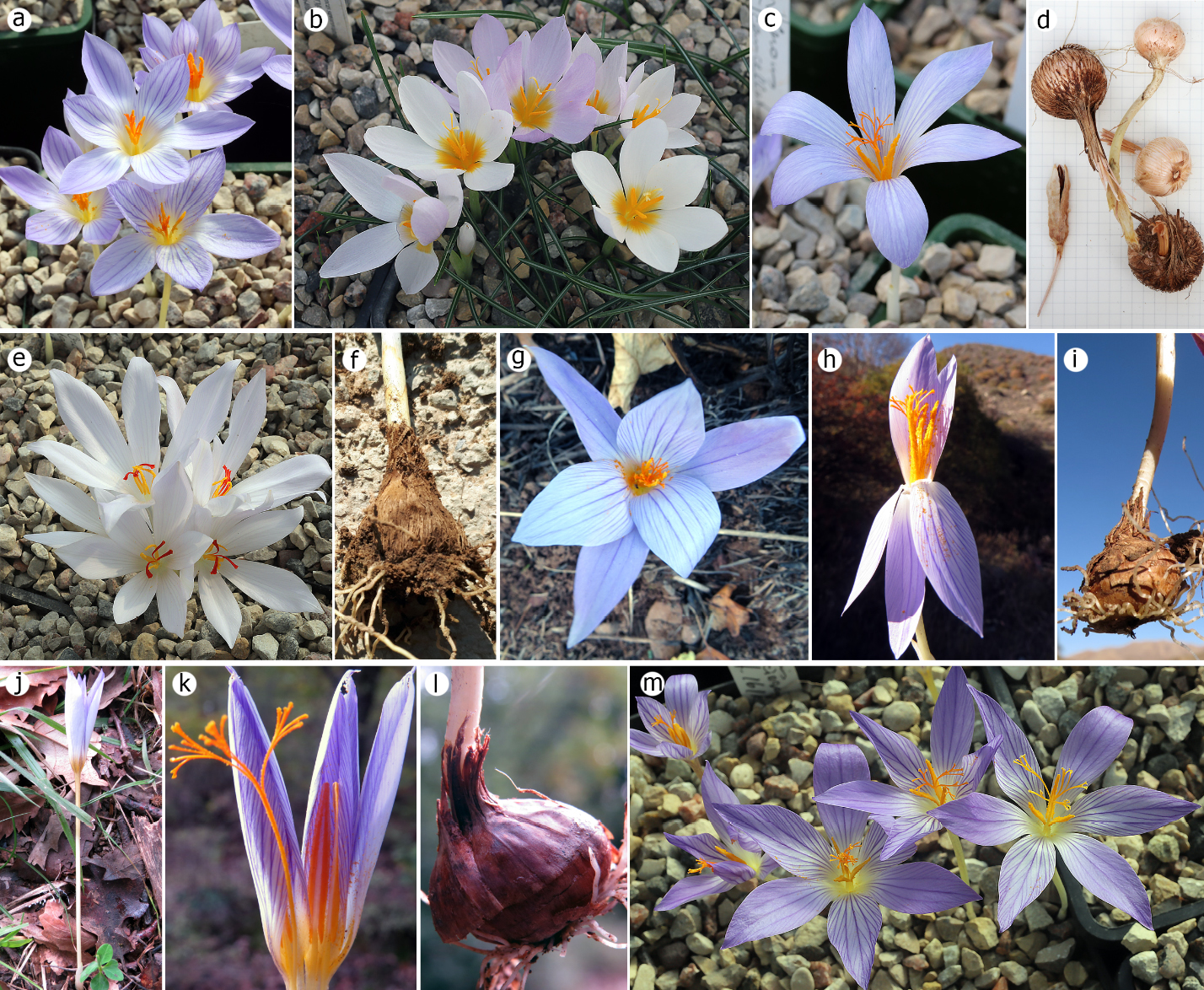
Corms and herbarium vouchers were collected from populations in natural habitats. The corms were planted in a trial field, and the vouchers were deposited in the Iranian biological resource center herbarium (IBRC). Table 1 presents the collecting localities and herbarium sheet numbers, and Figure 1 illustrates photos of all taxa studied. A complete list of Iranian Crocus species, along with previously reported chromosome numbers is provided in Table 3.
| Species | IBRC No. | Locality | Her. No. |
|---|---|---|---|
| C. archibaldiorum | P1015055 | Guilan: Asalem to Khalkhal, 1 km after Larzaneh road station. 37° 36’ 1.7” N; 48° 43’ 2.3” E, 2020m. | 3490 |
| P1015056 | Guilan: Asalem to Khalkhal, 2 km after Charasu village to Almas pass. 37° 35’ 53.8” N; 48° 48’ 2.2” E, 1080m. | 3489 | |
| C. caspius | P1015044 | Mazandaran: Qaem Shahr to Sari, Arteh, railway signalling station. 36° 29’ 42.5” N; 52° 55’ 26.8” E, 20m. | 3497 |
| P1015045 | Mazandaran: Sari to Semnan, Pahnehkolah, around cemetery. 36° 27’ 38.4” N; 53° 5’ 19.3” E, 140m. | 3495 | |
| P1015049 | Mazandaran: Tonekabon, Sehezar to Alamut, Tuskakuti village, Emamzadeh Seyed Yahya. 36° 41’ 14.2” N; 50° 50’ 48.8” E, 400m. | 3492 | |
| P1015058 | Guilan: Sangar to Lahijan, ca. 100 m after Siahkal entrance. 37° 10’ 19.1” N; 49° 52’ 26.3” E, 30m. | 3488 | |
| P1015059 | Guilan: 2 km a Saravan to Sangar, Balamahaleh Shahrestan. 37° 06’ 39.1” N; 49° 40’ 10” E, 55m. | 3501 | |
| C. damascenus | P1015062 | Markazi: ca. 30 km before Golpayegan a Khomein. 33° 37’ 50.5” N; 50° 11’ 19.6” E, 1855m. | 3639 |
| P1015063 | Esfahan: 6 km before Khonsar a Golpayegan. 33° 20’ 7.4” N; 50° 20’ 25” E, 2030m. | 3709 | |
| P1015064 | Esfahan: Khonsar-Boein-Miandasht road, just 1 km after the pass. 33° 13’ 10.2” N; 50° 15’ 29.7” E, 2820m. | 3640 | |
| P1015065 | Esfahan: 25 km a Aligoudarz to Damaneh. 33° 15’ 36.5” N; 49° 56’ 10.9” E, 2405m. | 3641 | |
| P1015089 | W Azerbaijan: N of Urumieh. 38° 00’ 53.8” N; 44° 56’ 37.6” E, 1875m. | 3710 | |
| P1015091 | W Azerbaijan: 15 km before Oshnavieh, a soil road towards West. 37° 10’ 47.3” N; 45° 04’ 17.3” E, 2170m. | 3712 | |
| P1015102 | W Azerbaijan: W of Oshnaviyeh. 36° 57’ 21.1” N; 45° 00’ 30.7” E, 1775m. | 3711 | |
| P1015119 | Kurdestan: around Marivan dam. 35° 35’ 51.1” N; 46° 18’ 50.5” E, 1420m. | 3713 | |
| P1015128 | Kurdestan: Marivan to Tizh Tizh. 35° 31’ 29.6” N; 46° 23’ 1.3” E, 1570m. | 3638 | |
| P1015138 | Kermanshah: between Songhor and Sahneh. 34° 38’ 39.8” N; 47° 35’ 21.7” E, 1980m. | 3714 | |
| C. haussknechtii | P1015067 | Lorestan: 42 km before Khorramabad a Doroud. 33° 31’ 18” N; 48° 45’ 37” E, 1835m. | 3716 |
| P1015131 | Kurdestan: Sanandaj, Salavat Abad pass. 35° 16’ 30.2” N; 47° 08’ 25.5” E, 2010m. | 3718 | |
| P1015136 | Kurdestan: Dehgolan to Ghorveh, on the road to Songhor. 34° 04’ 48” N; 47° 33’ 36” E, 2190m. | 3715 | |
| C. speciosus s.l. (= C. archibaldiorum) | P1015060 | Guilan: Rostamabad, hills NE Shamam village, between jungle trees. 36° 55’ 48.1” N; 49° 28’ 36.3” E, 880m. | 3499 |
| C. speciosus s.l. | P1015042 | Tehran: 3 km a Gaduk pass to Veresk. 35° 51’ 16” N; 52° 56’ 49.2” E, 2065m. | 3498 |
| P1015070 | Guilan: Totekabon to Jirandeh. 36° 48’ 33.3” N; 49° 38’ 8.6” E, 1010m. | 3719 |
Randomly selected corms were planted in a moistened mixture of coarse and fine perlite (1:1 ratio) and kept in a refrigerator. Root tips measuring 2–3 cm in length were pretreated in 0.029% aqueous solution of 8-hydroxiquinoline for 3 h and fixed in Carnoy’s I solution (3: 1 v/v 95% ethanol: glacial acetic acid) for 24 h at room temperature. Then root tips were hydrolyzed in 1n HCl for 14 min at 60°C and stained with 2% aceto-orcein for 3 h. The commonly applied squash technique was carried out to prepare slides. An Olympus BX51 light microscope equipped with a DP25 digital camera was used to take photos of as many good metaphase spreads as possible.
The Lengths of long (L) and short arms (S) of all chromosomes of at least five mitotic metaphase plates per accession were measured using IdeoKar software (http://agri.uok.ac.ir/ideokar/index.html). The total haploid length of chromosomes (THL), an approximate equivalent for genome size (Peruzzi et al. 2009), was assessed for all accessions. Mean centromeric asymmetry (MCA), coefficient of variation of chromosome length (CVCL), and coefficient of variation of centromeric index (CVCI) were estimated to quantify the inter- and intra-chromosomal asymmetries and heterogeneity in centromere positions, respectively (Peruzzi and Altinordu 2014). The chromosome terminology of Levan et al. (1964) was applied. All additional details including methods of statistical analysis (Principal Coordinate Analysis, PCoA, and Discriminant Analysis, DA), and the software employed, follow the procedures described in Peruzzi and Altinordu (2014). ArcMap 10.7.1 software was used to draw the distribution map.
Results and discussion
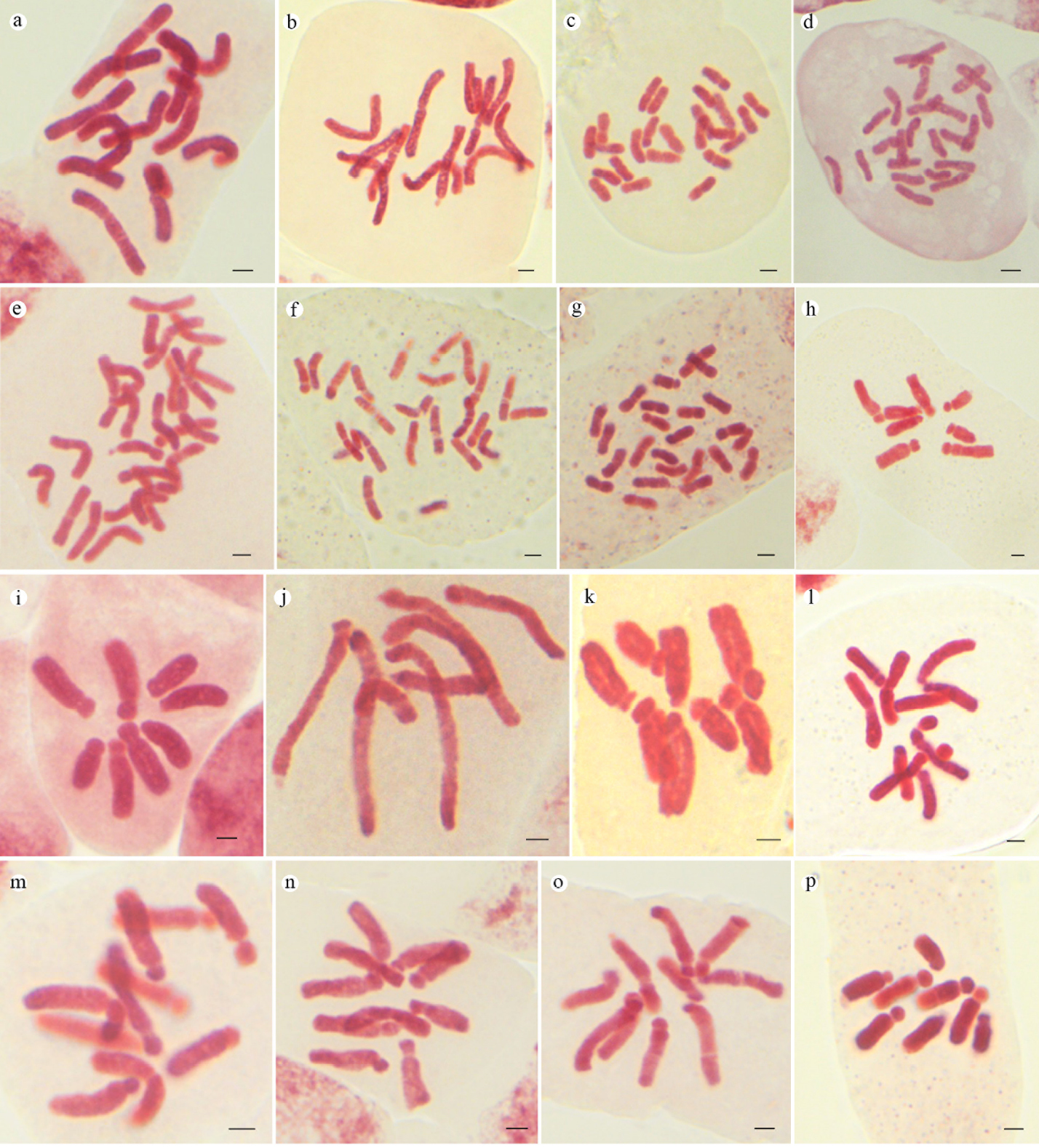
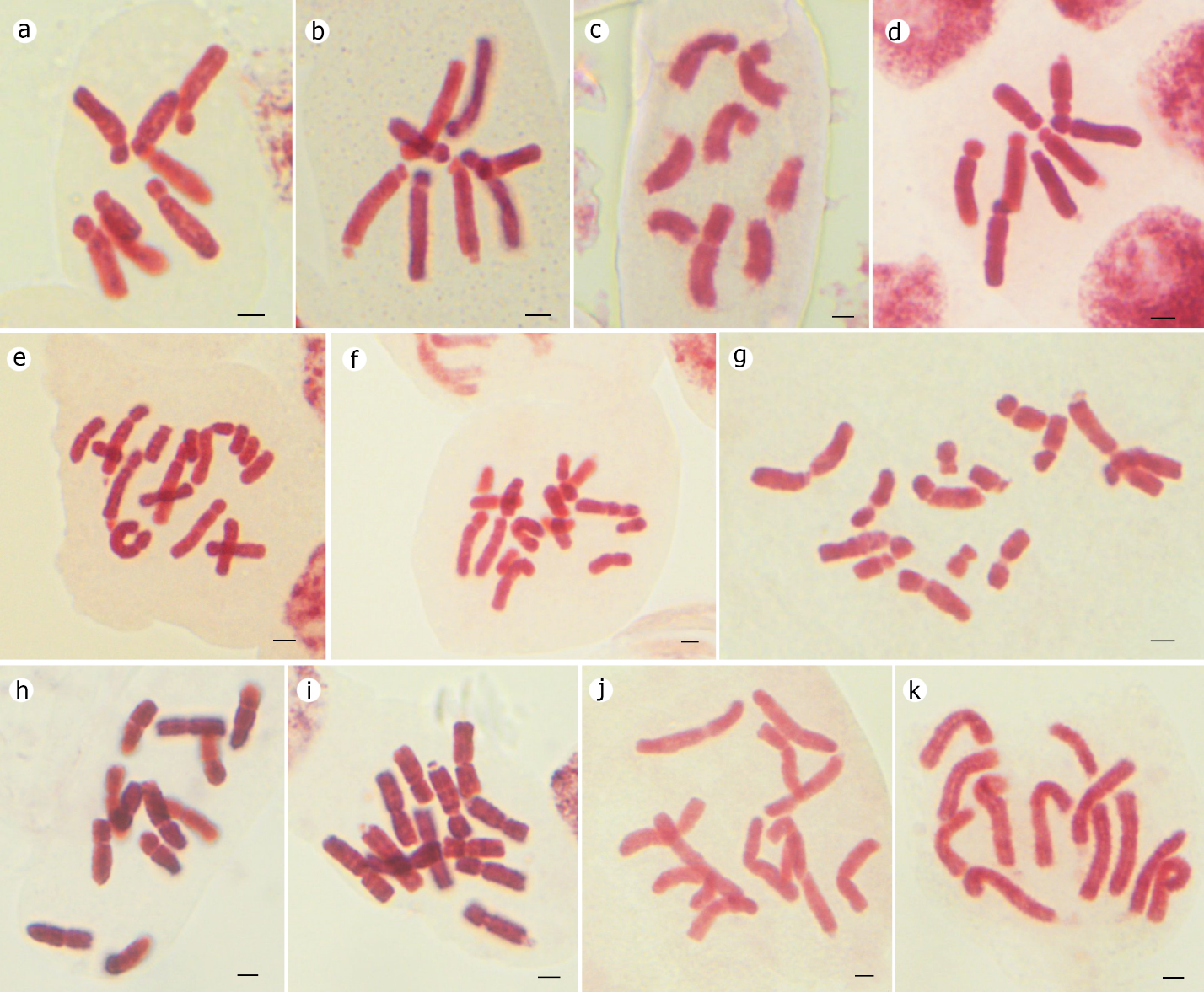
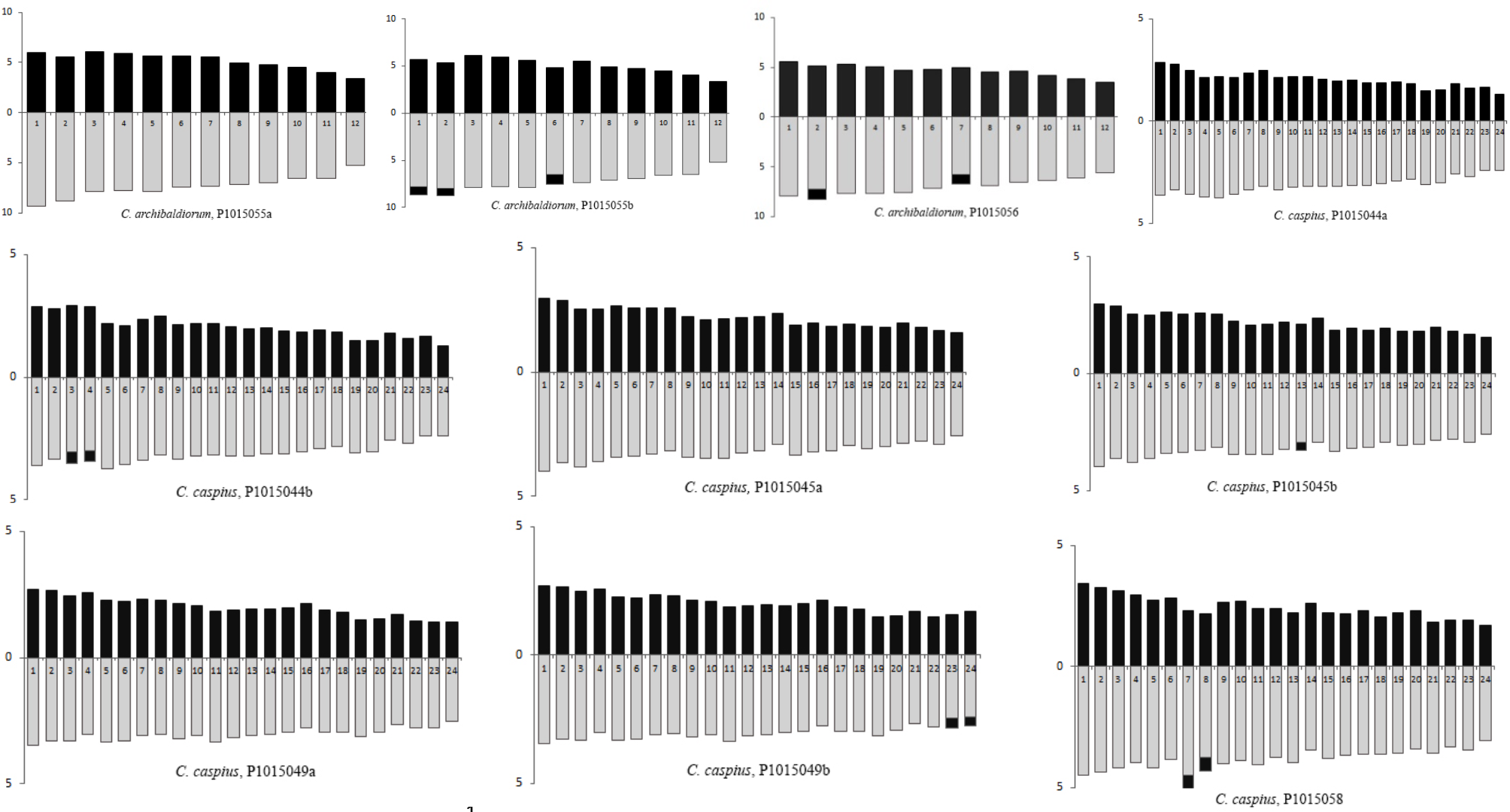
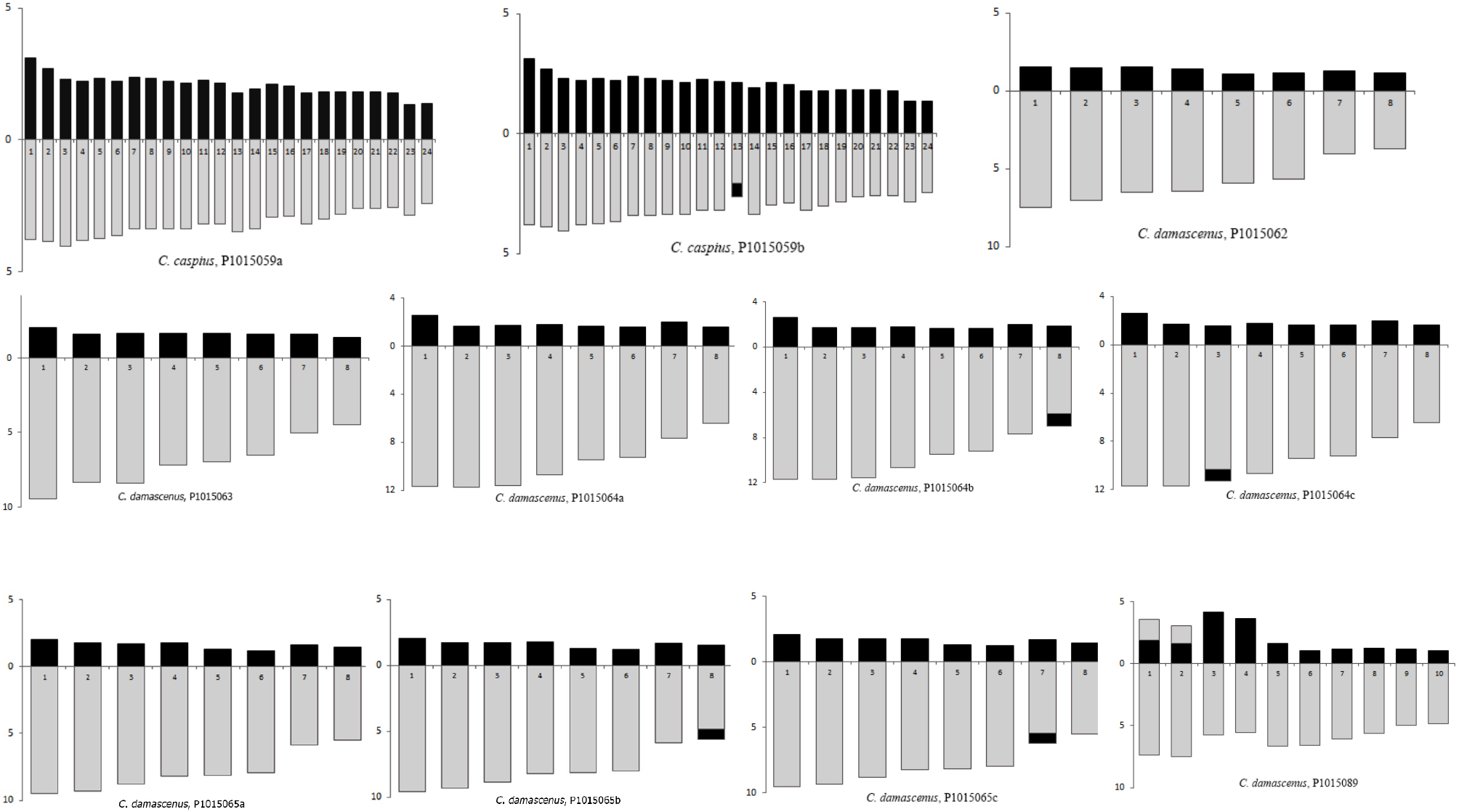
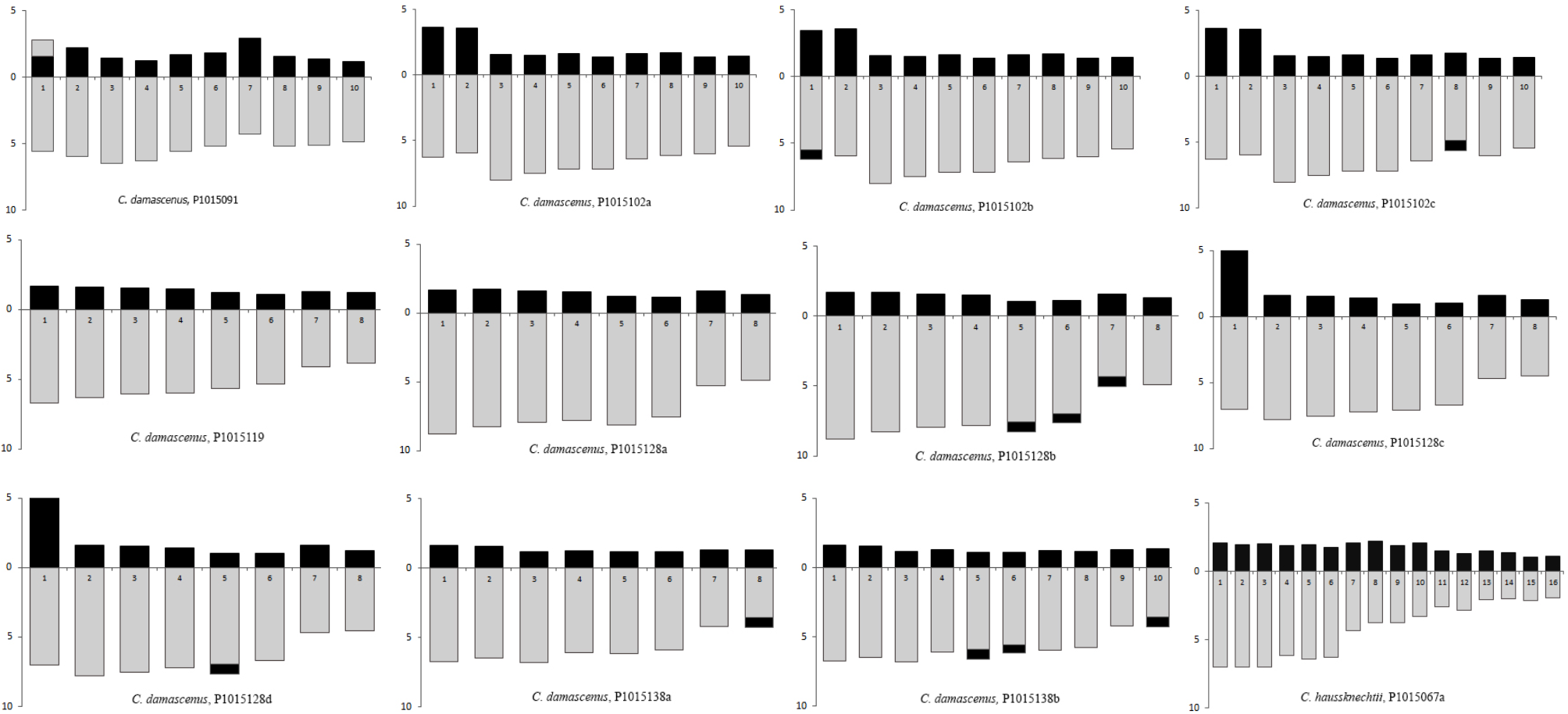
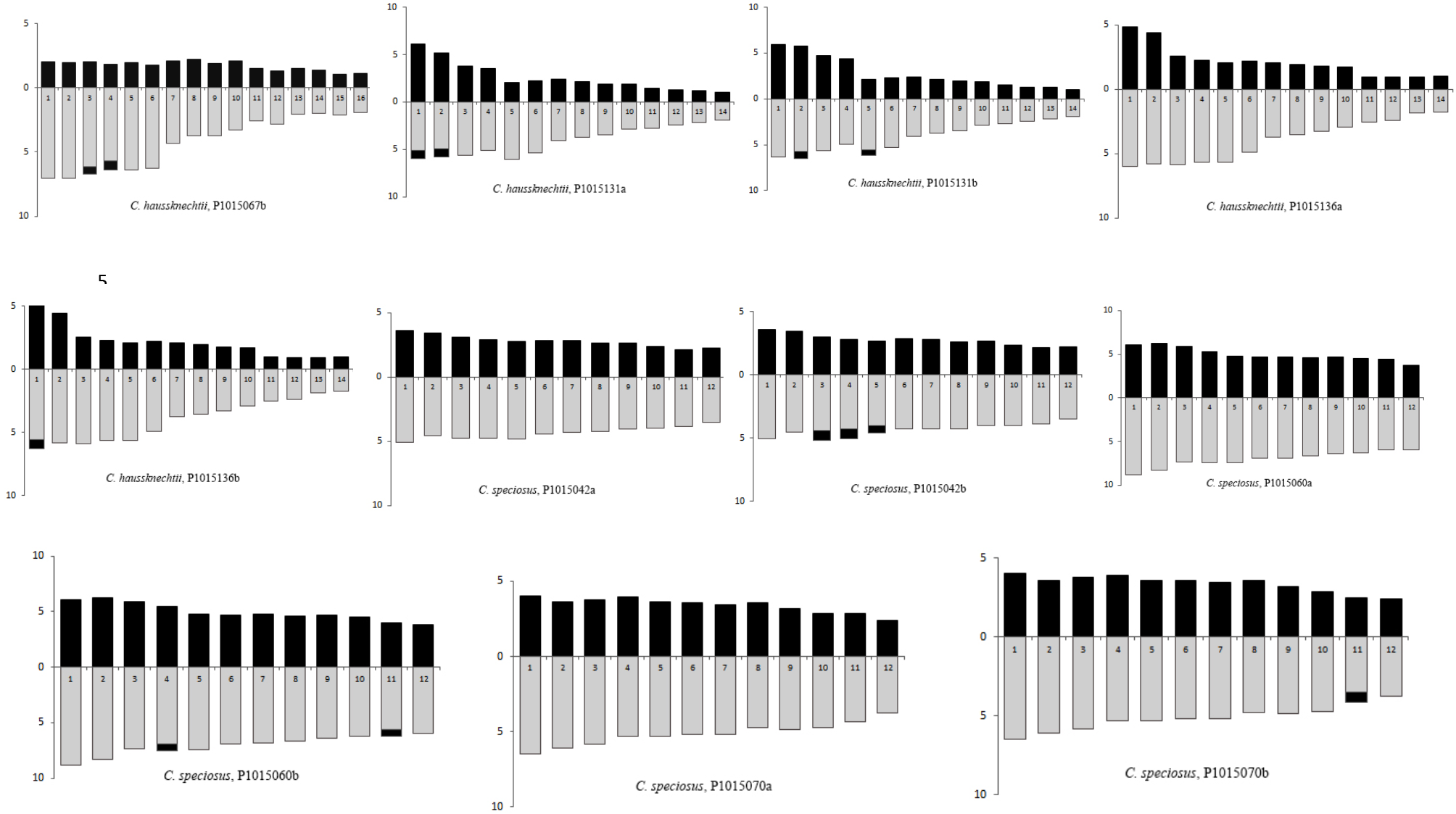
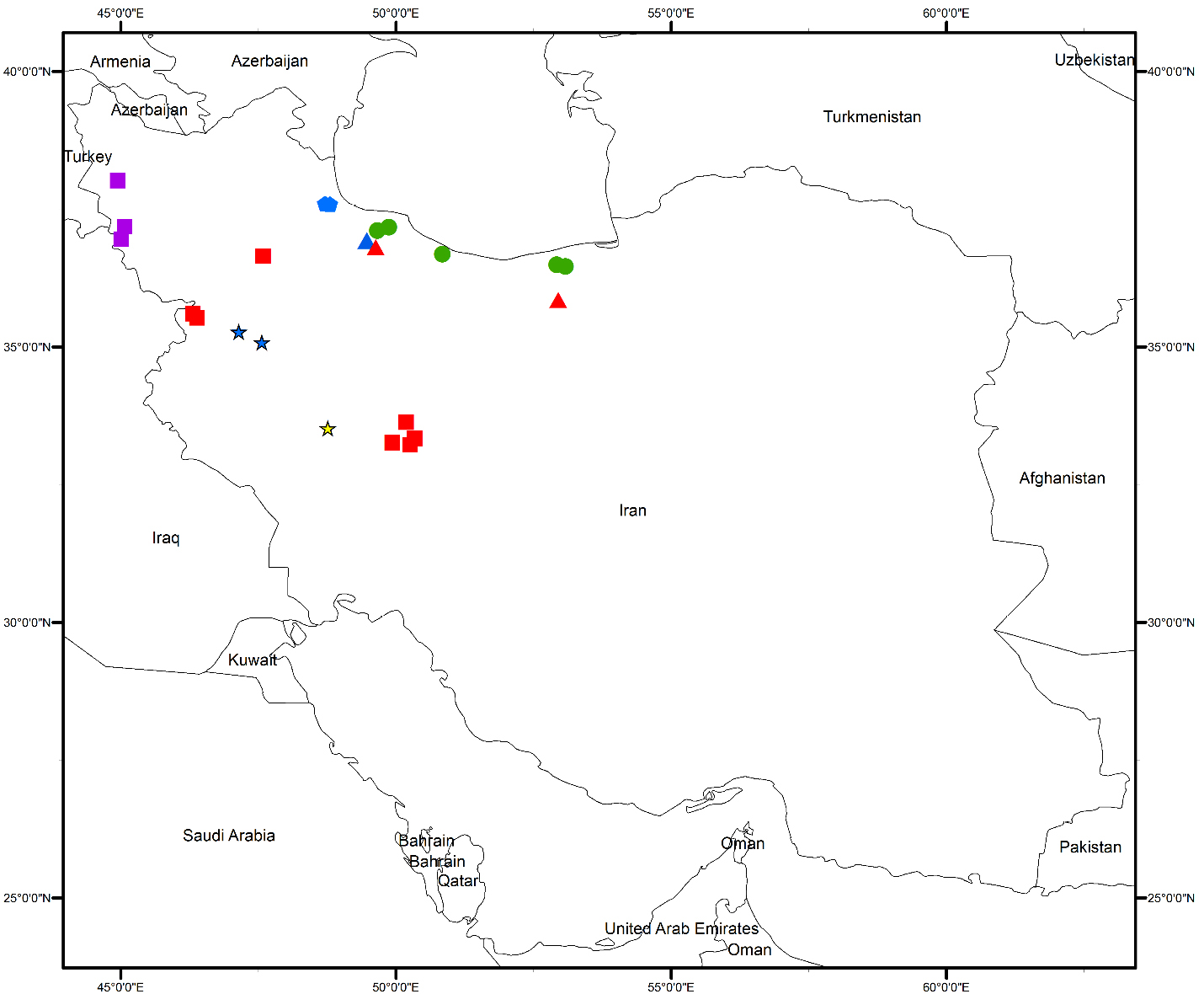
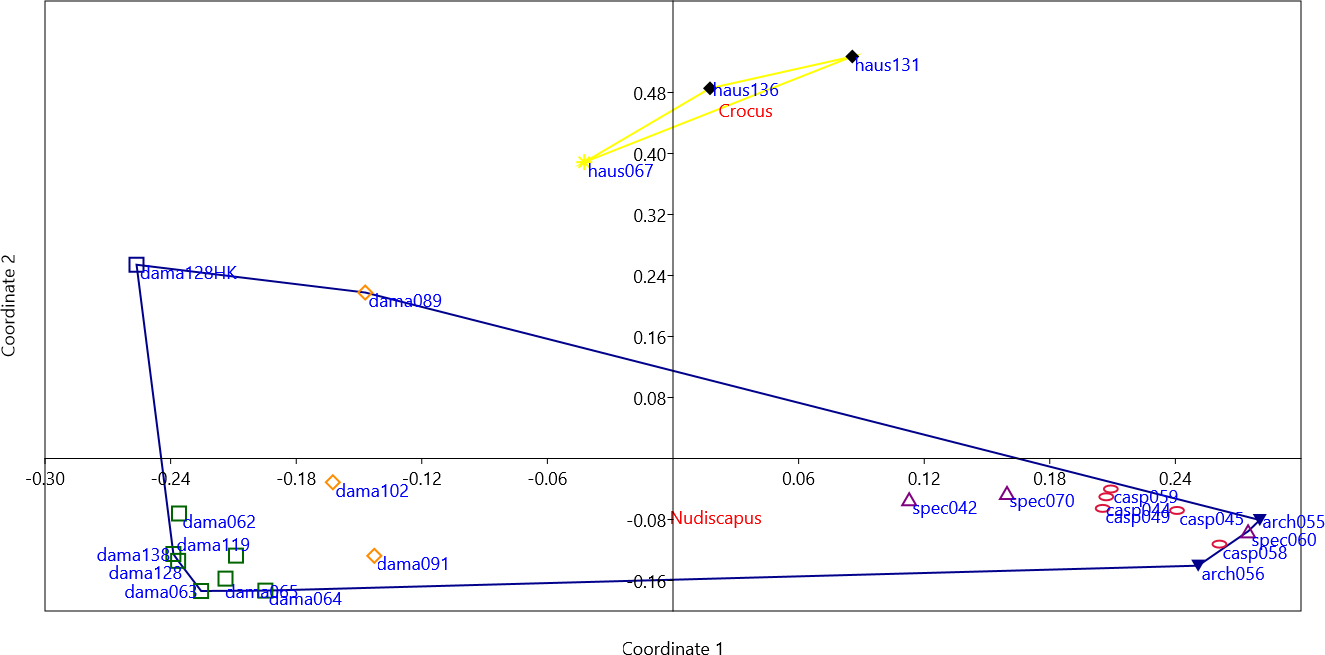
Mitotic spreads and idiograms for 23 accessions (125 individuals) belonging to four species and one aggregate are shown in Figs. 2 & 3, and in Figs. 4-7, respectively. Chromosome numbers, karyotype formulas, together with the calculated karyotypic parameters are given in Table 2. A distribution map (Fig. 8) indicates possible correlations between karyological data and geography. The result of PCoA analysis based on five karyotypic parameters is presented in Fig. 9. The idiograms underline that the basic chromosome number for each accession equals half of the total somatic number. In C. damascenus and C. haussknechtii several chromosome numbers and karyotypes were detected, while unique karyotypes were found in C. archibaldiorum, C. caspius, and the C. speciosus group.
| Species | IBRC No. | No. inv. cor. | Fig. refer. | 2n | Karyotype formula | SAT. Chr. No. | THL | MCA | CVCL | CVCI |
|---|---|---|---|---|---|---|---|---|---|---|
| Section Crocus | ||||||||||
| C. haussknechtii | P1015067 | 4 | 3e | 16 | 6sm+10st, 6sm+8st+2stsat | 0, 2 | 48.19 | 41.73 | 39.109 | 25.29 |
| P1015131 | 4 | 3f | 14 | 2msat+6m+6sm | 1, 2 | 47.39 | 22.78 | 44.59 | 15.81 | |
| P1015136 | 4 | 3g | 14 | 2m+12sm, 1m_1msat+12sm | 0, 1 | 42.71 | 30.32 | 43.91 | 16.72 | |
| Section Nudiscapus Mathew | ||||||||||
| C. archibaldiorum | P1015055 | 8 | 2a | 12 | 12m, 9m+3msat, 10m+2msat | 0, 2, 3 | 75.45 | 18.2 | 14.84 | 4.74 |
| P1015056 | 6 | 2b | 12 | 10m+2msat | 1, 2 | 70.29 | 20.18 | 11.75 | 3.25 | |
| C. caspius | P1015044 | 9 | 2c | 24 | 18m+6sm, 16m+2msat+6sm | 0, 2 | 62.19 | 22.02 | 13.65 | 8.14 |
| P1015045 | 7 | 2d | 24 | 18m+6sm, 17m+1msat+6sm | 0, 1 | 65.43 | 19.34 | 12.46 | 7.11 | |
| P1015049 | 8 | 2e | 24 | 18m+6sm,18m+5sm+1smsat, 18m+4sm+2smsat | 0, 1, 2 | 60.74 | 20.89 | 11.24 | 9.46 | |
| P1015058 | 6 | 2f | 24 | 16m+8sm, | 0, 1, 2 | 75.13 | 22.63 | 12.08 | 8.53 | |
| P1015059 | 5 | 2g | 24 | 16m+8sm, 14m+9sm+1smsat | 0, 1 | 63.71 | 22.61 | 14.73 | 8.33 | |
| C. damascenus | P1015062 | 6 | 2h | 8 | 8st | 0 | 28.68 | 62.97 | 20.42 | 16.81 |
| P1015063 | 4 | 2i | 8 | 8st | 0 | 32.64 | 66.13 | 18.22 | 12.65 | |
| P1015064 | 2 | 2j | 8 | 8st, 7st+1stsat | 0, 1 | 46.59 | 68.47 | 18.12 | 19.63 | |
| P1015065 | 4 | 2k | 8 | 8st, 7st+1stsat | 0,1 | 38.18 | 65.96 | 17.13 | 18.45 | |
| P1015089 | 5 | 2l | 10 | 2m+2smsat+ 6st | 2 | 41.25 | 47.67 | 21.78 | 40.81 | |
| P1015091 | 6 | 2m | 10 | 1m+2sm+1smsat+6st, 2sm+2smsat+ 6st | 1, 2 | 36.42 | 52.08 | 10.35 | 22.68 | |
| P1015102 | 7 | 2n, o | 10 | 2sm+ 8st, 1sm+1smsat+8st, 2sm+7st+1stsat | 0, 1, 2 | 42.81 | 54.43 | 11.74 | 35.9 | |
| P1015119 | 4 | 2p | 8 | 8st | 0 | 27.52 | 59.59 | 17.39 | 12.66 | |
| P1015128 | 3 | 3a, b | 8 | 8st, 7st+1stsat, 6st+2stsat, 5st+3stsat | 0, 1, 2, 3 | 35.21 | 66.53 | 17.1 | 20.81 | |
| 1 | 3c | 1m+7st, 1m+6st+ 1stsat | 0, 1 | 33.54 | 56.84 | 23.49 | 47.18 | |||
| P1015138 | 5 | 3d | 8 | 7st+1stsat, 6st+2stsat, 5st+3stsat | 1, 2, 3 | 28.5 | 62.98 | 16.14 | 18.48 | |
| C. speciosus s.l. (= C. archibaldiorum) | P1015060 | 5 | 3j | 12 | 12m, 11m+1msat, 10m+2msat | 0, 1, 2 | 71.87 | 16.97 | 13.16 | 3.9 |
| C. speciosus s.l. | P1015042 | 5 | 3h, i | 12 | 12m, 11m+1msat, 10m+2msat, 9m+3msat | 0, 1, 2, 3 | 42.95 | 21.94 | 12.1 | 5.28 |
| P1015070 | 7 | 3k | 12 | 12m, 11m+1msat | 0, 1 | 51.28 | 20.53 | 13.93 | 4.46 | |
Section Crocus, C. haussknechtii
This section is represented by C. gilanicus B.Mathew, C. hakkariensis (B.Mathew) Rukšāns, C. haussknechtii and C. sativus in Iran. Here, three accessions of C. haussknechtii were studied. Chromosome numbers of 2n = 14 in two accessions (P1015131, P1015136) from Kurdistan province, and 2n = 16 in P1015067 from Lorestan province were recorded. These results confirm intraspecific variation in chromosome numbers and also significant differences in karyotype formulas among accessions with different chromosome numbers (Brighton et al. 1973; Brighton 1977a; Sanei et al. 2007). The karyotype of 2n = 16 consists of ten subtelocentric plus six submetacentric chromosomes, whereas in 2n = 14 karyotypes, solely metacentric and submetacentric chromosomes occur. The MCA and CVCI parameters also confirm that the karyotype in P1015067 is more asymmetric than in the other two investigated accessions. The coefficient of variation of chromosome length (CVCL), giving a measure of interchromosomal asymmetry (Peruzzi and Altinordu 2014), showed the highest amounts for the three studied accessions of this species among the examined taxa (Table 2).
Brighton (1977a) presented a karyotype in two collections (as C. pallasii subsp. haussknechtii) from Iran (Kazerun and Firouzabad) with 2n = 16 chromosomes, to which the karyotypes of my samples from Lorestan province completely coincide. Brighton et al. (1973) also reported 2n = 14 chromosomes for a collection from Zagros Mts., but without presenting its karyotype. However, Mathew et al. (1979) presented the karyotype for an accession of this species with 2n = 14 from Sanandaj (Kurdistan), which corresponds to the karyotype of accession P1015136. Sanei et al. (2007) stated that their karyotype of 2n = 12 (from Kermanshah province) was very similar to the 2n = 14 cytotype of Mathew et al. (1979) when the smallest pair was missing. Totally, three cytotypes (2n = 12, 14 and 16) have been reported for C. haussknechtii from Iran so far.
The reported karyotypic differences among the studied cytotypes are much greater than that could have been simply overlooked earlier. Maybe, in the past such substantial variation was considered as commonly present (Feinbrun 1957; Brighton 1976; Rudall et al. 1984). However, reflecting the currently accepted species concept in the genus, such a peculiar chromosome polymorphism, especially at the infraspecific level, is anomalous. Detailed molecular and morphological analyses seem essential prior to making any taxonomic decisions.
Section Nudiscapus
Twenty-one species of this section are distributed in Iran. Among them, only C. damascenus is widely distributed, the others are either steno-endemics or sub-endemic elements. In the present study, detailed karyotypic data are provided for 15 accessions of C. caspius and C. damascenus, and also five accessions of Crocus speciosus aggregate (the series Speciosi).
Crocus caspius
All five investigated accessions from Mazandaran and Guilan provinces (Table 1) showed 2n = 24, confirming earlier chromosome counts (Brighton et al. 1973; Mathew and Brighton 1977; Heywood 1983). The estimated karyotypic parameters (Table 2) showed little variation among the studied accessions, reflected in their close positions occupied in the PCoA analysis (Fig. 9). Although 2n = 24 is the largest chromosome number among the examined taxa, the estimated total haploid length (THL) for most studied accessions of C. caspius (except for P1015058) was shorter than that was measured in C. archibaldiorum (2n = 12). Schneider et al. (2012) found larger chromosomes in taxa with lower chromosome numbers, and concluded that the numerical diploidization events were caused by chromosome fusions.
Crocus damascenus
Wendelbo and Mathew (1975) recognized this species as C. cancellatus Herb. subsp. damascenus (Herb.) B.Mathew. Phylogenetic studies strongly ruled out the subspecies concept of Mathew (1982) in crocuses and this subspecies, like many others, was raised to species level (Harpke et al. 2013; Rukšāns 2014a, b, 2015; Harpke et al. 2016).
Among 10 accessions analyzed from five Iranian provinces, three accessions from province W Azerbaijan had 2n = 10 chromosomes, while the other seven accessions showed 2n = 8 (Table 2). Identical counts were earlier published for collections from W Azerbaijan (Brighton et al. 1973, 2n = 10), Markazi and Esfahan provinces (Brighton et al. 1973; Ebrahimzadeh et al. 1998; Sanei et al. 2007; Ghaffari and Djavadi 2007, 2n = 8). Also, a chromosome number of 2n = 12 was counted in plants from Khoi (W Azerbaijan province) by Brighton et al. (1973) and Brighton (1977b). In addition, Ghaffari and Djavadi (2007) reported one B chromosome in C. damascenus from an Arak population, but no B chromosome was seen in the examined materials here.
Brighton (1977b) reported 2n = 8, 10, 12, 14 and 16 chromosomes in 90 investigated collections of C. cancellatus aggregate. Altogether, she found 1-9 B chromosomes in the 2n = 10 and 2n = 16 cytotypes, and three distinct karyotypes having 2n = 8, 10 and 12 chromosomes. Four of her collections were from Iran: one from Damaneh (Esfahan province, 2n = 8, karyotype 1: only acrocentric or subtelocentric chromosomes), two from Salmas and Urumieh (2n = 10, karyotypes 1 and 3: like type 1 but one acrocentric chromosome was replaced by one metacentric chromosome), and one collection from Khoi (2n = 12, karyotype 2: consisted of 1-3 pairs of submetacentric or metacentric chromosomes besides a varied number of acrocentric ones). I did not find 2n = 12, probably because I did not study samples from Khoi. In accordance to her results, karyotypes in my examined collections with 2n = 8 were constant and consisted of only eight subtelocentric chromosomes (karyotype 1, Figs. 5 & 6). However, in one individual each of accessions P1015128 (2n = 8) and P1015091 (2n = 10), karyotype 3 was found that was reported by Brighton (1977b) only in 2n = 10 cytotypes and not in 2n = 8 ones from Iran. However, Feinbrun (1957, 1958) reported karyotype 2 for 2n = 8 cytotypes of C. damascenus samples from Lebanon, Jordan and Syria. West Azerbaijan accessions (2n = 10) possessed one or two pairs of metacentric and/or submetacentric chromosomes (karyotype 2) observed by Brighton (1977b) in plants from Iran having 2n = 12 chromosomes.
The ten examined accessions showed substantial intraspecific polymorphism in chromosome number and structure. However, the estimated total haploid length (THL) did not vary remarkably among these collections. Like previous researchers (Brighton 1977b; Brighton et al. 1983; Harpke et al. 2015), I attribute these karyological alterations to Robertsonian translocation events having occurred frequently during the generic evolution. It seems also possible that, in this species with variable karyotypes, the karyological diversity could have been caused by infraspecific hybridization events in the contact zone of various phytogeographical regions (Brighton 1977b; Harpke et al. 2015).
Keeping in mind all available data, I hesitate considering the occurrence of three different chromosome numbers (2n = 8, 10 and 12) and three distinct karyotypes as characteristic of the widely distributed C. damascenus (Rukšāns 2017a). In my opinion, the currently accepted concept of this species needs substantial re-evaluation.
Crocus speciosus aggregate
Crocus speciosus aggregate is one of the most complicated taxonomic groups within the genus. Its members are distributed from Greece, Turkey and Crimea (Ukraine) to the southern coast of the Caspian Sea in N Iran. Mathew (1982) accepted three subspecies within C. speciosus, and subsumed under the typical subspecies karyologically very dissimilar samples with 2n = 8, 10, 12, 14, and 18 chromosomes (Brighton et al. 1983). Until now, C. archibaldiorum, C. zubovii Rukšāns and C. hyrcanus Rukšāns & Zubov have been split from the Iranian members of C. speciosus (Rukšāns 2014a, 2017a, Rukšāns and Zubov 2025). For now, I apply the name C. speciosus s.l. for any other materials from this aggregate not belonging to these three species.
Two accessions of C. archibaldiorum were karyologically investigated and showed 2n = 12 metacentric chromosomes. These are the first chromosome counts for this species.
In three collections of the C. speciosus aggregate from N Iran (Tables 1 and 2), 2n = 12 metacentric chromosomes were counted, and the karyological data for accession P1015060 were identical to those of C. archibaldiorum. Since this accession occupied a position close to accessions of the latter species in PCoA analysis (Fig. 9), I re-examined it morphologically and concluded that it was another population of C. archibaldiorum (confirmed by J. Rukšāns, personal communication). Also the separate position of two other accessions of the C. speciosus group may be considered as a good support for the assumption of Dolatyari et al. (2024) that possibly several undescribed species from this group occur in Iran.
Brighton et al. (1983) studied five collections of C. speciosus subsp. speciosus from N Iran and reported 2n = 12 with the karyotype formula of 6m + 6sm for them, to which mine virtually correspond. Ebrahimzadeh et al. (1998) also reported the same number and karyotype for this subspecies from Golestan province. Among the studied accessions, the largest total haploid length of chromosome set (THL) was measured in accession P1015055 of C. archibaldiorum.
Statistical analysis
To correctly highlight karyological relations among the studied taxa, I analysed five karyological parameters (2n, THL, MCA, CVCL, CVCI) of all investigated accessions using the principal coordinates (PCoA) method (Fig. 9). The cumulative variance explained by the first two axes was 81.07. Wherever I was going to test previous groupings, discriminate analysis (DA) was performed (Peruzzi and Altinordu 2014). Remarkably, DA correctly attributed the studied accessions to their two corresponding sections. This clustering pattern at the sectional level was in accordance with the findings of recent palynological studies on Iranian Crocus species, which similarly revealed clear distinctions between sections based on pollen morphology (Dolatyari and Dehghani 2025). This congruence between karyological and palynological data supports the reliability of both approaches in resolving taxonomic relationships within the genus. The most important characterizing karyological features were 2n, CVCL and THL. However, it must be noted that the heterogeneity of the investigated samples could have influenced the statistical results. In other words, another result seems possible if more samples of the sect. Crocus were analysed.
At the species level, all accessions of the same species occupied close and distinct positions. The isolated position of C. haussknechtii (sect. Crocus) far from the other four species (sect. Nudiscapus) was particularly striking. Crocus caspius (2n = 24) was positioned more closely to C. archibaldiorum and C. speciosus aggregate (both 2n = 12). These three taxa are distributed in northern Iran (Fig. 8).
At the infra-specific level, close and isolated positions of the five studied accessions of C. caspius mirrored its constant and distinct karyotypes. On the other hand, in C. damascenus, the isolated position of accession P1015089 (North of Urumieh) needs special attention. This accession greatly differed from the other two 2n = 10 accessions in CVCL and CVCI parameters, and having one pair of long metacentric chromosomes that are absent in the other accessions. These results shows that this accession may represent a distinct taxon demanding a future detailed taxonomic investigation.
Concluding remarks
The findings of this paper are in line with previous findings and confirm extreme karyological variation in crocuses. The extremely wide range of reported chromosome numbers (2n = 6 to 64) makes it difficult to infer ploidy levels directly from somatic chromosome complements. However, substantial changes in chromosome number and structure imply the pivotal role of karyological events, particularly dysploidy and polyploidy, in the genus evolution (Goldblatt and Takei 1997; Harpke et al. 2013; Raca et al. 2023).
The number and type of satellited chromosomes in the genus seem to be good karyological markers, but it remains unclear whether they are taxon-specific, since comprehensive publications, like those available for Allium (Dolatyari et al. 2018), are still missing to determine the taxonomic importance of such variation in crocuses. This issue is intended to be addressed in detail in the next publication.
Currently, the subspecies concept is no longer accepted in the genus Crocus, and all former infraspecific entities are recognized as distinct species. This attitude helped to resolve many long-standing karyologically characterized complexes. Additionally, accurate review of available chromosomal data suggests that most Crocus species possess constant karyotypes, with little intra-populational heterozygosity. In cases where different cytotypes are observed within one species, e.g. in C. damascenus and C. haussknechtii, it should be regarded as a strong signal for a future taxonomic revision.
Acknowledgment
I am very grateful to Dr. R.M. Fritsch for his careful review of the manuscript. His wise observations have significantly raised the manuscript’s coherence and clarity. I also want to acknowledge Dr. Doerte Harpke for her insightful scientific recommendations. Additionally, I thank Dr. Mehdi Dehghani for his crucial help with the final language check.
Funding interests
Funding for the project no. P-1401-01 of Iranian biological resource center is gratefully acknowledged.
References
Advay M, Rukšāns J. 2024. A new Crocus species from series adamii from western Iran. Int Rock Gard. 172: 3-29.
Agayev YM. 2002. New features in karyotype structure and origin of saffron, Crocus sativus L. Cytol. 67(3): 245-252.
ArcGIS Desktop (ver. 10.7.1). 2019. Esri Inc. https://desktop.arcgis.com/en/.
Baldini RM. 1990. Caryological observations on two Crocus species (Iridaceae) from Tuscany (Italy). Caryologia. 43(3-4):341-345.
Bolkhovskikh Z, Grif V, Matvejeva T, Zakharyeva O. 1969. Chromosome numbers of flowering plants. Komarov VL. Botanical Institute, Academy of Sciences of the USSR, Leningrad. Russian
Brighton CA, Mathew B, Marchant CJ. 1973. Chromosome counts in the genus Crocus (Iridaceae). Kew Bull. 28(3):451-464.
Brighton CA. 1976. Cytological problems in the genus Crocus (Iridaceae): I. Crocus vernus aggregate. Kew Bull. 31(1):33-46.
Brighton CA. 1977a. Cytology of Crocus sativus and its allies (Iridaceae). Plant Syst Evol. 128:137-157.
Brighton CA. 1977b. Cytological problems in the genus Crocus (Iridaceae): II. Crocus cancellatus aggregate. Kew Bull. 32(1):33-45.
Brighton CA. 1980. Cytology of Crocus vallicola and its allies (Iridaceae). Notes RBG Edin. 38(3):399-412.
Brighton CA, Mathew B, Rudall P. 1983. A detailed study of Crocus speciosus and its ally C. pulchellus (Iridaceae). Plant Syst Evol. 142:187-206.
Candan F, Sik L, Kesercioglu T. 2009. Cytotaxonomical studies on some Crocus L. taxa in Turkey. Afr J Biotechnol. 8(18):4374-4377.
Darlington CD, Wylie AP. 1955. Chromosome atlas of flowering plants. George Allen and Unwin Ltd., London.
Dolatyari A, Saeidi Mehrvarz S, Shahzadeh Fazeli SA, Naghavi MR, Fritsch RM. 2018. Karyological studies of Iranian Allium L. (Amaryllidaceae) species with focus on sect. Acanthoprason. 1. Mitotic chromosomes. Plant Syst Evol. 304(5):583–606.
Dolatyari, A, Rukšāns J. 2022. Five new Crocus species (Liliiflorae, Iridaceae) from north-western and western Iran (preliminary publication). Int Rock Gard. 150:47-93.
Dolatyari A, Tolyat Abolhasani M, Ardalani F, Rukšāns J. 2024. A taxonomic revision of the genus Crocus (Iridaceae) in Iran. Nord J Bot. e04270. https://doi.org/10.1111/njb.04270.
Dolatyari A, Dehghani M. 2025. Palynomorphological analysis of the genus Crocus L. (Iridaceae) in Iran and its taxonomic implications. Microsc. Res. Tech. doi: 10.1002/jemt.70036.
Ebrahimzadeh, H, Saboora A, Noori-Daloii MR, Ghaffari SM. 1998. Chromosomal studies on four Iranian Crocus species (Iridaceae). Iran J Bot. 7(2):179-192.
Estilai A. 1976. Chromosome number and sterility in saffron (Crocus sativus L.). Bull Fac Sci Tehran Univ. 8(1):33-41.
Estilai A, Aghamohammadi Z. 1977. Pollen stainability and pollen germination in relation to sterility of saffron (Crocus sativus L.). Bull Fac Sci Tehran Univ. 9(1):10-15.
Feinbrun N. 1957. The genus Crocus in Israel and neighboring countries. Kew Bull. 12(2):269-285.
Feinbrun N. 1958. Chromosome numbers in Crocus. Genet. 29:172-192.
Ghaffari SM. 1986. Cytogenetic studies of cultivated Crocus sativus (Iridaceae). Plant Syst Evol. 153:199-204.
Ghaffari SM, Bagheri A. 2009. Stigma variability in saffron (Crocus sativus L.). Afr J Biotechnol. 8(4):601-604.
Ghaffari SM, Djavadi SB. 2007. Chromosome study on Crocus cancellatus subsp. damascenus from Iran. Iran J Bot. 13(1):1-3.
Goldblatt P, Takei M. 1997. Chromosome cytology of Iridaceae: patterns of variation, determination of base number, and modes of karyotype change. Ann Mo Bot Gard. 84:285-304.
Harpke D, Meng S, Rutten T, Kerndorff H, Blattner FR. 2013. Phylogeny of Crocus (Iridaceae) based on one chloroplast and two nuclear loci: ancient hybridization and chromosome number evolution. Mol Phylogenet Evol. 66:617-627.
Harpke D, Carta A, Tomović G, Ranđelović V, Ranđelović N, Blattner FR, Peruzzi L. 2015. Phylogeny, karyotype evolution and taxonomy of Crocus series Verni (Iridaceae). Plant Syst Evol. 301:309–325.
Harpke D, Kerndorff H, Pasche E, Peruzzi L. 2016. Neotypification of the name Crocus biflorus Mill. (Iridaceae) and its consequences in the taxonomy of the genus. Phytotaxa. 260(2):131-143.
Heywood CA. 1983. Meiosis in some species and cultivars of Crocus (Iridaceae). Plant Syst Evol. 143:207-225.
Karamplianis T, Tsiftsis S, Constantinidis T. 2013. The genus Crocus (Iridaceae) in Greece: some noteworthy floristic records and karyotypes. Phytol Balc. 19(1):53–66.
Karasawa K. 1956. Karyological studies in Crocus IV. Genetica. 28:31-34.
Kerndorff H, Pasche E, Harpke D. 2017. Crocus adamii Gay (Liliiflorae, Iridaceae) and some of its relatives in Iran. Stapfia. 107:3–10.
Levan A, Fredga K, Sandberg AA. 1964. Nomenclature for centromeric position on chromosomes. Hered (Lund). 52:201–220.
Mather K. 1932. Chromosome variation in Crocus I. J Genet. 26:129-142.
Mathew B, Brighton CA. 1977. Four central Asian Crocus species (Liliaceae). Iran J Bot. 1(2):123-135.
Mathew B, Brighton CA, Baytop T. 1979. Taxonomic and cytological notes on Asiatic Crocus. Notes from R Bot Gard, Edinb. 37:469–474.
Mathew B. 1982. The Crocus, a revision of the genus Crocus (Iridaceae). Timber Press Inc., Portland, pp. 224.
Pathak GN. 1940. Studies in the cytology of Crocus. Ann Bot. 4(14):227-256.
Peruzzi L, Leitch IJ, Caparelli KF. 2009. Chromosome diversity and evolution in Liliaceae. Ann Bot. 103:459–475. https://doi.org/10.1093/aob/mcn230.
Peruzzi L, Altinordu F. 2014. A proposal for a multivariate quantitative approach to infer karyological relationships among taxa. Comp Cytogenet. 8(4):337–349. doi: 10.3897/CompCytogen.v8i4.8564.
Raca I, Blattner FR, Waminal NE, Kerndorff H, Ranđelović V, Harpke D. 2023. Disentangling Crocus series Verni and its polyploids. Biol. 12, 303. https://doi.org/10.3390/biology12020303.
Rudall PJ, Owens SJ, Kenton AY. 1984. Embryology and breeding systems in Crocus (Iridaceae). A study in causes of chromosome variation. Plant Syst Evol. 148:119-134.
Rukšāns J. 2014a. Crocus danfordiae Maw and C. chrysanthus (Herbert) Herbert (Iridaceae) and some of their allies in Turkey and Iran. Int Rock Gard. 52:2-31.
Rukšāns J. 2014b. The genus Crocus (Iridaceae) in Iran, three new species from the so-called “Crocus biflorus” aggregate. Int Rock Gard. 61:2-26.
Rukšāns J. 2015. Some new Crocus taxa (Iridaceae) from Western Turkey and East Aegean Islands. Int Rock Gard. 64:2-36.
Rukšāns J. 2017a. The World of Crocuses. The Latvian Academy of Sciences, Riga, pp. 568.
Rukšāns J. 2017b. Crocus inghamii Rukšāns, a new Crocus species from NW Iran. Int Rock Gard. 89:3-18.
Rukšāns J. 2022. Crocus dolatyarii Rukšāns, a new species from W Iran. Int Rock Gard. 149:70-90.
Rukšāns J. 2023. The World of Crocuses, the first supplement. The Latvian Academy of Sciences, pp. 144.
Rukšāns J., Zubov D. 2025. Three new Crocus taxa (Iridaceae) described from the series Speciosi. Int Rock Gard. 182:12–53.
Sanei M, Rahimyan H, Agayev YM, Soheilivand S. 2007. New cytotype of Crocus pallasii subsp. haussknechtii from west of Iran. Acta Hortic. 739:107–111.
Saxena RB. 2010. Botany, taxonomy and cytology of Crocus sativus series. AYU. 31(3):374–380.
Schneider I, Kerndorff H, Pasche E. 2012. Chromosome numbers of Turkish Crocus (Liliiflorae, Iridaceae) and their geographical distribution. Feddes Repert. 123(1):73–79.
Wendelbo P, Mathew B. 1975. Iridaceae. In Rechinger, K. H. (Ed.) Flora Iranica vol. 112. Akademische Druck- und Verlagsanstalt, Graz, Austria.