Received: March 30, 2025; Accepted: Month 11, 2026; Published: Month 11, 2026
The genome organization of repetitive sequences in the Golden Damselfish, Amblyglyphidodon aureus (Cuvier, 1830) (Family Pomacentridae): insights from extensive pericentric inversions
Department of Biology, Faculty of Science and Technology, Muban Chombueng Rajabhat University, Chombueng, Ratchaburi 70150, Thailand
*Corresponding author. E-mail: kamikasri@mcru.ac.th
Abstract. The genus Amblyglyphidodon (damselfishes) is one of the most distinctive fish groups in the Indo-Pacific coral reef ecosystem. It consists of 11 recognized species, which display complex taxonomic relationships and cryptic lineages across their extensive range, often inhabiting coral environments. The timing of evolutionary divergences among these species varies greatly, and the cytogenetic events that accompanied their diversification remain poorly understood. In this regard, chromosomal divergence analysis from a phylogenetic viewpoint provides valuable insights into karyoevolutionary trends. In this study, we employed conventional cytogenetic and cytogenomic techniques to investigate the Golden Damselfish, Amblyglyphidodon aureus, focusing on mapping repetitive DNA elements and transposable elements, including 18S rDNA, 5S rDNA, (CA)15, (GA)15, and (CAA)10. The result show that A. aureus has a distinct karyotype (2n=48, FN=96), characterized by numerous bi-armed chromosomes, with pericentric inversions playing a key role in its karyotypic structure. Pericentric inversions often function as postzygotic reproductive barriers in many species, and this may also be the case for A. aureus. These chromosomal differences illustrate the contrasting evolutionary pathways within the Amblyglyphidodon genus, shedding light on the karyotypic characteristics that define the group.
Keywords: Damselfishes, chromosome, repetitive sequences, repetitive DNA.
Contents
Sampling and chromosome preparations and conventional methods
Chromosome probes and FISH experiments
Chromosomes and speciation in Amblyglyphidodon
Introduction
The Pomacentridae family, commonly known as damselfishes, is among the most abundant and characteristic families of coral reef fishes (Bone and Moore, 2008). Due to the strong interactions between damselfishes and their reef habitats, they represent a crucial lineage for biodiversity conservation (Litsios et al., 2012) and evolutionary research. With 399 species (Eschmeyer and Fong, 2016), Pomacentridae ranks as one of the most species-rich fish families. The family exhibits a variety of sex-related patterns, including gonochoric, hermaphroditic, protogynous, and protandrous species (Fishelson, 1998; Fricke and Holzberg, 1974; Warner, 1984). Additionally, the Pomacentridae family exhibits phylogeographic patterns that range from minimal genetic structuring across vast oceanic regions (Rocha et al., 2008) to notable divergences between populations in close proximity (Drew and Barber, 2012; Planes et al., 2011). This considerable genetic variation is also evident in the family’s diverse chromosomal characteristics (Getlekha et al., 2016a,b; Kashiwagi et al., 2005; Molina, 2007; Molina and Galetti, 2002; 2004a,b).
The subfamily Pomacentrinae is the most diverse among the five subfamilies of Pomacentridae, representing half of all damselfish species. Some of these species exhibit complex taxonomic patterns (Jang-Liaw et al., 2002; Quenouille and Bermingham, 2004). One of its genera, Amblyglyphidodon Bleeker, 1877, which includes 11 species primarily found in the Central and Western Pacific and Indian Oceans, is the second most species-rich group of damselfishes. These damselfishes are typically found swimming alone, in pairs, or in small groups, often among coral reefs. The clades within this genus display distinct evolutionary histories, with some lineages having been separated for extended periods, while others have diverged recently (Frédérich et al., 2013; Sorenson et al., 2014).
Damselfishes are among the few reef fish species that have benthic eggs and, in some cases, relatively short pelagic larval stages, as observed in certain Amblyglyphidodon species (Wellington and Victor, 1989). Their limited mobility restricts gene flow, which promotes local adaptation and leads to differentiation processes, the formation of polytypic species, and the emergence of cryptic or incipient speciation (Drew and Barber, 2012; Steinke et al., 2009). In fact, several species complexes within the Pomacentridae family, which share similar meristic and morphological characteristics, including chromatic body patterns, have been identified in the Indo-Pacific (Allen and Randall, 2002; Bernardi and Crane, 1999; Sorenson et al., 2014). Specifically, Amblyglyphidodon contains multiple species complexes with recent diversification (Allen et al., 2017; Liu et al., 2012), making them ideal models for studying chromosomal evolution in post-diversification processes. Indeed, many biological traits of Pomacentridae have been linked to chromosomal diversification (Getlekha et al., 2016a,b; Molina, 2007; Molina and Galetti Jr., 2004b).
Although there is a substantial amount of cytogenetic information available for the Pomacentridae family (Arai, 2011), chromosomal data on species complexes remain limited (Getlekha et al., 2016a). Cytogenetic studies are also taxonomically restricted for Amblyglyphidodon, often focusing mainly on karyotype descriptions. However, the available data generally show considerable variation in chromosomal structure (Arai, 2011; Molina & Galetti, 2004b). Several damselfish species complexes exhibit significant genetic differentiation (Allen et al., 2015; Liu et al., 2013), and cytogenetic analyses could provide valuable insights into their diversification and evolutionary processes, as well as their phylogenetic and taxonomic classification. These studies could also clarify the role of chromosomal changes as postzygotic barriers in lineage divergence. In the case of the Amblyglyphidodon genus, A. aureus from the Indian and Pacific Oceans, along with potential cryptic species yet to be described, has shown diversification linked to the Indo-Pacific barrier and sea level fluctuations during the Pleistocene (Liu et al., 2012, 2013; Sorenson et al., 2014).
Repetitive DNAs play a crucial role in the evolutionary dynamics of karyotype changes in several Pomacentridae species (Getlekha et al., 2016a,b; Molina and Galetti, 2002). In the genus Abudefduf, where species exhibit highly conserved karyotypes, different classes of repetitive DNAs show minimal variation across species (Getlekha et al., 2016b). In contrast, the genus Dascyllus, which displays significant karyotype modifications due to Robertsonian translocations, shows notable interpopulation variation in certain repetitive DNA sequences (Getlekha et al., 2016a). Mobile elements, known to be associated with chromosomal rearrangements (Dobigny et al., 2004; Lim and Simmons, 1994), may contribute to these changes. Additionally, in Pomacentrus, chromosomal alterations such as pericentric inversions are known to drive speciation and evolutionary divergence, and the organization and content of repetitive DNA sequences likely influence the genomic landscape and evolutionary trajectories of these species (Getlekha et al., 2018). The highly diversified karyotypes of Amblyglyphidodon further offer an opportunity to investigate the role of transposable elements in the diversification process.
In this study, we examined the chromosomal patterns and organization of five repetitive DNA classes [18S rDNA, 5S rDNA, (CA)15, (GA)15, and (CAA)10] in Amblyglyphidodon aureus. Our results indicate that the species possess cryptic karyotypes with a high proportion of bi-armed chromosomes, suggesting that their evolution has largely been driven by extensive chromosomal inversions within this genus.
Material and methods
Sampling and chromosome preparations and conventional methods
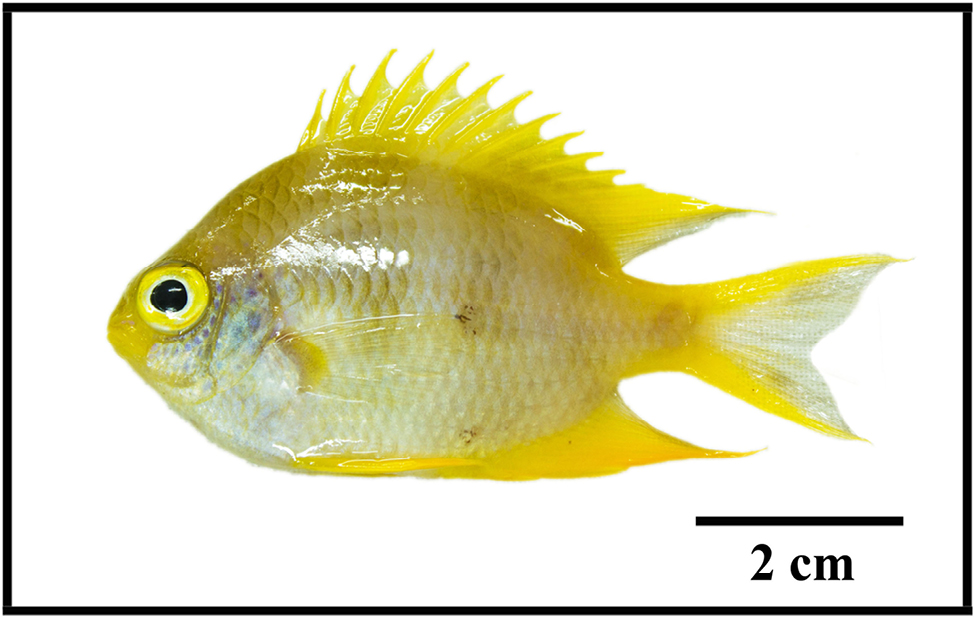
Cytogenetic analyses were performed on the Golden damselfish, Amblyglyphidodon aureus (Cuvier, 1830), with a sample consisting of 9 males and 10 females, collected from the Andaman Sea (Indian Ocean) near the Gulf of Thailand (Fig. 1). The specimens were captured using a hand-net, placed in sealed plastic bags containing oxygenated clean water, and transported to the research station for further analysis.
Mitotic chromosomes were obtained from cell suspensions of the anterior kidney following the conventional air-drying method (Bertollo et al., 2015). The C-banding technique was used to identify the distribution of C-positive heterochromatin (Sumner, 1972), while silver staining helped locate the Ag-NOR sites on the chromosomes (Howell and Black, 1980). The specimens were then deposited in the fish collection of the Cytogenetic Laboratory, Department of Biology, Faculty of Science and Technology, Muban Chombueng Rajabhat University.
Chromosome probes and FISH experiments
Two DNA sequences, arranged in tandem and isolated from the genome of the Erythrinidae fish Hoplias malabaricus (Bloch, 1794), were used as probes. The first probe contained a 5S rDNA repeat copy, including 120 base pairs (bp) of the transcribed 5S rRNA gene and 200 bp of the non-transcribed spacer (NTS) region (Martins et al., 2006). The second probe consisted of a 1400 bp segment from the 18S rRNA gene, which was amplified by PCR from the nuclear DNA. These 5S and 18S rDNA probes were then cloned into plasmid vectors and propagated in DH5α Escherichia coli competent cells (Invitrogen, San Diego, CA, USA). The probes were labeled with Spectrum Orange-dUTP and Spectrum Green-dUTP, respectively, using nick translation according to the manufacturer’s guidelines (Roche, Mannheim, Germany).
The microsatellites (CA)15, (GA)15, and (CAA)10 were synthesized according to Kirkpatrick (2010). During synthesis, these sequences were directly labeled with Cy3 at the 5’ terminus by Sigma (St. Louis, MO, USA).
Fluorescence in situ hybridization (FISH) was carried out under high stringency conditions (Yano et al., 2017). Metaphase chromosome slides were treated with RNAse (40 μg/ml) for 1.5 hours at 37°C. Chromosomal DNA was denatured in a solution of 70% formamide/2x SSC at 70°C for 4 minutes. Then, 20 µl of the hybridization mixture (containing 2.5 ng/μl probes, 2 μg/μl salmon sperm DNA, 50% deionized formamide, and 10% dextran sulfate) was applied to the slides, and hybridization was carried out overnight at 37°C in a moist chamber with 2x SSC. The first post-hybridization wash was done with 2x SSC at 65°C for 5 minutes, followed by a final wash at room temperature in 1x SSC for 5 minutes. Finally, the slides were counterstained with DAPI and mounted in an antifade solution (Vectashield, Vector Laboratories).
Image processing
Around 20 metaphase spreads were examined per individual to verify the diploid chromosome number, karyotype structure, and FISH results. Images were captured using an Olympus BX50 microscope (Olympus Corporation, Ishikawa, Japan) equipped with a CoolSNAP camera and Image Pro Plus 4.1 software (Media Cybernetics, Silver Spring, MD, USA). Chromosomes were classified based on their arm ratios as metacentric (m), submetacentric (sm), acrocentric (a), or telocentric (t).
Results
All Golden damselfish, Amblyglyphidodon aureus (Cuvier, 1830), exhibit a consistent diploid chromosome number of 2n=48. The karyotype of A. aureus (6m+22sm+20a; FN=96) is mainly composed of bi-armed chromosomes (Fig. 2). C-positive heterochromatic blocks are primarily located in the centromeric and telomeric regions of specific chromosome pairs in all specimens. Additionally, faint heterochromatic regions are present in the interstitial areas of chromosome pair No. 18 (Fig. 2).
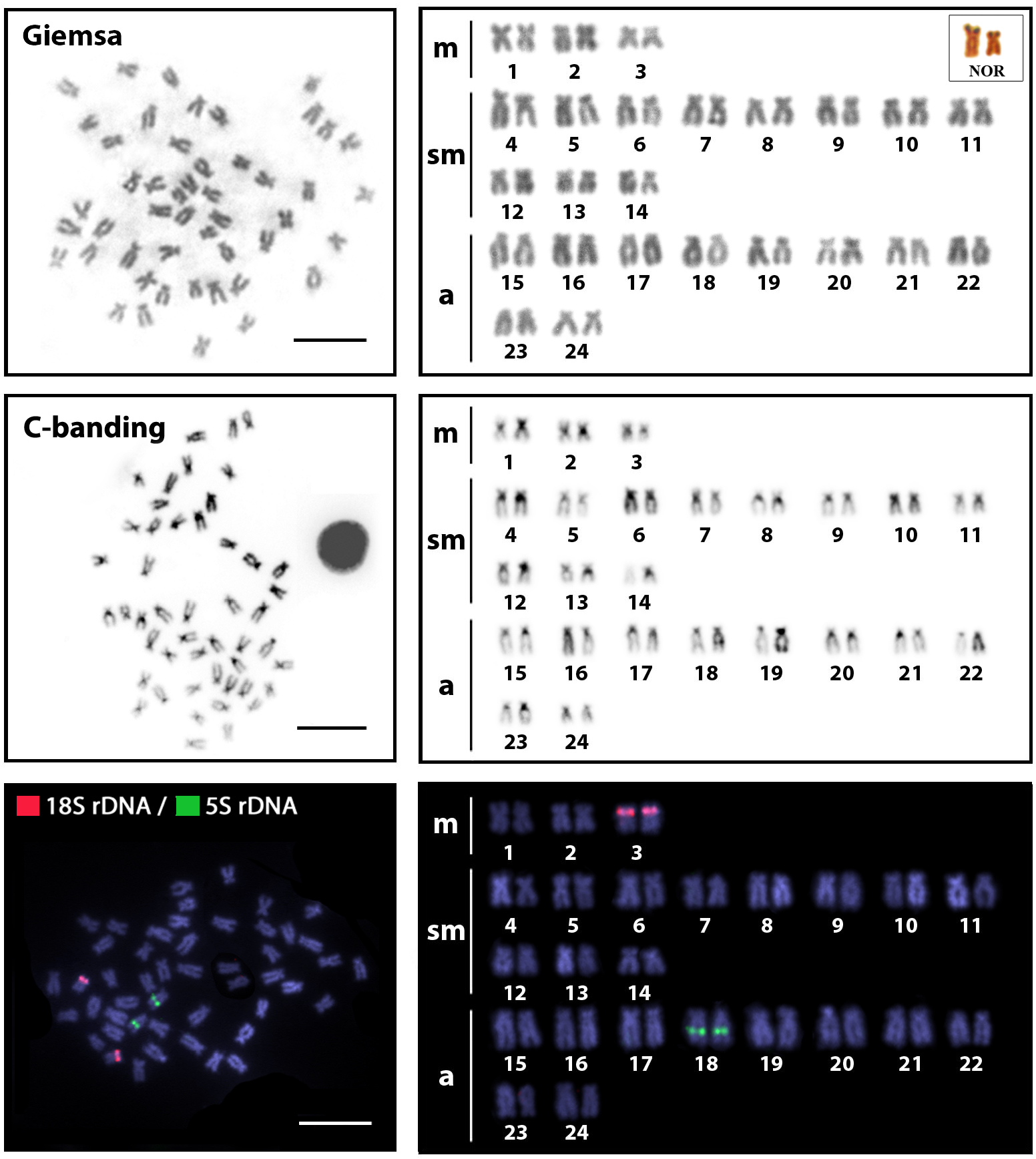
The Ag-NOR sites in all specimens are positioned in the subtelomeric portion of the short arms of the submetacentric chromosomes (Fig. 2). The 5S rDNA sites are not adjacent to the 18S rDNA sites. Instead, they are found in the interstitial regions of acrocentric chromosome pair 18, whereas the 18S rDNA sites are located at the distal ends of the short arms of metacentric chromosome pair 3 (Fig. 2).
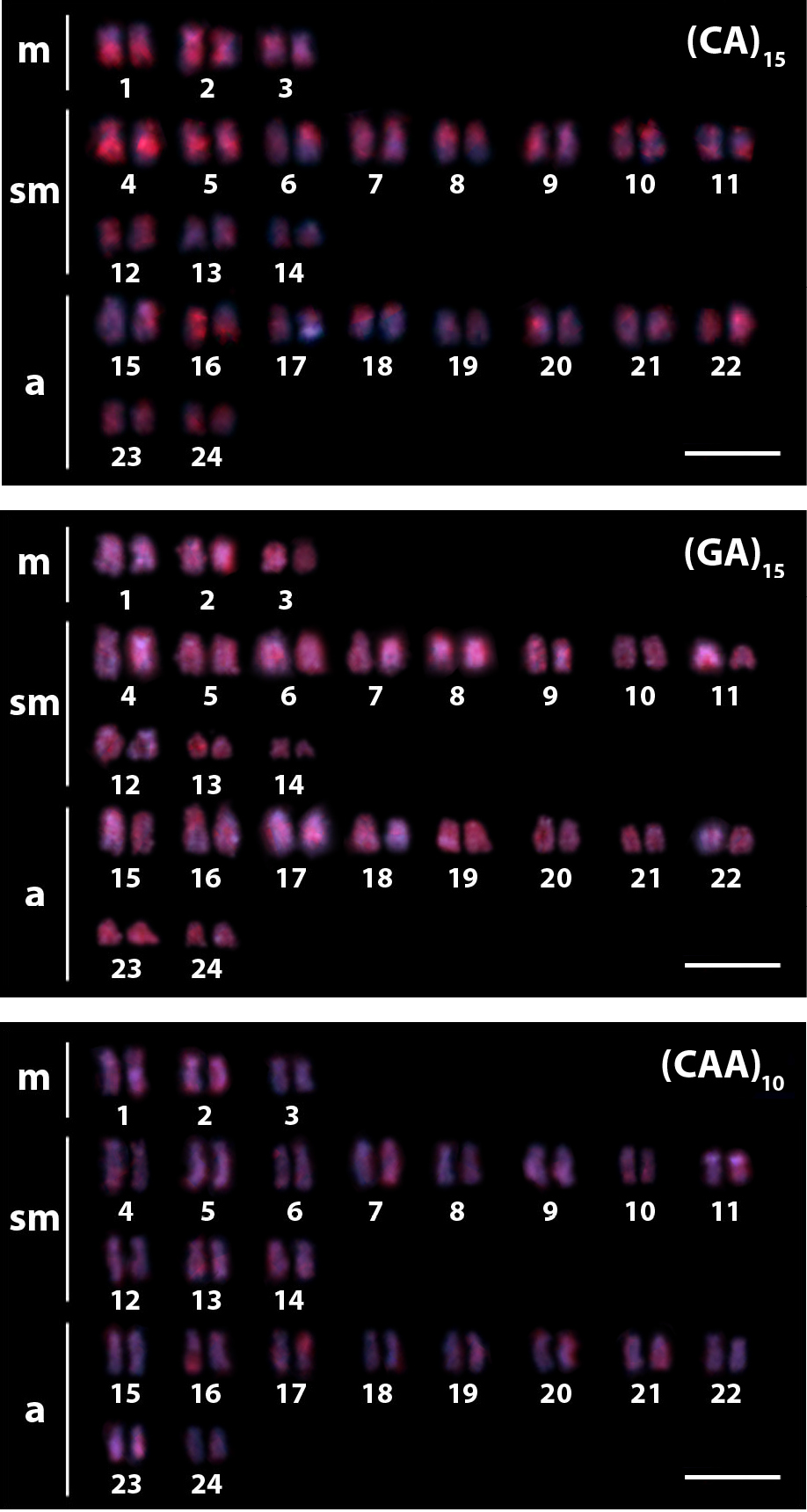
The mapping of the (CA)15 microsatellite revealed a broad distribution across most chromosomes, with prominent clusters present in certain chromosomal pairs. These clusters are located in the centromeric regions and occur with decreasing frequency across all specimens (Fig. 3). In contrast, the (GA)15 and (CAA)10 repeats are more sparsely distributed on the chromosomes, showing less distinct clusters in some chromosomal pairs, including in the interstitial regions (Fig. 3).
The idiogram of the Golden damselfish, Amblyglyphidodon aureus (Cuvier, 1830), shows chromosomes with progressively decreasing lengths (Fig. 4). The karyotype of this species is marked by an asymmetrical chromosome arrangement, consisting of metacentric (m), submetacentric (sm), and acrocentric (a) chromosomes. The karyotype formula for Amblyglyphidodon aureus is expressed as: 2n (48) = Lm2+Lsm8+ La10+ Mm4+Msm14+ Ma10 or 6m+22sm+20a
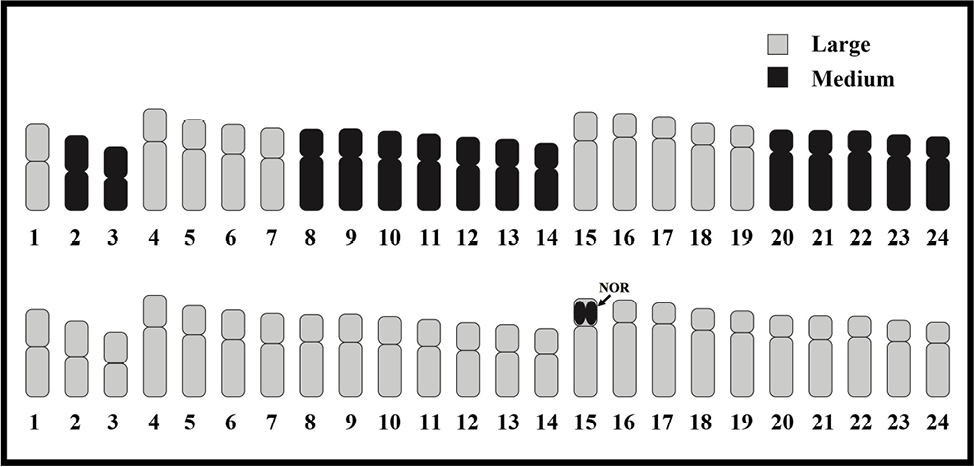
This formula offers a detailed depiction of the chromosome composition and structure in Amblyglyphidodon aureus, highlighting the variety in chromosome types and sizes within its genome.
Discussion
Phylogenetic divergence, karyotypic evolution, and repetitive DNA organization across Amblyglyphidodon species
The varying periods of divergence among some Amblyglyphidodon clades, resulting from multiple radiations under different scenarios, create an ideal setting for studying chromosomal evolution and diversification mechanisms in this genus. The distribution of Amblyglyphidodon species, primarily concentrated in the Indo-Malay-Philippines Archipelago with approximately 80% of the species (Cooper et al., 2009), has been shaped by several historical events, such as sea level fluctuations during glacial cycles (Naish, 2009), significantly impacting their evolution and phylogenetic diversification (Allen, 2008; Gaither and Rocha, 2013). It has been estimated that the stem lineages of Amblyglyphidodon originated approximately 30 million years ago. Previously, the Indo-Pacific pomacentrid genus Amblyglyphidodon was believed to consist of several distinct geographic color variations. However, the current study reveals that it is actually a complex of four species: A. leucogaster (Bleeker, 1847), A. orbicularis (Hombron & Jacquinot, 1853), A. indicus Allen & Randall, 2002, and A. melanopterus Allen & Randall, 2002. The species within the Amblyglyphidodon complex are primarily distinguished by a combination of color patterns and gill-raker counts (Allen and Randall, 2002).
The previously reported phylogenetic analysis of Amblyglyphidodon curacao (Bloch, 1787), along with the currently available mitogenome data for the Pomacentridae family (Kumar et al., 2016), revealed that A. curacao clusters with species in the subfamily Pomacentrinae, such as Stegastes flavilatus (Gill, 1862) and Abudefduf vaigiensis (Quoy & Gaimard, 1825), distinguishing it from species in the subfamily Amphiprioninae. However, A. curacao showed the highest sequence identity (87%) with Amphiprion frenatus Brevoort, 1856. This suggests that the fish genera Amblyglyphidodon, Stegastes, Abudefduf, and Amphiprion are closely related.
A species key for Amblyglyphidodon is provided, and the extended phylogenetic divergence within these clades may help explain their unique karyotype patterns. Specifically, Amblyglyphidodon curacao and A. aureus (Table 1) exhibit karyotypes predominantly consisting of bi-armed chromosomes (2n=48; FN=76 and 96, respectively) (Takai and Ojima, 1986; Ojima and Yamamoto, 1990; Ojima, 1983; Hardie and Hebert, 2004; present study). The Stegastes complex, comprising at least seven species, displays karyotypes with 2n=48 and NF=78-90, while the Amphiprion complex, with at least three species, shows karyotypes with 2n=48 and NF=78-86. In contrast, the Abudefduf complex, consisting of at least five species, exhibits cryptic karyotypes exclusively made up of acrocentric chromosomes (2n=48, FN=50-52) (Arai, 2011).
| Species | 2n | NF | Formula | NORs | Reference |
|---|---|---|---|---|---|
| Abudefduf bengalensis | 48 | 52 | 2m+2sm+44t | 2 | Getlekha et al. (2016b) |
| A. notatus | 48 | 52 | 2m+2a/sm+44t | - | Arai and Inoue (1976) |
| A. saxatilis | 48 | 52 | 2m+2sm+44t | 2 | Getlekha et al. (2016b) |
| A. sexfasciatus | 48 | 50 | 2m+46t | 2 | Getlekha et al. (2016b) |
| A. sordidus | 48 | 54 | 2m+2sm+2a+42t | - | Hardie and Hebert (2004) |
| A. vaigiensis | 48 | 52 | 2m+2sm+2a+42t | 2 | Arai and Inoue (1976) |
| 2m+2sm+44t | 2 | Getlekha et al. (2016b) | |||
| Amblyglyphidodon curacao | 48 | 76 | 6m+22sm+20t | 2 | Takai and Ojima, 1986 Ojima and Yamamoto 1990 Ojima, 1983 Hardie and Hebert, (2004) |
| A. aureus | 48 | 96 | 6m+22sm+20a | 2 | Present study |
| Cheiloprion labiatus | 48 | 74 | 26sm+22t | 2 | Takai and Ojima (1987) |
| Chrysiptera cyanea | 42 | 64 | 6m+16sm+2a+18t | 2 | Takai and Ojima (1995) Ojima and Yamamoto (1990) Hardie and Hebert (2003) |
| 48 | 48 | 48st/a | - | Ojima (1983) | |
| C. hemicyanea | 48 | 78 | 30sm+10a+18t | 2 | Takai and Ojima (1991, 1999) Ojima and Yamamoto (1990) |
| 48 | 80 | 32sm+16t | - | Ojima (1983) | |
| C. leucopoma | 48 | 74 | 4m+22sm+6a+16t | 2 | Takai and Ojima (1995a) |
| C. rex | 36 | 58 | 12m+10sm+14t | 2 | Takai and Ojima (1995a) |
| 48 | 78 | 8m+22sm+18t | - | Ojima (1983) | |
| C. starcki | 48 | 60 | 2m+10sm+36t | 2 | Takai and Ojima (1986, 1987) |
| Microspathodon chrysurus | 48 | 54 | 6m+10sm+32t | 2 | Galetti et al. (2006) Molina and Galetti (2004a) |
| Neoglyphidodon melas | 48 | 82 | 8m+26sm+2a+12t | - | Takai (2010) |
| N. nigroris | 48 | 82 | 8m+26sm+2a+12t | 2 | Takai and Ojima (1991) |
| N. oxyodon | 48 | 70 | 2m+20sm+12a+14t | 2 | Takai and Ojima (1991) |
| Plectroglyphidodon leucozonus | 48 | 52 | 4a+44t | - | Arai and Inoue (1976) |
| Pomacentrus auriventris | 48 | 48 | 48t | 2 | Getlekha et al. (2018) |
| P. chrysurus | 48 | 90 | 8m+22sm+12a+6t | 2 | Hardie and Hebert (2004) |
| P. coelestis | 48 | 48 | 48t | 2 | Takai and Ojima (1999) |
| 48 | 48 | 48t | – | Hardie and Hebert (2004) | |
| P. cuneatus | 48 | 86 | 8m+16sm+14a+10t | 2 | Getlekha et al. (2018) |
| P. moluccensis | 48 | 94 | 10m+26sm+10a+2t | 2 | Hardie and Hebert (2004) |
| 48 | 94 | 10m+26sm+10a+2t | 2 | Getlekha et al. (2018) | |
| P. cf. nagasakiensis | 48 | 50 | 2m+46t | 2 | Takai and Ojima (1987) |
| P. philippinus | 48 | 90 | 8m+24sm+10a+6t | 2 | Takai and Ojima (1991) |
| P. trilineatus | 50 | 58 | 8m/sm+42t | – | Rishi (1973) |
| P. similis | 48 | 48 | 48t | 2 | Getlekha et al. (2018) |
| Stegastes fuscus | 48 | 90 | 20m+22sm+6t | 2 | Galetti et al. (2006) |
| S. insularis | 48 | 86 | 14m+24sm+6a+4t | 2 | Nagpure et al. (2006) |
| S, leucostictud | 48 | 88 | 18m+22sm+8t | 2 | Galetti et al. (2006) Molina and Galetti (2004b) |
| S. lividus | 48 | 78 | 6m+24sm+18t | - | Ojima (1983) |
| S. nigricans | 48 | 52 | 2m+2sm+24t | - | Ojima (1983) Hardie and Hebert (2004) |
| S. pictus | 48 | 90 | 14m+28sm+2a+4t | 2 | Galetti et al. (2006) Molina and Galetti (2004b) |
| S. variabilis | 48 | 88 | 18m+22sm+8t | 2 | Galetti et al. (2006) |
A karyotype with 2n=48a chromosomes, considered a foundational trait for Perciformes, is commonly found across several Clupeocephala families (Arai, 2011; Molina, 2007). While many Percomorpha families preserve a stable karyotype structure, the karyotype evolution in Pomacentridae is notably dynamic (Molina & Galetti Jr., 2004b). In Pomacentrinae, pericentric inversions are the most common karyotype alteration mechanism. These events are particularly evident in Amblyglyphidodon clades, where the gradual accumulation of inversions supports an in-depth analysis of a possible coordinated pericentric inversion process. This pattern has also been observed in other Pomacentrinae genera, where it occurs recurrently and leads to significant karyotype diversification (Kasiroek et al., 2014; Molina & Galetti, 2004a,b). The stabilization of specific chromosomal rearrangements in damselfishes seems not to be random but is likely driven by common orthoselective pressures across multiple lineages (Molina, 2007; Molina and Galetti Jr., 2004a,b).
The presence of C-positive heterochromatin in the centromeric and terminal regions of chromosomes, as observed in the species under investigation, appears to represent a basal condition previously reported in other Pomacentridae species (Molina and Galetti Jr., 2004a,b; Takai, 2012). In contrast, the data for A. aureus reveal interstitial C-positive blocks, indicating potential chromosomal rearrangements, likely caused by paracentric inversions, which are often considered cryptic events in fish chromosomes.
In A. aureus, the Ag-NOR sites are located at the terminal position on the short arms of acrocentric chromosome pair 15, while the 18S rDNA sites are positioned on the short arms of pair 3. The 5S rDNA sites are found in an interstitial position on the long arms of pair 18. The non-syntenic arrangement of these genes is common and likely represents a plesiomorphic condition in Pomacentridae (Cunha et al., 2014; Getlekha et al., 2016b, 2018; Molina and Galetti, 2002).
The role of repetitive DNAs in driving karyotype variation in damselfishes has been extensively studied (Getlekha et al, 2016a,b, 2018). The high evolutionary dynamics observed in Pomacentridae chromosomes (Molina et al., 2014b) may be closely linked to their organization and composition, as demonstrated by the repetitive DNA arrangements in A. aureus. Transposable elements (TEs), which are among the most abundant elements in fish genomes, have been shown to play a significant role in genome evolution and chromosomal rearrangements (Belyayev et al., 2010; Ferreira et al., 2011). However, the physical organization of these elements in Pomacentridae chromosomes remains largely unexplored. In A. aureus, the scattered distribution of repetitive DNA elements in the chromosomes has been associated with low evolutionary dynamism (Getlekha et al, 2016b, 2018). This is similar to the pattern observed in Dascyllus and Pomacentrus species, where microsatellite sequences are evenly distributed across most chromosomes without any significant accumulation. In contrast, Abudefduf species show varied and inconsistent distribution patterns, with (CA)15 and (GA)15 microsatellites concentrated in the nucleolar organizer regions, and (CAA)10 repeats being highly accumulated across all chromosomes (Getlekha et al., 2016a).
Chromosomes and speciation in Amblyglyphidodon
Conspicuous evolutionary changes in chromosome number, karyotype formula, and heterochromatin structure are well-documented among damselfishes (Getlekha et al. 2016a,b, 2018; Molina and Galetti, 2002, 2004a). These structural karyotypic differences are clearly visible in the species analyzed (Table 1). This raises the question of whether alterations in chromosome structure and the organization of repetitive DNA may have actively contributed to reproductive isolation and speciation in this family (Getlekha et al. 2016a,b, 2018; Molina, 2007; Molina and Galetti, 2004a; Takai and Ojima, 1999). While speciation is typically a gradual process, it can occur rapidly in cases of ecological divergence. The resulting genomic differentiation tends to be concentrated in regions with low recombination rates, often clustered around genes that control ecotype-specific phenotypic traits (Marques et al., 2016).
In allopatric fish species, the time required for complete reproductive isolation is estimated to be around 11.6 million years (Russell, 2003). In this context, the early stages of speciation within species complexes represent a critical period of evolution that is not well understood in terms of cytogenetic factors. Although hybridization is considered rare in species with benthic nesting, several instances have been reported across different subfamilies (Coleman, 2014; Johansen et al., 2017; Maruska and Peyton, 2007; Van Herwerden and Doherty, 2006). These cases suggest that, during phyletic diversification, the genetic and cytogenetic differentiation in some damselfishes may have been insufficient to maintain genetic integrity and cohesion within certain species. Hybridization events have occurred in the evolutionary history of some damselfish species, particularly during the early phases of their divergence, when reproductive barriers are often less effective (Montanari et al., 2016).
In Pomacentrinae, a significant number of pericentric inversions, and possibly paracentric inversions as well, are primary mechanisms of karyotype differentiation, as demonstrated in some Pomacentrus species (Getlekha et al, 2018). These chromosomal rearrangements, along with structural modifications such as changes in centromere position, can have additional consequences, such as alterations in gene expression, meiotic pairing abnormalities, and reduced recombination (Kirkpatrick, 2010). The reduction in recombination helps increase the frequency of adaptive alleles in local populations (Hoffmann and Rieseberg, 2008), driving genomic differentiation and evolutionary divergence of lineages. These rearrangements have been extensively observed in closely related Pomacentrinae species, indicating their direct involvement in the diversification process (Molina WF, Galetti Jr PM, 2004a).
In contrast, certain chromosomal rearrangements appear to have limited impact as postzygotic reproductive barriers. For example, in Chrominae, the karyotypes of the Whitetail dascyllus, Dascyllus aruanus (Linnaeus, 1758) (2n=28-32), and the Reticulate dascyllus, D. reticulatus (Richardson, 1846) (2n=34-36), diverge significantly from each other due to Robertsonian rearrangements (Getlekha et al., 2016a; Kashiwagi et al., 2005). Notably, despite belonging to separate species complexes (Bernardi and Crane, 1999) and having diverged for a long period (around 15 Mya) (Frédérich et al., 2013, 2014), natural hybridization has been observed between these species (Johansen et al., 2017).
Some species of pomacentrid fish, such as Pomacentrus auriventris Allen, 1991 and P. coelestis Jordan & Starks, 1901, have a relatively recent divergence time (~0.3 Mya) (Sorenson et al., 2014), raising questions about the extent of reproductive isolation they have achieved. Two species from this complex, P. similis Allen, 1991 and P. alleni Burgess, 1981, coexist sympatrically in the northeastern Indian Ocean. Interestingly, P. alleni exhibits one of the most pronounced color differences within the “coelestis” complex, suggesting that color morphs may have evolved through assortative mating, thereby maintaining their genetic isolation even after secondary contact (Sorenson et al., 2014).
The high cytogenomic similarity observed in recently radiated allopatric species is likely shared, at least partially, with other species within the pomacentrid complex. This suggests that the genetic cohesion in these incipiently divergent species may be maintained by pre-zygotic barriers rather than post-zygotic ones. In fact, the structural and organizational patterns of genes and repetitive sequences in the karyotypes indicate that chromosomal changes play a limited role as key post-zygotic barriers. Consequently, cytogenetic data imply potential risks of reverse speciation due to secondary contact between these species, highlighting the importance of this information for their genetic conservation.
Overall, the available data highlight the significant role that chromosomal rearrangements have played in the evolutionary development of Amblyglyphidodon species, as well as the genome distribution of certain repetitive DNA classes. We were able to identify distinct chromosomal pathways in the phyletic diversification of Amblyglyphidodon aureus, with a detailed characterization of its chromosomal features. Amblyglyphidodon aureus was most recently evaluated by The IUCN Red List of Threatened Species in 2010, where it was classified as Least Concern. This species is found in the tropical marine waters of the Eastern Indian and Western Pacific oceans, native to the central Indo-Pacific. It typically inhabits outer reef areas, deep lagoons, and regions with strong ocean currents, often living among gorgonians, either alone or in small groups. Its range extends from Thailand to Indonesia, across New Guinea, north to the Philippine Islands and Taiwan, and as far east as the Marshall Islands and Fiji. In Australia, it is found in the offshore reefs of north-western Western Australia and the Great Barrier Reef in Queensland. In the context of glacial cycles, where sea levels have risen and fallen, Amblyglyphidodon species may have experienced repeated isolation and reconnection events, making them an ideal model for studying chromosomal patterns related to the speciation process.
Acknowledgements
The authors appreciate the correctness verification of the paper and the invaluable assistance provided by the Toxic Substances in Livestock and Aquatic Animals Research Group at Khon Kaen University and and Department of Biology, Faculty of Science and Technology, Muban Chombueng Rajabhat University that provided support for this study.
References
Allen GR, Erdmann MV, Cahyani DNK. Review of the Chrysipteraoxycephala complex of damselfishes (Pomacentridae) with descriptions of three new species from the East Indian Archipelago. Journal of the Ocean Science Foundation. 2015;17:56–84.
Allen GR, Erdmann MV, Purtiwi PD. Descriptions of four new species of damselfishes (Pomacentridae) in the Pomacentrus philippinus complex from the tropical western Pacific Ocean. Journal of the Ocean Science Foundation. 2017;25:47–76.
Allen GR, Randall JE. A review of the Leucogaster species complex of the Indo-pacific pomacentrid genus Amblyglyphidodon, with descriptions of two new species. aqua, International Journal of Ichthyology. 2002;5:139–152.
Allen GR. Conservation hotspots of biodiversity and endemism for Indo-Pacific coral reef fishes. Aquat Conser Mar Freshw Ecosyst. 2008;18:541–556.
Arai R, Inoue M. Chromosomes of four species of coral fishes from Japan. Bulletin of the National Science Museum, Series A. 1976;2(2):137-141.
Arai R. Fish Karyotypes: a check list. Tokyo: Springer; 2011.
Belyayev A, Kalendar R, Brodsky L, Nevo E, Schulman AH, Raskina O. Transposable elements in a marginal plant population: temporal fluctuations provide new insights into genome evolution of wild diploid wheat. Mobile DNA. 2010; https://doi.org/10.1186/1759-8753-1-6.
Bernardi G, Crane NL. Molecular phylogeny of the humbug damselfishes inferred from mtDNA sequences. J Fish Biol. 1999;54:1210–1217.
Bertollo LAC, Cioffi MB, Moreira-Filho O: Direct chromosome preparation from freshwater teleost fishes. In: Ozouf-Costaz C, Pisano E, Foresti, F and Almeida Toledo LF, editors. Fish Cytogenetic Techniques (Chondrichthyans and Teleosts).CRC Press: Enfield, Boca Raton, FL; 2015. pp. 21–26.
Bone Q, Moore RH. Biology of fishes. 3rd ed. New York: Taylor & Francis Group, 2008.
Coleman RR, Gaither MR, Kimokeo B, Stanton FG, Bowen BW, Toonen RJ. Large-scale introduction of the Indo-Pacific damselfish Abudefduf vaigiensis into Hawaii promotes genetic swamping of the endemic congener A. abdominalis. Mol Ecol. 2014;23:5552–5565.
Cooper WJ, Smith LL, Westneat MW. Exploring the radiation of a diverse reef fish family: phylogenetics of the damselfishes (Pomacentridae), with new classifications based on molecular analyses of all genera. Molecular Phylogenetics and Evolution. 2009;52:1–16.
Cunha IMC, Souza AS, Dias EA, Amorim KDJ, Soares RX, Costa GWWF, García-Machado E, Galetti Jr PM, Molina WF. Genetic multipartitions based on d-loop sequences and chromosomal patterns in Brown Chromis, Chromis multilineata (Pomacentridae), in the Western Atlantic. BioMed Research International. 2014;254698.
Dobigny G, Ozouf-Costaz C, Waters PD. LINE-1 amplification accompanies explosive genome repatterning in rodents. Chromosome Research. 2004;12:787.
Drew JA, Barber PH. Comparative phylogeography in Fijian coral reef fishes: a multi-taxa approach towards marine reserve design. PLoSOne. 2012; https://doi:10.1371/journal.pone.0047710.
Eschmeyer WN, Fong JD. Title of subordinate document. In: Species by Family/Subfamily. 2016. http://researcharchive.cala cademy.org/research/ichthyology/catalog/SpeciesByFamily.asp. Accessed 15 Jan 2025.
Ferreira DC, Porto-Foresti F, Oliveira C, Foresti F. Transposable elements as a potential source for understanding the fish genome. Mobile Genetic Elements. 2011;1:2:112–117.
Fishelson L. Behaviour, socio-ecology and sexuality in damselfishes (Pomacentridae). Italian Journal of Zoology. 1998;65:387–398.
Frédérich B, Olivier D, Litsios G, Alfaro ME, Parmentier E. Trait decoupling promotes evolutionary diversification of the trophic and acoustic system of damselfishes. Proc R Soc B. 2014;281:20141047.
Frédérich B, Sorenson L, Santini F, Slater GJ, Alfaro ME. Iterative ecological radiation and convergence during the evolutionary history of damselfishes (Pomacentridae). Am Nat. 2013;181:94–113.
Fricke HW, Holzberg S. Social units and hermaphroditism in a pomacentrid fish. Naturwissensch. 1974;61:367–68.
Gaither MR, Rocha LA. Origins of species richness in the Indo-Malay-Philippine biodiversity hotspot: evidence for the centre of overlap hypothesis Journal of Biogeography. 2013;40:1638–1648.
Galetti PM, Molina WF, Affonso PRAM. Assessing genetic diversity of Brazilian reef fishes by chromosomal and DNA markers. Genetica,. 2006;126(1):91–99.
Getlekha N, Cioffi MB, Yano CF, Maneechot N, Bertollo LAC, Supiwong W, Tanomtong A, Molina WF. Chromosome mapping of repetitive DNAs in sergeant major fishes (Abudefdufinae, Pomacentridae): a general view on the chromosomal conservatism of the genus. Genetica. 2016b;144:567–576.
Getlekha N, Molina WF, Cioffi MB, Yano CF, Maneechot N, Bertollo LAC, Supiwong W, Tanomtong A. Repetitive DNAs highlight the role of chromosomal fusions in the karyotype evolution of Dascyllus species (Pomacentridae, Perciformes). Genetica 2016a;144:203–211.
Getlekha, N, Cioffi MB, Maneechot N, Bertollo LAC, Supiwong W. Tanomtong A, Molina WF. Contrasting Evolutionary Paths Among Indo-Pacific Pomacentrus Species Promoted by Extensive Pericentric Inversions and Genome Organization of Repetitive Sequences. Zebrafish. 2018;15(1): 45–54.
Hardie D C, Hebert PD. The nucleotypic effects of cellular DNA content in cartilaginous and ray-finned fishes. Genome. 2003; 46(5): 683–706.
Hardie DC, Hebert PD. Genome-size evolution in fishes. Can J Fish Aquatic Sci. 2004;61(9): 1636–1646.
Hoffmann AA, Rieseberg LH. Revisiting the impact of inversions in evolution: from population genetic markers to drivers of adaptive shifts and speciation? Annu Rev Ecol Evol Syst. 2008;39:21–42.
Howell WM, Black DA. Controlled silver-staining of nucleolus organizer regions with a protective colloidal developer: a 1-step method. Experientia. 1980;36:1014–1015.
Jang-Liaw NH, Tang KL, Hui C-F, Shao K-T. Molecular phylogeny of 48 species of damselfishes (Perciformes: Pomacentridae) using 12S mtDNA sequences. Mol Phylogenet Evol. 2002;25:445–454.
Johansen JL, He S, Frank G, Pappas MK, Berumen ML, Hoey AS. Hybridization between damselfishes Dascyllus aruanus and D. reticulatus on the Great Barrier Reef. Coral Reefs. 2017; https://doi.org//10.1007/s00338-017-1563-z.
Kashiwagi E, Takai A, Ojima Y. Chromosomal distribution of constitutive heterochromatin and nucleolus organizer regions in four Dascyllus fishes (Pomacentridae, Perciformes). Cytologia. 2005;70:345–349.
Kasiroek W, Luangoon N, Getlekha N, Saowakoon S, Phinrub W, Tanomtong A. First report on heteromorphic NORs and chromosome analysis of Rolland’s demoiselle, Chrysiptera rollandi (Perciformes, Pomacentrinae) by conventional and Ag-NOR staining techniques. Cytologia. 2014;79:289–297.
Kirkpatrick M. How and why chromosome inversions evolve. PLoS Biology, 2010; https://doi.org/10.1371/journal.pbio.1000501.
Kumar S, Blaxter M, Hebert PD. Complete mitochondrial genome of Staghorn damselfish, Amblyglyphidodon curacao (Perciformes: Pomacentridae). Mitochondrial DNA Part B. 2016; 1(1):1–2.
Lim JK, Simmons MJ. Gross chromosome rearrangements mediated by transposable elements in Drosophila melanogaster. Bioessays. 1994;16:269–275.
Litsios G, Pellissier L, Forest F, Lexer C, Pearman PB, Zimmermann NE, Salamin N, Trophic specialization influences the rate of environmental niche evolution in damselfishes (Pomacentridae). Proc Biol Sci. 2012;279:3662–3669.
Liu SYV, Dai CF, Allen GR, Erdmann MV. Phylogeography of the neon damselfish Pomacentrus coelestis indicates a cryptic species and different species origins in the West Pacific Ocean. Mar Ecol Prog Ser. 2012;458:155–167.
Liu SYV, Ho HCH, Dai CF. A new species of Pomacentrus (Actinopterygii: Pomacentridae) from Micronesia, with comments on its phylogenetic relationships. Zool Stud. 2013;52:6–13.
Marques DA, Lucek K, Meier JI, Mwaiko S, Wagner CE, Excoffier L, Seehausen O, Genomics of rapid incipient speciation in sympatric threespine stickleback. PLOS Genetics. 2016;12:2:e1005887.
Martins C, Ferreira IA, Oliveira C, Foresti F, Galetti Jr PM. A tandemly repetitive centromeric DNA sequence of the fish Hoplias malabaricus (Characiformes: Erythrinidae) is derived from 5S rDNA. Genetica. 2006;127:133–141.
Maruska KP, Peyton KA. Interspecific spawning between a recent immigrant and an endemic damselfish (Pisces: Pomacentridae) in the Hawaiian Islands. Pac Sci. 2007;61:211–221.
Molina WF, Galetti Jr PM. Karyotypic changes associated to the dispersive potential on Pomacentridae (Pisces, Perciformes). J Exp Mar Biol Ecol. 2004a;309:109–119.
Molina WF, Galetti Jr PM. Multiple pericentric inversions and chromosomal divergence in the reef fishes Stegastes (Perciformes, Pomacentridae). Genet Mol Biol. 2004b;27:543–548.
Molina WF, Galetti Jr PM. Robertsonian rearrangements in the reef fish Chromis (Perciformes, Pomacentridae) involving chromosomes bearing 5S rRNA genes. Genet Mol Biol. 2002;25:373–377.
Molina WF, Martinez PA, Bertollo LA, Bidau CJ. Preferential accumulation of sex and Bs chromosomes in biarmed karyotypes by meiotic drive and rates of chromosomal changes in fishes. An Acad Bras Ciênc. 2014b;86:4:1801–1812.
Molina WF. Chromosomal changes and stasis in marine fish groups. In: Pisano E, Ozouf-Costaz C, Foresti F, Kapoor BG. editors. Fish cytogenetics. Enfield: Science Publishers; 2007. pp. 69–110,
Montanari SR, Hobbs JP, Pratchett MS, van Herwerden L. The importance of ecological and behavioural data in studies of hybridisation among marine fishes. Reviews in Fish Biology and Fisheries. 2016;26:181–198.
Nagpure NS, Kumar R, Srivastava SK, Kushwaha B, Gopalakrishnan A, Basheer VS. Cytogenetic characterization of two marine ornamental fishes, Chaetodon collare and Stegastes insularis. Journal of the Marine Biological Association of India. 2006; 48(2):267-269.
Naish T, Powell R, Levy R, Wilson G, Scherer R, Talarico F, Krissek L, Niessen F, Pompilio M, Wilson T. Obliquity-paced Pliocene West Antarctic ice sheet oscillations. Nature. 2009;458:322–328.
Ojima Y. Fish cytogenetics. In: Sharma AK, Sharma A, editors. Chromosomes in evolution of eukaryotic groups. CRC Press: Boca Raton; 1983.
Ojima Y. Yamamoto K. Cellular DNA contents of fishes determined by flow cytometry. La Kromosomo II. 1990;57:1871–1888.
Planes S, Doherty PJ, Bernardi G. Strong genetic divergence among populations of a marine fish with limited dispersal, Acanthochromis polyacanthus, within the Great Barrier reef and the Coral Sea. Evolution. 2001;55:2263–2273.
Rishi KK. A preliminary report on the karyotypes of eighteen marine fishes. Research Bulletin of the Punjab University. 1973;24:161–162.
Rocha LA, Rocha CR, Robertson DR, Bowen BW. Comparative phylogeography of Atlantic reef fishes indicates both origin and accumulation of diversity in the Caribbean. BMC Evolutionary Biology. 2008; 8:157.
Russell ST. Evolution of intrinsic post-zygotic reproductive isolation in fish. Ann Zool Fennici. 2003;40:321–329.
Sorenson L, Allen GR, Erdmann MV, Dai CF, Liu S-YV. Pleistocene diversification of the Pomacentrus coelestis species complex (Pisces: Pomacentridae): historical biogeography and species boundaries. Mar Biol. 2014;161:2495–2507.
Steinke D, Zemlak TS, Hebert PDN. Barcoding Nemo: DNA-based identifications for the ornamental fish trade. PLoS One 2009; 4:e6300.
Sumner AT. A simple technique for demonstrating centromeric heterochromatin. Exp Cell Res. 1972;75:304–306.
Takai A, Ojima Y. Chromosome evolution associated with Robertsonian rearrangements in Pomacentrid fish (Perciformes). Cytobios. 1995;84:103–110.
Takai A, Ojima Y. Comparative studies of karyotypes and distributions of nucleolus organizer regions in pomacentrid fish. Cytobios. 1991;65:199–205.
Takai A, Ojima Y. Constitutive heterochromatin distribution in the chromosomes of Pomacentrid fishes (Perciformes). Cytologia. 1999;64:87–91.
Takai A. Chromosomal distribution of C-band-positive heterochromatin in eight species of Pomacentridae (Perciformes). Chromosome Science. 2012;15:39–42.
Takai A. Karyotype and nucleolar organizer regions in the pomacentrid fish Neoglyphidodon melas. Memoirs of Osaka Shin-Ai College. 2010; 45:9–13.
Takai A. Ojima Y. Comparative studies of karyotypes and distributions of nucleolus organizer regions in Pomacentrid fishes. Proceedings of the Japan Academy, Series B. 1986;62(1):17–22.
Takai A. Ojima Y. Comparative studies of karyotypes and distribution of nucleolus organizer regions in Pomacentrid fish. Proc Jpn Acad. 1987;63B: 17–20.
Van Herwerden L, Doherty PJ. Contrasting genetic structures across two hybrid zones of a tropical reef fish, Acanthochromis polyacanthus (Bleeker 1855). Journal of Evolutionary Biology. 2006;19:239–252.
Wellington GM, Victor BC. Planktonic larval duration of one hundred species of Pacific and Atlantic damselfishes (Pomacentridae). Marine Biology. 1989;101:557–567.
Yano CF, Bertollo LAC, Cioffi MB. Fish-FISH: Molecular Cytogenetics in Fish Species. In: Liehr T, editors. Fluorescence in situ Hybridization (FISH)-Application Guide. 3rd ed. Springer: Berlin; 2017. pp. 429–444.