Received: May 11, 2025; Accepted: November 1, 2025; Published: December 24, 2025
Spontaneous stickiness in somatic metaphase cells suggests chromosomal instability in a Mexican population of Aeschynomene sp. prope villosa (Fabaceae: Papilionoideae: Dalbergieae)
Facultad de Estudios Superiores Zaragoza, Universidad Nacional Autónoma de México, Laboratorio de Genecología, Batalla 5 de mayo s/n esquina Fuerte de Loreto, Col. Ejército de Oriente, Alcaldía Iztapalapa, C.P. 09230, Ciudad de México, Mexico
Email: pasfer@unam.mx
Abstract. Aeschynomene sp. prope villosa (a dalbergioid legume) represents a group of populations with morphological characteristics similar to those of Aeschynomene villosa, but without complete overlap, and whose cytogenetic characteristics subtly differ from both the latter and other related taxa. In this study, conventional surface spread and air-drying techniques, along with Giemsa staining, were used to analyze metaphase chromosome complements and karyotypes of individuals belonging to a population of A. sp. prope villosa, a taxon included in the Americanae series of Aeschynomene. The results confirm a previously obtained karyotypic formula. Differences observed in chromosome sizes do not modify the karyotype or its symmetry. They are interpreted here as a loss of gene flow between populations or adaptations to different ecogeographic conditions. The presence of chromosome stickiness in 7.4% of the nuclei analyzed is noteworthy. This aberration, not previously observed in Aeschynomene, primarily involves areas near the telomeres of apparently homologous and non-homologous chromosomes. This phenomenon, observed mainly in meiosis, has been linked to the tendency of chromosomes to clump together during cellular divisions following plant hybridization events. The same criterion of chromosomal interaction after hybridization could explain the changes in the number and position of satellites recorded in a previous study. Although unexpected, these results should not be surprising, since intergradation between A. villosa and A. americana, species with which it overlaps in its distribution area, has been suspected for at least 70 years. Furthermore, hybridization and allopolyploidy have already been demonstrated in other morphological series of Aeschynomene.
Keywords: Chromosomal instability, chromosome stickiness, hybridization, interchromosomal connections, karyotype, SAT-chromosomes.
Contents
Chromosome and karyotype procedures
Introduction
Aeschynomene L. is a genus of flowering plants in Leguminosae, subfamily Papilionoideae, and recently assigned to the tribe Dalbergieae. It includes around 130 species of pantropical distribution, commonly referred to as joint vetch (Lavin et al. 2001; Wojciechowski et al. 2004; Cardoso et al. 2012, 2020; WFO 2025). It includes herbaceous and woody species, annual, perennial, and repetitive, with different ecological requirements and of increasing economic importance as green manure by supplementing nitrogen to the soil through nodulating stems and roots in symbiosis with nitrogen-fixing bacteria (Alazar and Becker 1987; Fernandes 1996; Souza et al. 2012; Tapia-Pastrana and Delgado-Salinas 2020).
In the New World, Aeschynomene villosa Poir. and its three varieties (included in the Americanae series, a taxon defined on morphological basis) constitute a group widely distributed from southern Arizona through Mexico (mostly on the Pacific side) and Central America to northern South America and the West Indies. (Rudd 1955; McVaugh 1987; Rodríguez 1990). It also occurs, apparently as an introduced species, in the tropics of the Old World. It is highly variable, and often weedy (McVaugh 1987). On the other hand, Rudd (1955) observed a close relationship between A. villosa and A. americana L. (also in the Americanae series) and anticipated probable intergradation due to divergence.
In Mexico, the distribution of A. villosa overlaps in many areas with that of A. americana and its varieties flabellata and glandulosa, which are also widely distributed (Rudd 1955). This overlap also extends to some morphological features, confusing fieldwork, especially when the two taxa lack fruit (Rudd 1955; Reynolds 1990; Olvera-Luna et al. 2012). Additionally, phylogenetic analyses consistently indicate that both species are closely related (Chaintreuil et al. 2013; Brottier et al. 2018; Cardoso et al. 2020). It is important to note here that A. villosa Poir. was initially described as Aeschynomene americana var. villosa (Urban 1905, cited by Rudd 1955) and as Aeschynomene americana var. longifolia (Micheli 1895, cited by McVaugh 1987); however, its specific status, as well as that of its varieties, was confirmed by morphological (Rudd 1955) and chromosomal (Tapia-Pastrana et al. 2020) characters and are currently accepted names in the genus Aeschynomene (WFO).
Morphological similarities between species of the Americanae series, particularly between A. americana and A. villosa, were recognized during a cytogenetic analysis that included, among others, seven taxa of this series that thrive in Mexico. Two of them were described as A. sp. prope americana and A. sp. prope villosa, whose karyotypic characteristics supported their taxonomic identity; however, they also showed some similarities concerning the typical species (Tapia-Pastrana et al. 2020). In this research, the taxonomic criteria of Rudd (1955) and McVaugh (1987) for species in the morphological Americanae series of Aeschynomene were followed, in addition to the available cytogenetic information. It was considered that the individuals under study fit better in the description of Aeschynomene sp. prope villosa (Tapia-Pastrana et al. 2020).
Aeschynomene sp. prope villosa can be confused with the typical variety (A. villosa) and with A. americana; however, there are sufficient morphological differences to allow them to be differentiated, particularly the length of the inflorescence and the abundance of glandular hairs on vegetative structures, flowers, and fruits (Rudd, 1955). In some descriptions, A. villosa var. longifolia is considered a synonym of A. villosa var. villosa (WFO 2025). Additionally, the possible hybridization between the typical variety and A. americana is proposed (Rudd 1955; WFO 2025).
Aeschynomene sp. prope villosa comprises erect, branching subshrubs that reach up to 1.6 m in height. Stems are green or slightly reddish, with abundant glandular hairs. The stipules are hispid on mature plants, 12-20 mm long, striated, and ciliate, with the upper portion up to three times longer than the lower portion. Leaves 2.5-6 cm long, 18-66 foliolate, oblong, ciliate, with reddish edges; inflorescences with axillary flowers shorter than the underlying leaves; bracts cordate, slightly hispid, ciliate; bracteoles lanceolate 2.0 x 1.0 mm, serrate-ciliate, with reddish edges; peach-yellow or rusty yellow flowers 8.0-9.0 x 5.5-7.5 mm, glandular hairs on the margins; calyx deeply bilabiate, adaxial lip ciliate 3.5 mm x 1.5 mm, nearly glabrous; carinal lip 3.5-4.5 mm x 1.5 mm, glandular hairs on the outer surface; standard petal sub orbiculate to reniform, 6 mm long, 4.5 mm wide, claw less than 1 mm, macule dark yellow with reddish semicircular margins, nectar guides reddish; wing petals 6 x 2.5-3.0 mm, sculptured on the distal portion suprabasal-medial; claws 0.7 mm wide; keel petals 6.0 x 2.5 mm, lower margin slightly ciliate, claw less than 1 mm; stamens 5.0-5.5 mm long, pistil 6 mm long, ovary profusely hispid; fruits slightly curved with persistent style, commonly 4-6 jointed, articles 4 x 3 mm, hispid in early stages of development, verrucose during ripening; seeds 2.5 x 2.0 mm, brown or light olive (Fig. 1A-J).
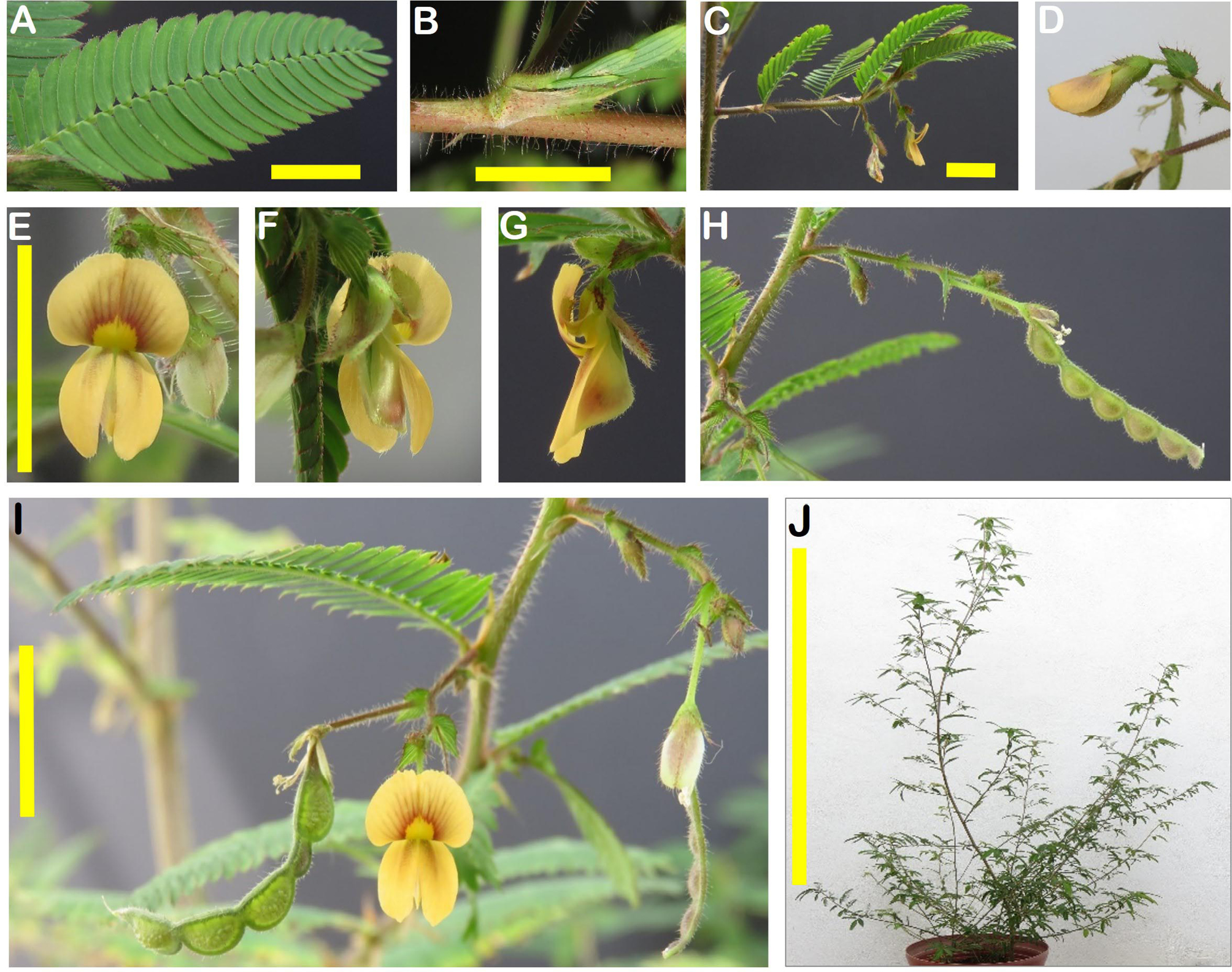
This research aims to: (1) present the relevant morphological characters of individuals belonging to a population initially identified as Aeschynomene villosa var. longifolia, but which, after a thorough review, are finally treated as A. sp. prope villosa, (2) corroborate cytogenetic characteristics and karyotype, (3) discuss the possible hybrid origin of the individuals under study based on morphological and chromosomal evidence, and (4) offer some data on their phenology.
Materials and methods
Plant material
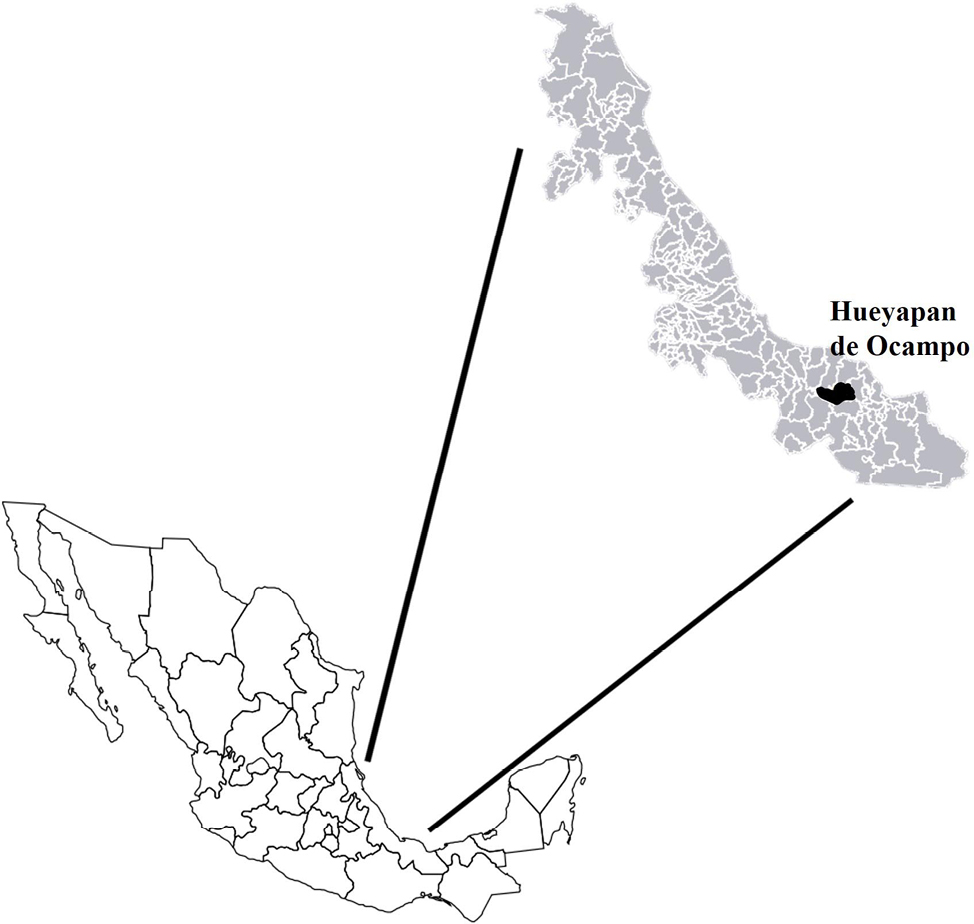
Cytogenetic studies were performed on seeds collected in January 2017 in the Locality of Los Mangos, Municipality of Hueyapan de Ocampo, State of Veracruz, Mexico (18°14’37’’ N; 95°7’22’’ W. 350 m asl; Fig. 2). The identity of the plants was established after comparing them with specimens deposited in the National Herbarium (MEXU) collection. Specimens prepared from plants grown in greenhouse conditions were entered as vouchers in the same collection.
Chromosome and karyotype procedures
The mitotic cells were obtained from radicular meristems of seeds from five individuals, germinated in Petri dishes lined with cotton moistened in distilled water. Chromosomes at metaphase were obtained following the splash method by Tapia-Pastrana and Mercado-Ruaro (2001) briefly described as follows: the meristems were separated from the root when it reached between 3-5 mm in length and were pretreated with fresh solution of 0.002M 8-hydroxyquinoline for 5 h at room temperature and fixed in the fixative Farmer´s solution (ethanol: acetic acid, 3:1). Then they were treated in a mixture of 2% cellulase (w/w, Sigma) and 20% pectinase (v/w, Sigma) in 75 mM KCl for 2 h at 37 °C. After centrifugation at 1500 rpm for 10 min, the cell pellet was transferred to 75 mM KCl solution for 20 min at 37 °C. After two successive rinses with KCl solution, they were again fixed in Farmer´s solution and rinsed twice more. Two drops of the suspension of the pellet were placed on clean slides, air dried, and stained in 10% Giemsa for 10 min. Preparations were made permanent using a synthetic resin (solution in xylol Hycel). At least ten well-spread metaphase plates, no chromosome overlapping, were photographed, using a Carl Zeiss Axioscope A1, and analyzed for chromosome number. Five photographs of metaphases with chromosomes having comparable degrees of contraction and centromeres localized were used to obtain mean values in the following chromosomal parameters: the difference in length between the longest chromosome and the shortest chromosome (Range), total haploid chromosome length (THC), average chromosomal size (AC) and ratio of the longest/shortest chromosome (Ratio, L/S). The asymmetry index (TF%) was obtained following Huziwara (1962). Chromosomes were classified as metacentric (m), submetacentric (sm), and subtelocentric according to their morphology and arm proportions (Levan et al. 1964). Chromosome size was estimated using a Mitutoyo Digimatic Caliper. A karyotype is prepared from a photomicrograph by cutting individual chromosomes, organizing them in descending order of length, and matching based on morphology.
Results
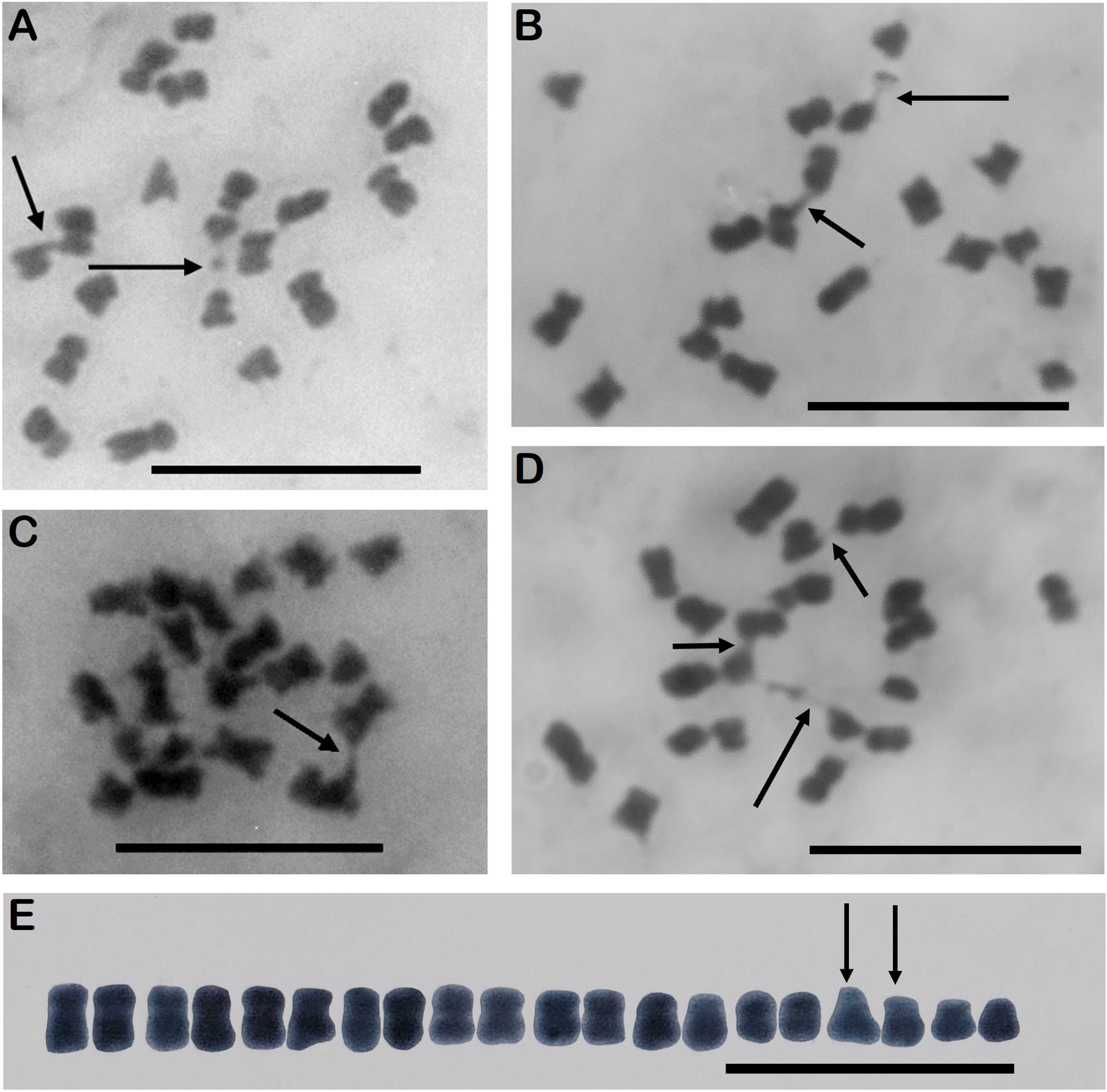
108 typical metaphase nuclei exhibiting a 2n = 20 were examined (Fig. 3 A-D). The complements showed a predominance of m chromosomes, few sm chromosomes, and a single pair of st chromosomes carrying secondary constriction and satellites on short arms (Table 1; Fig. 3A, B, and D). The chromosome formula and other cytogenetic parameters are summarized in Table 2. The karyotype obtained is shown in Fig. 3E. Eight metaphase complements (7.4%) exhibited chromosomes of different shapes and sizes linked by chromatin strands (interchromosomal connections) in regions close to the telomeres (Fig. 3A-D) and an apparent satellite association between the st chromosomes (Fig. 3D). Interphase cells exhibited one or two nucleoli.
| CP | TCL (µm) | LLA (µm) | LSA (µm) | r | S | ||||||||||||||
|---|---|---|---|---|---|---|---|---|---|---|---|---|---|---|---|---|---|---|---|
| 01 | 2.25±0.19 | 1.26±0.18 | 0.98±0.09 | 1.63 | m | ||||||||||||||
| 02 | 2.10±0.13 | 1.21±0.10 | 0.89±0.05 | 1.35 | m | ||||||||||||||
| 03 | 1.96±0.08 | 1.13±0.06 | 0.87±0.08 | 1.29 | m | ||||||||||||||
| 04 | 1.75±0.13 | 0.99±0.12 | 0.75±0.04 | 1.32 | m | ||||||||||||||
| 05 | 1.67±0.13 | 0.89±0.09 | 0.77±0.04 | 1.15 | m | ||||||||||||||
| 06 | 1.58±0.11 | 0.90±0.11 | 0.67±0.04 | 1.34 | m | ||||||||||||||
| 07 | 1.51±0.12 | 1.02±0.09 | 0.48±0.04 | 2.12 | sm | ||||||||||||||
| 08 | 1.40±0.13 | 0.74±0.09 | 0.64±0.04 | 1.15 | m | ||||||||||||||
| 09 | 1.30±0.20 | 1.02±0.16 | 0.27±0.05 | 3.77 | st* | ||||||||||||||
| 10 | 1.25±0.14 | 0.87±0.08 | 0.37±0.07 | 2.35 | sm | ||||||||||||||
| CP=Chromosome pair; TCL=total chromosome length; LLA=length long arm; LSA=length short arm; ±=SD; r=arms ratio; S=shape after Levan et al. (1964). *Chromosomes with secondary constrictions on the short arm. | |||||||||||||||||||
| NA | 2n | Karyotype formula | Sat | THC ± SD (µm) |
AC ± SD (µm) |
Range ± SD (µm) |
L/S ± SD | TF% ± SD | |||||||||||
|---|---|---|---|---|---|---|---|---|---|---|---|---|---|---|---|---|---|---|---|
| 108 | 20 | 7m + 2sm+1st | 2 | 16.79±1.18 | 1.67±0.11 | 1.03 ± 0.14 | 1.85 ± 0.20 | 40.08 ± 1.45 | |||||||||||
| NA = Nuclei analyzed; Sat = Number of satellites; THC = Total haploid chromosome length; AC = Average chromosome size; TF% = Asymmetry index. | |||||||||||||||||||
Discussion
The chromosome number 2n = 20 obtained for Aeschynomene sp. prope villosa confirms the predominance of n=10 in dalbergioid legumes. It adds to the records showing that the species and subspecific taxa in the Americanae series of Aeschynomene cytogenetically analyzed are strictly diploid. Its karyotypic formula (7m + 2sm + 1st) confirms the chromosomal architecture observed in a previous study for another Mexican population also registered as A. sp. prope villosa. Although it shows slight differences in some cytogenetic parameters such as THC and AC, this does not substantially affect either the chromosomal formula or the asymmetry index (TF%) and instead suggests a loss of genetic interaction between populations or adaptations to different eco-geographic factors (Tapia-Pastrana et al. 2020). However, the most striking difference is the presence of a single SAT chromosome pair observed here, in which the microsatellites are located on the short arms of the st chromosomes (Fig. 3A and D), whereas, in the previous description, the complements also showed microsatellites on a pair of m chromosomes. The observation of up to two nucleoli in interphase could indicate the presence of two NOR regions, thus coinciding with the record of two pairs of SAT chromosomes described previously. In Aeschynomene, SAT chromosomes are considered to carry, at least in part, the NOR regions (Tapia-Pastrana et al. 2020).
Although this might suggest a new cytotype in A. sp. prope villosa, evidence of chromosomes linked by chromatin strands, a phenomenon known as chromosome stickiness, might offer another explanation. Stickiness is a chromatid aberration resulting from the induction of breaks and exchanges in chromosomes during their folding in mitotic prophase, when chromatin fibers remain bound in a three-dimensional organization and do not unfold due to some physical interference. The result is an intermingling of fibers and chromosomes joined by chromatidic bridges. That is when chromosome fibers do not condense correctly, in preparation for mitosis, they become trapped and physically entangled with fibers from other chromosomes (McGill et al. 1974; Pathak et al. 1975; Klášterská et al. 1976; Grant 1978; Gaulden 1987; Al-Achkar et al. 1989). Even more, Evans (1962) considered stickiness as a chromatid aberration, where the localized junction points represent sites in which different parts of the chromatids have undergone exchanges that occur naturally in plants and animals, especially after genetic instability due to hybridization.
For example, in plants, there are records of chromosomal stickiness after hybridization in Rosa (Klášterská and Natarajan 1975), Panicum maximum (Pessim et al. 2015), and Brassica napus (Sheidai et al. 2003). Furthermore, hybridization between plant species has been reported to cause cytological alterations, chromosomal instability, loss of somatic chromosomes, heritable changes in their size and staining, and abnormalities in meiotic behavior, although the exact mechanisms of such phenomena are unknown (Moav 1961; Moav et al. 1968; Wagenaar 1969; Klášterská and Natarajan 1975; Klášterská et al. 1976; Rao et al. 1990; Kiihl et al. 2011).
Today, there is a broad record of chromosomal alterations in plants that involve close contact between chromosomes or parts thereof. For example, the proximity of homologous chromosomes in metaphase is referred to as somatic associations (Therman 1951; Hiraoka 1958; Mitra and Steward 1961; Chauhan and Abel 1968; Wagenaar 1969). Dicentric chromosomes, anaphase bridges, and acentric fragments have also been recorded, recognizable as lagging chromatin during the separation of daughter nuclei due to instability in mitotic cells (Puizina et al. 2004). Other types of metaphase chromosome associations include somatic syndesis observed in Daphne odora (Hiraoka 1958), somatic pairing of homologous chromosomes recorded in Impatiens balsamina and Salvia nemorosa (Chauhan and Abel 1968) or Ornithogalum graminifolium and O. caudatum (Therman 1951). However, Fig. 3 A-D shows that the type of association observed in the mitotic chromosomes of Aeschynomene sp. prope villosa involves the telomeric regions of both homologous and non-homologous chromosomes. In this respect, the phenomenon observed here also differs from the associations observed in Allium cepa, where the ends of adjacent homologous chromosomes join in pairs to form chromosome chains (Wagenaar 1969).
The evidence of chromosome stickiness observed in Aeschynomene sp. prope villosa fits well with the chromatid bridges model described above and is interpreted as the result of a molecular event that can occur at different phases of the cell cycle (including prophase contraction) recognizable in prometaphase, metaphase, and anaphase in both mitosis and meiosis (Gaulden 1987). Furthermore, given the number of chromosomes involved, it would correspond to the moderate type of chromosome stickiness (Dowd et al. 1986; Gaulden 1987), facilitating an accurate chromosome count and the establishment of the karyotypic formula in the analyzed nuclei.
Other explanations consider chromosomal stickiness under genetic control due to the mutation of a recessive gene called sticky (Beadle 1932; Mehra and Rai 1970; Sosnikhina 1973; Golubovskaya 1989; Rao et al. 1990), and under this approach, it has been studied in several species of higher plants (Mendes-Bonato et al. 2001; Kaur and Singhal 2019). Likewise, the deficient functioning of non-histone proteins such as DNA topoisomerase and peripheral proteins, which are integral components of the chromosome whose function is necessary for the separation and segregation of chromatids, has been suggested (Gaulden 1987). However, given the supposed hybrid origin of Aeschynomene sp. prope villosa studied here, it is more likely that the observed chromosome stickiness results from improper folding of chromosome fibers, as mentioned above.
It is known that inter- or intraspecific hybridization events lead to genomic instability, which results in de novo chromosomal rearrangements due to changes in chromatin structure among other aspects (Fontdevila 1992, 2005; Metcalfe et al. 2007). Thus, changes in the number and position of NORs have been recorded in species of the genus Allium and their hybrids (Sato 1981; Loidl and Greilhuber 1983; Schubert et al. 1983; Schubert 1984; Schubert and Wobus 1985; Pich et al. 1996), in subspecies of Turnera sidoides (Arbo 1985; Solís Neffa and Fernández 2002), and recently in the so-called Aeschynomene americana complex (Tapia-Pastrana et al. 2020).
Today, it is recognized that the Americanae morphological series of Aeschynomene includes taxa that are difficult to identify, but whose karyotypes confirm the evolutionary relationships rescued in phylogenies that use molecular data (Rudd 1955; Chaintreuil et al. 2013; Tapia-Pastrana et al. 2020). The suspicion that this group includes taxa that have not yet been described remains in force, so a more inclusive taxonomic revision is needed that considers morphological characters such as floral morphotypes and macule geometry in the standard petal, in addition to cytogenetic and ecological information (Tapia-Pastrana et al. 2020).
The present study shows for the first time the occurrence of chromosomal stickiness in a taxon of Aeschynomene L., an unsuspected cytogenetic event with various implications, particularly related to hybridization, an evolutionary pathway already described in other morphological series and phylogenetic clades of Aeschynomene (Arrighi et al. 2014; Tapia-Pastrana and Delgado-Salinas 2020).
Acknowledgements
The author is grateful for the support of the Division of Postgraduate Studies and Research, Faculty of Higher Studies Zaragoza.
References
Alazar D, Becker M. 1987. Aeschynomene as green manure for rice. Plant Soil 101:141-143. https://doi.org/10.1007/BF02371043
Al-Achkar W, Sabatier L, Dutrillaux B. 1989. How are sticky chromosomes formed? Ann Genet. 32:10-15.
Arbo MM. 1985. Notas taxonómicas sobre Turneráceas Sudamericanas. Candollea 40(1):175-191.
Arrighi JF, Chaintreuil C, Cartieaux F, Cardi C, Rodier-Goud M, Brown SC, Boursot M, D´Hont A, Dreyfus B, Giraud E. 2014. Radiation of the Nod-independent Aeschynomene relies on multiple allopolyploid speciation events. New Phytol. 201(4):1457-1468. https://doi.org/10.1111/nph.12594
Beadle GW. 1932. A gene in Zea mays for failure of cytokinesis during meiosis. Cytologia 3(2):142-155. https://doi.org/10.1508/cytologia.3.142
Brottier L, Chaintreuil C, Simion P, Scornavacca C, Rivallan R, Mournet P, Moulin L, Lewis GP, Fardoux J, Brown SC, et al. 2018. A phylogenetic framework of the legume genus Aeschynomene for comparative genetic analysis of the Nod-dependent and Nod-independent symbioses. BMC Plant Biol. 18:333. https://doi.org/10.1186/s12870-018-1567-z
Cardoso D, de Queiroz LP, Pennington RT, de Lima HC, Fonty E, Wojciechowski MF, Lavin M. 2012. Revisiting the phylogeny of papilionoid legumes: New insights from comprehensively sampled early-branching lineages. Am J Bot. 99(12):1991-2013. https://doi.org/10.3732/ajb.1200380
Cardoso DBOS, Mattos CMJ, Filardi F, Delgado-Salinas A, Lavin M, Moraes PLR, Tapia-Pastrana F, Lima HC. 2020. A molecular phylogeny of the pantropical papilionoid legume Aeschynomene supports reinstating the ecologically and morphologically coherent genus Ctenodon. Neodiversity 13:1-38. https://doi.org/10.13102/neod.131.1
Chaintreuil C, Arrighi JF, Giraud E, Miché L, Moulin L, Dreyfus B, Munive-Hernández JA, Villegas-Hernández MC, Béna G. 2013. Evolution of symbiosis in the legume genus Aeschynomene. New Phytol. 200(4):1247-1259. https://doi.org/10.1111/nph.12424
Chauhan KPS, Abel WO. 1968. Evidence for the association of homologous chromosomes during premeiotic stages in Impatiens and Salvia. Chromosoma 25:297-302. https://doi.org/10.1007/BF01183122
Dowd MA, Gaulden ME, Proctor BL, Seibert GB. 1986. Formaldehyde-induced acentric chromosome fragments and chromosome stickiness in Chortophaga neuroblasts. Environ Mutagen. 8:401-411. https://doi.org/10.1002/em.2860080309
Evans HJ. 1962. Chromosome aberrations induced by ionizing radiations. Int Rev Cytol. 13:221-321. https://doi.org/10.1016/S0074-7696(08)60285-5
Fernandes A. 1996. O táxon Aeschynomene no Brasil. Fortaleza: Edições UFC, Brasil, 130 pp.
Fontdevila A. 1992. Genetic instability and rapid speciation: are they coupled? Genetica 86(1-3):247-258. https://doi.org/10.1007/BF00133723
Fontdevila A. 2005. Hybrid genome evolution by transposition. Cytogenet Genome Res. 110:49-55. https://doi.org/10.1159/000084937
Gaulden ME. 1987. Hypothesis: some mutagens directly alter specific chromosomal proteins (DNA topoisomerase II and peripheral proteins) to produce chromosome stickiness, which causes chromosome aberrations. Mutagenesis 2:357-365. https://doi.org/10.1093/mutage/2.5.357
Golubovskaya IN. 1989. Meiosis in maize: mei-genes and conception of genetic control of meiosis. Adv Genet. 26:149-192. https://doi.org/10.1016/S0065-2660(08)60225-4
Grant WF. 1978. Chromosome aberrations in plants as a monitoring system. Environ Health Perspect. 27:37-43. https://doi.org/10.1289/ehp.782737
Hiraoka T. 1958. Somatic syndesis in Daphne odora. I. The chromosome behaviour in mitosis. Proc Jap Acad. 34:700-705.
Huziwara Y. 1962. Karyotype analysis in some genera of Compositae. VIII. Further studies on the chromosomes of Aster. Am J Bot. 49:116-119. https://doi.org/10.1002/j.1537-2197.1962.tb14916.x
Kaur D, Singhal VK. 2019. Meiotic abnormalities affect genetic constitution and pollen viability in dicots from Indian cold deserts. BMC Plant Biol. 19:10. https://doi.org/10.1186/s12870-018-1596-7
Kiihl PRP, Pereira ARA, Godoy SMD, Stenzel NMC, Risso-Pascotto C. 2011. Chromosome stickiness during meiotic behavior analysis of Passiflora serrato-digitata L. (Passifloraceae). Cienc Rural 41:1018-1023. http://www.redalyc.org/articulo.oa?id=33119153028
Klášterská I, Natarajan AT. 1975. Stickiness in Rosa meiosis induced by hybridisation. Caryologia 28:81-88. https://doi.org/10.1080/00087114.1975.10796599
Klášterská I, Natarajan AT, Ramel C. 1976. An interpretation of the origin of subchromatid aberrations and chromosome stickiness as a category of chromatid aberrations. Hereditas 83(2):153-162. https://doi.org/10.1111/j.1601-5223.1976.tb01581.x
Lavin M, Pennington RT, Klitgaard BB, Sprent JI, de Lima HC, Gasson PE. 2001. The dalbergioid legumes (Fabaceae): delimitation of a pantropical monophyletic clade. Am J Bot. 88(3):503-533. https://doi.org/10.2307/2657116
Levan A, Fredga K, Sandberg AA. 1964. Nomenclature for centromeric position on chromosomes. Hereditas 52:201-219. http://dx.doi.org/10.1111/j.1601-5223.1964.tb01953.x
Loidl J, Greilhuber J. 1983. Structural changes of Ag-stained nucleolus organizing regions and nucleoli during meiosis in Allium flavum. Can J Genet Cytol. 25(5):524-529. https://doi.org/10.1139/g83-079
McGill M, Pathak S, Hsu TC. 1974. Effects of ethidium bromide on mitosis and chromosomes: A possible material basis for chromosome stickiness. Chromosoma 47:157-166. https://doi.org/10.1007/BF00331803
McVaugh R. 1987. Flora Novo-Galiciana (Leguminosae) V. University of Michigan Press. Ann Arbor, EUA. 786 pp.
Mehra RC, Rai KS. 1970. Cytogenetic studies of meiotic abnormalities in Collinsia tinctoria. I. Chromosomal stickiness. Can J Genet Cytol. 12:560-569. https://doi.org/10.1139/g70-075
Mendes-Bonato AB, Pagliarini MS, Do Valle CB, Penteado MIDO. 2001. A severe case of chromosome stickiness in pollen mother cells of Brachiaria brizantha (Hochst.) Stapf (Gramineae). Cytologia 66(3):287-291. http://dx.doi.org/10.1508/cytologia.66.287
Metcalfe CJ, Bulazel KV, Ferreri GC, Schroeder-Reiter E, Wanner G, Rens W, Obergfell C, Eldridge MDB, O’Neill RJ. 2007. Genomic instability within centromeres of interspecific marsupial hybrids. Genetics 177(4):2507-2515. https://doi.org/10.1534/genetics.107.082313
Mitra J, Steward FC. 1961. Growth induction in cultures of Haplopappus gracilis. II. The behaviour of the nucleus. Amer J Bot. 48(5):358-368. https://doi.org/10.2307/2439327
Moav R. 1961. Genetic instability in Nicotiana hybrids. II. Studies of the Ws (pbg) locus of N. plumbaginifolia in N. tabacum nuclei. Genetics 46(9):1069-1087. https://doi.org/10.1093/genetics/46.9.1069
Moav J, Moav R, Zohary D. 1968. Spontaneous morphological alterations of chromosomes in Nicotiana hybrids. Genetics 59(1):57-63. https://doi.org/10.1093/genetics/59.1.57
Olvera-Luna AR, Gama-López S, Delgado-Salinas A. 2012. Flora del Valle de Tehuacán-Cuicatlán: Fabaceae tribu Aeschynomeneae. Universidad Nacional Autónoma de México, Instituto de Biología.
Pathak S, McGill M, Hsu TC. 1975. Actinomycin D effects on mitosis and chromosomes: sticky chromatids and localized lesions. Chromosoma 50:79-88. https://doi.org/10.1007/bf00284964
Pessim C, Pagliarini MS, Silva N, Jank L. 2015. Chromosome stickiness impairs meiosis and influences reproductive success in Panicum maximum (Poaceae) hybrid plants. Genet Mol Res. 14(2):4195-4202. https://doi.org/10.4238/2015.April.28.2
Pich U, Fuchs J, Schubert I. 1996. How do Alliaceae stabilize their chromosome ends in the absence of TTTAGGG sequences? Chromosome Res. 4(3):207-213. https://doi.org/10.1007/BF02254961
Puizina J, Siroky J, Mokros P, Schweizer D, Riha K. 2004. Mre11 deficiency in Arabidopsis is associated with chromosomal instability in somatic cells and Spo11-dependent genome fragmentation during meiosis. Plant Cell 16:1968-1978. https://doi.org/10.1105/tpc.104.022749
Rao PN, Ranganadham P, Nirmala A. 1990. Behaviour of a sticky desynaptic mutant in pearl millet. Genetica 81:221-227. https://doi.org/10.1007/BF00360869
Reynolds ST. 1990. Aeschynomeneae (Benth.) Hutch. (Leguminosae) in Australia. Austrobaileya 3(2):177-202. https://www.jstor.org/stable/41738754
Rodríguez G. 1990. El género Aeschynomeme L. (Leguminosae: Papilionoideae) en Venezuela. Sinopsis. Acta Bot Venez. 16(1):117-136. https://www.jstor.org/stable/41740492
Rudd VE. 1955. The American species of Aeschynomene. Contr US Natl Herb. 32:1-172.
Sato S. 1981. Cytological studies on the satellited chromosomes of Allium cepa. Caryologia 34(4):431-440. https://doi.org/10.1080/00087114.1981.10796911
Schubert I. 1984. Mobile nucleolus organizing regions (NORs) in Allium (Liliaceae s. lat)? Inferences from the specifity of silver staining. Plant Syst Evol. 144(3-4):291-305. https://doi.org/10.1007/BF00984139
Schubert I, Ohle H, Hanelt P. 1983. Phylogenetic conclusions from Giemsa banding and NOR staining in Top Onions (Liliaceae). Plant Syst Evol. 143(4):245-256. https://doi.org/10.1007/BF00986607
Schubert I, Wobus U. 1985. In situ hybridization confirms jumping nucleolus organizing regions in Allium. Chromosoma 92(2):143-148. https://doi.org/10.1007/BF00328466
Sheidai M, Noormohamadi Z, Mirabdolbaghi-Kashani N, Ahmadi MR. 2003. Cytogenetic study of some rapeseed (Brassica napus L.) cultivars and their hybrids. Caryologia 56(4):387-397. https://doi.org/10.1080/00087114.2003.10589349
Solís Neffa VG, Fernández A. 2002. Karyotypic studies in Turnera sidoides complex (Turneraceae, Leiocarpae). Am. J Bot. 89(4):551-558. https://doi.org/10.3732/ajb.89.4.551
Sosnikhina SP. 1973. Genetic control of the behaviour of chromosomes in meiosis in inbred lines of diploid rye (Secale cereale L.) 2. Abnormalities on the stages of Anaphase I and II tetrads. Genetika 9:21-26.
Souza MC, Vianna LF, Kawakita K, Miotto STS. 2012. O genero Aeschynomene L. (Leguminosae, Faboideae, Dalbergieae) na planicie de inundacao do alto rio Parana, Brasil. Braz. J. Biol. 10:198-210.
Tapia-Pastrana F, Delgado-Salinas A. 2020. First cytogenetic register of an allopolyploid lineage of the genus Aeschynomene (Leguminosae, Papilionoideae) native to Mexico. Caryologia 73(4):17-26. https://doi.org/10.13128/caryologia-949
Tapia-Pastrana F, Delgado-Salinas A, Caballero J. 2020. Patterns of chromosomal variation in Mexican species of Aeschynomene (Fabaceae, Papilionoideae) and their evolutionary and taxonomic implications. Comp Cytogenet. 14:157-182. https://doi.org/10.3897/CompCytogen.v14i1.47264
Tapia-Pastrana F, Mercado-Ruaro P. 2001. A combination of the “squash” and “splash” techniques to obtain the karyotype and asses meiotic behavior of Prosopis laevigata L. (Fabaceae: Mimosoideae). Cytologia 66:11-17. https://doi.org/10.1508/cytologia.66.11
Therman E. 1951. Somatic and secondary pairing in Ornithogalum. Heredity 5:253-269.
Wagenaar EB. 1969. End-to-end chromosome attachments in mitotic interphase and their possible significance to meiotic chromosome pairing. Chromosoma 26:410-426. https://doi.org/10.1007/BF00326353
WFO (The World Flora Online). Aeschynomene villosa var. villosa. Published on the internet http://www.worldfloraonline.org/taxon/wfo-0000179554. [accessed on: 21 Feb 2025].
Wojciechowski MF, Lavin M, Sanderson MJ. 2004. A phylogeny of legumes (Leguminosae) based on analysis of the plastid matK gene resolves many well-supported subclades within the family. Am J Bot. 91(11):1846-1862. https://doi.org/10.3732/ajb.91.11.1846