https://doi.org/10.36253/caryologia-3626
Received: July 5, 2025; Accepted: October 7, 2025; Published: December 20, 2025
Cytotoxic effects of %70 Thiophanate methyl fungicide
Department of Pathology Laboratory Techniques, Şuhut Vocational School of Health Services, Afyonkarahisar Health Sciences University, Afyonkarahisar, Turkey
E-mail: ysneren@gmail.com, yasin.eren@afsu.edu.tr
Abstract. In this study, Triticum growth inhibition test was used to determine the effects of this fungicide on root and stem growth and % mitotic index. For this purpose, Kate A1 Russian wheat variety was used as test material. According to the Triticum root growth test, the concentration value that halves the root length is known as the 50 EC50 (effective concentration) value. According to the test, root length of the control group was 9.38 ± 0.66 cm and stem length was 9.56 ± 0.88 cm. According to Triticum test, the EC50 value of the fungicide was found to be approximately 5000 ppm. Some doses of this fungicide used (2500, 5000 and 10000 ppm) were observed to inhibit root and stem growth and all the results were statistically significant according to Dunnet-t test. % In the root mitotic index analysis studies, 5000 cells were counted for the doses and it was observed that the tested concentrations of 1250, 2500, 5000 and 10000 ppm decreased mitotic activity. It was observed that the concentration of 10000 ppm decreases the mitotic index (11.02 ± 2.35 cm) the most. The highest recommended dose of the tested fungicide in the fight against agricultural pests is 1000 ppm and the EC50 value is determined as 5000 ppm according to the test results indicating that the cytotoxic effects of this fungicide will be limited. In MTT assay, toxic effects were observed at all concentrations and time applications of 70% Thiophanate Methyl fungicide. Dose and time dependent decreases in cell viability were observed. These results show that the fungicide has a cytotoxic effect on MDBK cells at the doses used.
Keywords: Thiophanate methyl, Triticum test, MTT assay, cytotoxicity.
Contents
Root and Stem Growth Inhibition Test (EC50 determination)
Mitotic index (MI) determination
Introduction
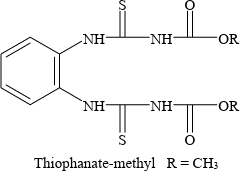
Thiophanate-methyl chemical’s approved common name for dimethyl 4,4-(o-phenylene) bis (3-thioallophanate) (IUPAC). Thiophanate-methyl is a systemically active benzimidazole fungicide that inhibits the synthesis of β tubulin (FAO, 1995). Thiophanate-methyl chemical structure was shown in Figure 1.
Some of the toxicity researches with thiophanate-methyl in mice, rats and dogs indicated the most sensitive organs were liver and thyroid. Thiophanate-methyl does not cause gene mutations; it causes changes in chromosome number in vitro and in vivo. (Marshall, 1997a). In animals administered thiophaneate-methyl, a significant decrease in the proportion of immature erythrocytes was observed in animals sampled after 24 hours, while a dose-dependent increase in the frequency of micronucleated immature erythrocytes was observed in other time applications. (Proudlock, 1999).
Barale et al. (1993) conducted an in vivo cytogenetic micronucleus test in mice and reported that a dose of 1000 mg/kg thiophanate-methyl had very little effect (1 polyploidy in 600 cells). Furthermore, a 2000 mg/kg dose of thiophanate-methyl was compared with the control group and caused a slight increase in micronucleated erythrocytes (Proudlock 1999). In rats, a 5000 mg/kg dose resulted in cytogenetic effects in bone marrow and spermatogonial cells. (Makita et al 1973). These results shows that thiophanate methyl has a low aneugenic potential and therefore, it is unlikely to be the cause of the in vivo cytogenetic presence.
The MTT assay is a widely used and reproducible test. The assay can also be used for floating cancer cells and is suitable for detecting cell replication and cell death (Mosmann 1983). In testing anti-proliferative drugs, both the Triticum assay and other proliferation assays have been observed to show the same effect. For this purpose, this study investigated the cytotoxic effect of fungicides at different concentrations on the root growth of wheat seeds (Komlodi-Pasztor et al 2012). Other plants have also been used as tools for screening toxicity, similar to Triticum. Plant tests are low-cost and correlate with other toxicity tests (Czerniawska-Kusza et al. 2006; Jitǎreanu et al. 2013; Radić et al. 2010).
In a short-term toxicity study conducted in accordance with US EPA test guidelines, groups consisting of four male and four female beagle dogs were administered gelatin capsules containing thiophanate-methyl at doses of 0, 50, 200, or 800 mg/kg body weight daily for 3 months. Due to severe toxicity, the final dose was reduced to 400 mg/kg body weight daily on day 50 of the test. One male at the highest dose was sacrificed on day 41 because of severe toxicity; one male at 50 mg/kg bw per day died on day 36, but this death did not appear to be related to treatment (Auletta, 1991).
Materials and methods
70% Thiophanate Methyl fungicide was purchuased from agricultural pesticide sales centers. Triticum test were carried out with Kate A1 Russian (obtained from Transitional Zone Agricultural Research Institute)wheat and different concentrations of the 70% Thiophanate Methyl fungicide (1250, 2500, 5000 and 10000 ppm), were used for the root and stem growth inhibition test.
Root and Stem Growth Inhibition Test (EC50 determination)
Various concentrations of the 70% Thiophanate Methyl (1250, 2500, 5000 and 10000 ppm), were used for the root and stem growth inhibition test. The wheats were grown in freshly made distilled water for 24 h and then exposed for 96 h to the control group and other concentrations of 70% Thiophanate Methyl. In order to determine efficient concentration (EC50) values, ten roots from each wheat were cut off at the end of the treatment period, and the root and stem’s length were measured. The concentration that decreased root growth about 50% when compared to the negative control group (distilled water), was accepted as EC50 value.
Mitotic index (MI) determination
Root tips were cut and fixed in ethanol:glacial acetic acid (3:1)end of the 72 h, then they were hydrolyzed in 1N HCl at 60ºC for 7 min. Roots from each dose treatment were stained with Feulgen dye for 1 h. Five slides were prepared for each concentration and 1000 cells/per slide were counted. 5000 cells were observed for each concentration. Example slide photos were given in Figure 2. In mitotic index (MI) determination, about 5000 cells were counted, and MI% was determined with the following formulation:

MI% = divided cell number/total cell number × 100
MTT Assay
This test was performed with MDBK cells (obtained from Sigma) according to Mosmann, (1983) and the test was repeated three times. Cells were incubated with different doses of fungicide. Then test materials were removed at the end of the incubation period. Cells were incubated with 5mg/ml MTT solution about 2 h in CO2 incubator. Then MTT dyes were removed and 100 µl DMSO was added to the wells. Plates were analysed by ELISA at 540 nm wavelength. Cell proliferation of control group was accepted “0” (Mosmann, 1983).
Results
In this study, the cytotoxic effect of thiophanate methyl fungicide was determined using Triticum and MTT tests. Both of these tests have been proven effective in determining cytotoxicity in previous studies, and it has been stated in the literature that these two tests yield mutually supportive results.
In this root mitotic index analysis study, 5000 cells were counted for the doses and it was observed that the tested concentrations of 1250, 2500, 5000 and 10000 ppm decreased mitotic activity. It was observed that the concentration of 10000 ppm decreases the mitotic index (11.02 ± 2.35 cm) the most. The highest recommended dose of the tested fungicide in the fight against agricultural pests is 1000 ppm and the EC50 value is determined as 5000 ppm according to the test results indicating that the cytotoxic effects of this fungicide will be limited, like previous studies. In MTT assay, toxic effects were observed at all concentrations and time applications of 70% Thiophanate Methyl fungicide. Dose and time dependent decreases in cell viability were observed. The results about root and stem growth inhibition test results with Triticum test of 70% Thiophanate methyl were shown in Table 1. In MTT assay, toxic effects were observed at all concentrations and time applications of 70% Thiophanate Methyl fungicide. Dose and time dependent decreases in cell viability were observed. MTT results were given in Figure 3.
| Dose | Stem length | Root mitotic index | Stem length |
|---|---|---|---|
| Control (dH2O) | 9.38±0.66 | 9.56±0.88 | 37.61±5.60 |
| 1250 ppm | 7.45±0.92 | 8.20±0.61 | 32.23±5.02 |
| 2500 ppm | 6.25±0.26* | 7.65±0.55* | 26.25±5.40* |
| 5000 ppm | 5.20±0.35* | 5.05±0.48* | 21.66±4.84* |
| 10.000 ppm | 2.75±0.41* | 3.95±0.25* | 11.02±2.35* |
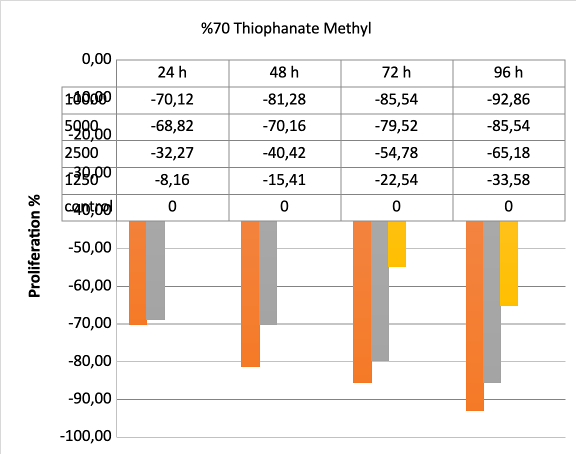
As a result these findings show that used fungicide has a cytotoxic effect on MDBK cells at the doses used. But our doses were higher than previous studies and these results suggested that doses above 1250 ppm may be cytotoxic. According to Triticum test, the EC50 value of the fungicide was found to be approximately 5000 ppm. Some doses of this fungicide used (2500, 5000 and 10000 ppm) were observed to inhibit root and stem growth. The highest recommended dose of the tested fungicide against agricultural pests is 1000 ppm and the EC50 value is determined as 5000 ppm, the cytotoxic activity of this fungicide may be limited at the doses required.
Discussion
The clastogenic potential of thiophanate-methyl has been demonstrated through both in vivo and in vitro tests; however, its gene mutation potential is weak in neither bacterial nor mammalian cells. There is no assumed threshold for the clastogenic properties of thiophanate-methyl; therefore, toxicological reference values (such as acceptable daily intake (ADI) in the diet and acute reference dose cannot be derived (Arena et al., 2018). In this study cytotoxic activity was studied and these results suggested that above 1250 ppm doses may be cytotoxic for MTT assay and 5000 ppm was found EC50 concentration for Triticum mitotic activity test.
When administered orally at a dose of 5000 mg/kg bw with 96.55% purity, thiophanate-methyl did not cause any signs of toxicity or mortality (Souma and Nishibe, 1990a). After acute inhalation of the compound with 95.3% purity at concentrations close to the LC50 (1.7–1.9 mg/liter), signs of toxicity included ataxia, decreased motor activity, tremors, and convulsions (Saika and Nishibe, 1987). No evidence of genotoxicity or mutagenicity has been found. But in this study some of the doses showed cytotoxic effects. The aneugenic potential of thiophanate-methyl was tested with mice administered an oral dose of 1000 mg/kg bw. Bone marrow cells were analyzed for micronuclei, chromosomal aberrations, hyperdiploidy, and polyploidy 16, 24, 36, and 48 hours after treatment. Large micronuclei were significantly induced, but the response was relatively weak. No increase was observed in the frequency of chromosomal aberrations. At 24 and 36 hours, a treatment-related increase was observed in the frequency of polyploid and hyperdiploid cells, which is of borderline significance given the very low frequency of changes in ploidy (Barale et al., 1993).
Chromosomal aberration study on CHO cells at 100, 200, 300, 400 ppm concentrations showed negative results with thiophanate-methyl (Murli ,1988). Reverse mutation assay with S. typhimurium TA98 TA100, TA1535, TA1537 strains at doses of 312.5, 625, 1250 ppm gave negative results (Kanaguchi and Nishibe, 1990).
Thiophanate methyl showed different risk results with various living organisms. Thiophanate methyl was found lethal toxic to zebrafish adult (12.1 ppm), juvenile (25.2 ppm), larvae (20.9 ppm) and embryo (12.1 ppm) forms (Wang et al., 2021). For thiofanate-methyl in beans and wheat, the acute risk to mammals is low; however, its use in grapes has been assessed as high (Arena et al., 2018). Although the type of organism and life forms used in the study differed, cytotoxic activity was detected at higher doses than those used in these studies. The selection of doses used in our study was based on the EC50 dose.
References
Arena Maria, Domenica Auteri, Stefania Barmaz, Giulia Bellisai, Alba Brancato, Daniela Brocca, Laszlo Bura, Harry Byers, Arianna Chiusolo, Daniele Court Marques, Federica Crivellente, Chloe De Lentdecker, Mark Egsmose, Zoltan Erdos, Gabriella Fait, Lucien Ferreira, Marina Goumenou, Luna Greco, Alessio Ippolito, Frederique Istace, Samira Jarrah, Dimitra Kardassi, Renata Leuschner, Christopher Lythgo, Jose Oriol Magrans, Paula Medina, Ileana Miron, Tunde Molnar, Alexandre Nougadere, Laura Padovani, Juan Manuel Parra Morte, Ragnor Pedersen, Hermine Reich, Angela Sacchi, Miguel Santos, Rositsa Serafimova, Rachel Sharp, Alois Stanek, Franz Streissl, Juergen Sturma, Csaba Szentes, Jose Tarazona, Andrea Terron, Anne Theobald, Benedicte Vagenende, Alessia Verani and Laura Villamar-Bouza (2018) Peer review of the pesticide risk assessment of the active substance thiophanate-methyl. Efsa Journal 16(1): 5133.
Auletta, C.S. (1991) A subchronic (3-month) oral toxicity study in the dog via capsule administration with thiophanate-methyl. Unpublished report No. RD-9119, project No. 89-3525 from Bio/dynamics Inc., East Millstone, New Jersey, USA. Submitted to WHO by Nippon Soda Co. Ltd, Tokyo, Japan.
Barale R, Scapoli C, Meli C, Casini D, Minunni M, Marrazzini A, Loprieno N, Barrai I. (1993) Cytogenetic effects of benzimidazoles in mouse bone marrow. Mutation Research 300: 15-28.
Czerniawska-Kusza I, Ciesielczuk T, Kusza G, Cichoń A (2006) Comparison of the Phytotoxkit microbiotest and chemical variables for toxicity evaluation of sediments. Environ Toxicol. 21: 367–372.
FAO, (1995) Specifıcations For Plant Protection Products Thiophanate-Methyl (Agp:Cp/331), Food And Agriculture Organization Of The United Nations Rome.
Jitǎreanu A, Pǎdureanu S, Tǎtǎrîngǎ G, Tuchilus GC, Stǎnescu U (2013) Evaluation of phytotoxic and mutagenic effects of some cinnamic acid derivatives using the Triticum test. Turk J Biol. 37: 748–756.
Kanaguchi, Y. and Nishibe, T. (1990) Thiophanate-methyl reverse mutation study on bacteria. Unpublished report No. RD-9065 from Nippon Soda Co. Ltd. Submitted to WHO by Nippon Soda Co. Ltd, Tokyo, Japan.
Komlodi-Pasztor E, Sackett DL, Fojo AT. (2012) Inhibitors targeting mitosis: Tales of how great drugs against a promising target were brought down by a flawed rationale. Clin Cancer Res. 18: 51–63.
Makita T, Hashimoto Y, Noguchi T (1973) Mutagenic, cytogenic and teratogenic studies on Thiophanate-methyl. Tox. Applied. Pharmacol. 24: 206-215.
Marshall R (1997a) Thiophanate-methyl technical: Induction of micronuclei in cultured human peripheral blood lymphocytes. Corning Hazelton, New Yorkshire, England. Report number: 68/151-1052. Report date: February 1997.
Murli, H. (1988) Mutagenicity test on Topsin M technical (thiophanate- methyl) in an in-vitro cytogenetic assay measuring chromosomal aberration frequencies in Chinese hamster ovary (CHO) cells. Unpublished report HLA Study No 10345-0-437 (RD-9120) from Hazleton Laboratories America, Inc. Submitted to WHO by Nippon Soda Co. Ltd, Tokyo, Japan.
Proudlock, R.J. (1999) Thiophanate-methyl mouse micronucleus test. Unpublished report No. NOD 024/983714 from Huntingdon Life Sciences Ltd., Huntingdon, Cambridgeshire, England. Submitted to WHO by Nippon Soda Co., Ltd. Tokyo, Japan.
Radić S, Stipaničev D, Vujcić V, Rajcić MM, Širac S, Pevalek-Kozlina B (2010) The evaluation of surface and wastewater genotoxicity using the Allium cepa test. Sci Total Environ. 408: 1228–1233.
Saike, O. and Nishibe, T. (1987) Thiophanate-methyl: Acute inhalation toxicity study in rats. Unpublished report No. 0219 from Nisso Institute for Life Sciences, Kanagawa, Japan. Submitted to WHO by Nippon Soda Co. Ltd, Tokyo, Japan.
Souma, S. and Nishibe, T. (1990a) Thiophanate-methyl acute oral toxicity study in rats. Unpublished report No. RD-9083 from Nisso Institute for Life Sciences, Kanagawa, Japan. Submitted to WHO byNippon Soda Co. Ltd, Tokyo, Japan.
Wang Y, Lu L, Xu C, Wang D, Yang G, Wang X, Weng H and Wang Q (2021) Mixture toxicity of thiophanate-methyl and fenvalerate to embryonic zebrafish (Danio rerio) and its underlying mechanism. Sci Total Environ. 756: 143754.