https://doi.org/10.36253/rifp-4463
Il tema
Planetary Madness: Globalizing the Ship of Fools
Follia planetaria: globalizzare la nave dei folli
University of Chicago, USA
Abstract. Starting from the analysis of the anonymous nineteenth-century lithograph of an anarchic dockworker astride the globe as a key for rethinking Allan Sekula’s Ship of Fools / The Docker’s Museum, the essay proposes an unfinished visual theory of planetary madness. Read not as a marginal illustration but as the latent ‘archon’ of Sekula’s archive, the image condenses the essay’s central claim: the classical allegory of the Ship of Fools, once tied to the crisis of the state and the irrationality of sovereignty, must now be globalized and relocated within maritime space, where the material infrastructures of trade, labor, risk, and circulation make visible the contemporary world-system.
Keywords: madness, sovereignty, sea, planet, atlas.
Riassunto. A partire dall’analisi della litografia anonima del XIX secolo raffigurante un lavoratore portuale a cavallo del globo, l’articolo propone di ripensare la Ship of Fools / The Docker’s Museum di Allan Sekula, come una teoria visuale incompiuta della follia planetaria. Letta non come un’illustrazione marginale ma come l’‘archè’ latente dell’archivio di Sekula, l’immagine condensa la tesi centrale del saggio: l’allegoria classica della Nave dei folli, un tempo legata alla crisi dello Stato e all’irrazionalità della sovranità, deve ora essere globalizzata e ricollocata nello spazio marittimo, dove le infrastrutture materiali del commercio, del lavoro, del rischio e della circolazione rendono visibile il sistema-mondo contemporaneo.
Parole chiave: follia, sovranità, mare, pianeta, atlante.
Contents
Conclusion: Back to Allan Sekula.
Where bodies are buried in secret there must also be a buried archive…waiting for resurrection. An archive, but not an atlas; the point here is not to take the world upon one’s shoulder, but to crouch down to the earth and dig.
Allan Sekula
In the destructive element immerse.
Joseph Conrad, Lord Jim
We are like sailors who have to rebuild their ship on the open sea, without ever being able to dismantle it in dry-dock and reconstruct it from its best components.
Otto Neurath
The theme of the end of the world, and of the great final violence, was also a part of the critical experience of madness…
Michel Foucault, History of Madness, 25
My attempt to ‘see through madness’ has evolved as a series of ever-larger concentric circles, from the ‘up close and personal’ accounts of a singular cases of schizophrenia, to the crazy historical period in which this book was written, to the larger world of the arts and media, to an atlas of the world’s images.1 But today it looks as if a ‘planetary madness’ is afflicting the world. Reactionary nationalism, authoritarianism, and racism are on the march, and the world’s most powerful democracy has elected a lunatic and con man to be its president. It is not the first time that a mad sovereign has assumed tyrannical powers. From the Biblical Nebuchadnezzar to King George III to Hitler, the emergence of terrifying authoritarian regimes has punctuated epochs in human history. And democracies, as Palto foresaw, are especially vulnerable to the rise of maniacal despots. Plato’s famous metaphor of the Ship of fools captures perfectly the way populist irrationality can lead the ship of State, steered by an incompetent, corrupt, and deranged captain, into a catastrophic shipwreck.
But our time is different. We are no longer in a world where disastrous wars, destruction of the environment, and the immiseration of vast populations can be confined within national borders. In an age of global climate change and a deeply dysfunctional global economy of deregulated capitalism, the risks have taken on a planetary scale. The Ship of fools is no longer a metaphor for the rogue state. It now applies to the planet, inhabited by a species that fits the legal criterion for insanity, namely, that it is a danger to itself and others.
If the Ship of fools is now a planetary vessel, then the earth can no longer be seen as an island in space. As the etymology of the word ‘planet’ (an errant wanderer – OED)2 indicates, we now have to catch up with the intuition of Walt Disney’s Epcot Center, and imagine ourselves realistically as ‘spaceship earth,’ a Noah’s Ark that may not have any harbor waiting for it.
But exactly what kind of spaceship do we inhabit? Bruno Latour3 has provided an image of the most urgent way of thinking about this question. He compares the contemporary world to an enormous passenger plane that is running low on fuel. The pilots announce that the long-standing destination of human progress – modernity, modernization, and ‘the global’ – has just been closed off by the simple fact that the planet cannot possibly sustain modern development as presently envisaged. We would need anywhere from ‘2 to 5 virtual planets’ to accommodate the 8 billion people who will inhabit this orb in the predictable future. Globalization, as an economic and ecological program, has become obsolete.
The passengers on Latour’s airplane are understandably concerned. Some of them even stop sipping their whiskeys and begin looking at alternative destinations. The most popular at this point is nationalism, the populist, reactionary answer. Let’s go back to ‘where we came from,’ to our ‘own country,’ our nation and our kind of people. Let’s return to the Homeland, or just ‘the Land,’ whether it is called Fortress America or Little England. Certainly, it is not Europe, or any of the global destinations. And most certainly it involves a closing of borders to immigrants, foreigners, aliens, refugees, and outsiders. The passengers tell the pilot, well let’s go back, then. Let’s go home. Let’s make America, or Russia, or France ‘great again’.
The pilots, however, have bad news. The Homeland is no longer reachable either; the borders have already been long since breached, and the spaces promised by neo-nationalists “offer a space much too small for us.” The only answer is to ‘triangulate’, to imagine a third destination – Latour4 calls it “Gaia” or “the Earth” – the actual physical ecosystem in which the species has to come to ground, or risk crashing and burning.
Latour’s choice of Earth is, I think, to be taken both literally and metaphorically: literally as the limited amount of solid ground for feeding and housing an out of control population; metaphorically as a figure for ecological balance and harmony, the kind of thing envisioned back in the 1960s by the Whole Earth Catalog. But there is a fourth possibility that he does not consider, and that is the sea, which covers two thirds of the planet. This is an element that must surely be considered in both its literal and metaphoric terms as well. We need to remember that every plane flight begins with safety instructions that include a short lesson on what to do ‘in case of a water landing’. For one thing, climate change is already producing a rise in sea levels, so the proportion of the planet comprised of dry land is going to shrink.5 The sea is also where all of the planet’s life-forms originated, and a major source of its nutrition. It is, despite the dominance of hyper-modern modes of communication and transportation, air travel and the internet, the medium in which most of the world’s material commerce is carried on. Speculative finance capital may operate at the blinding speed of computers, but physical commodities still circulate around the world at about the same speed that they did in the late 19th century era of the steamship. I am invoking here the striking conclusion of the late Allan Sekula’s photo essay, Fish Story, in which he makes the following point:
My argument here runs against the commonly held view that the computer and telecommunications are the sole engines of the third industrial revolution. In effect, I am arguing for the continued importance of maritime space in order to counter the exaggerated importance attached to that largely metaphysical construct, ‘cyberspace,’ and the corollary myth of ‘instantaneous’ contact between distant spaces. I am often struck by the ignorance of intellectuals in this respect: the self-congratulating conceptual aggrandizement of ‘information’ frequently is accompanied by peculiar erroneous beliefs: among these is the widely held quasi-anthropomorphic notion that most of the world’s cargo travels as people do, by air.6
I want to take Sekula’s irrefutable argument as a launching point for a reconsideration of the ship at sea rather than the airship or airplane as the appropriate metaphor for re-imagining our earthly habitat, and the sea as the inevitable image of the element in which that ship lives and moves and has its being.7 Sekula’s last unfinished project, The Docker’s Museum, already points toward that heading. And it does so with particular emphasis on the question of collective and individual madness as the psychological and political framework within which a critical account of our planetary insanity has to be re-framed. I should say, however, that I don’t think this was exactly the direction that Allan himself was heading. He was a hard-headed Marxist materialist, and as an artist-photographer committed to documenting the material conditions of labor. His treatment of madness, or more precisely, folly, was basically pitched toward ideologies such as the metaphysics of cyberspace that he skewers in the passage just quoted, and in the neoliberal processes of globalization that have turned our attention away from maritime space while planting the seeds of destruction for human life on this planet.
My aim here is to emphasize the question of folly and madness, both in the global system that Sekula criticized, and in the heroic, even Herculean effort he waged to bring it all into focus. Like Aby Warburg, Sekula was obsessed with Hercules as the hero of labor, especially of physical and material labor and the defeat of monsters who threaten humanity.
His installation at Documenta 12 in 2007 explicitly referenced the twelve labors of Hercules, especially the cleansing of the Augean stables. Among these is the task of taking the world on his shoulders to relieve Atlas of his burden while the Titan fetches the Apples of the Hesperides. The Docker’s Museum complements Sekula’s photographic documentation of maritime laborers (Ship of Fools) with a vast array of material objects collected from around the globe.
The Docker’s Museum includes postcards, figurines, toys, posters, tools, a ship’s siren, a fan, a soccer ball autographed by Pelé, a Herculean club, a model of the human spine, an antique child’s crutch, various medals, tiny carvings, miscellaneous souvenirs, and the packing boxes in which they were shipped back to Los Angeles. Sekula stressed that these items are not to be seen as ‘found objects’ like Duchamp’s Fountain, nor could they be assimilated to a single coherent program like Marcel Broodthaers’ Department of Eagles (1968), or the artistic collections of Gerhard Richter. None are valuable works of art. They are more like mementos of a life at sea, shipped from ports all over the planet. Sekula described them as “a kind of cargo, or [. . .] a cargo cult, my own private cargo cult.”8 I want to take seriously the remarks of Sekula’s widow, photo historian Sally Stein, who saw the wild miscellany of objects in Allan’s Docker’s Museum “as a private archive […] in all the madness of that collecting enterprise” that Walter Benjamin described: “Every passion borders on the chaotic, but the collector’s passion borders on the chaos of memories.”9 Stein goes one step further to suggest that Allan was risking ‘immersion’ in ‘a sinkhole of money spent on a folly’. He was in the grip of a ‘mad materialism’ that pre-dated the onset of his fatal illness in 2011. Benjamin’s hope that a legible ‘constellation’ would emerge from the collector’s chaotic passion has yet to happen with Sekula’s last project. There is no guarantee that it ever will, and certainly I will not be able to provide one.10 We are like Walter Benjamin’s “revolutionary spy or detective”11 contemplating a wall of evidence, a forensic atlas that is either reducible to something like the material conditions of narrative as such, the ‘ball of string’, the yarn that connects all the images and objects, or a subjective complex that may turn any perceived order in the array into a case of apophenia, the psychiatric syndrome in which one projects patterns into an array of clues that are not visible to anyone else.
Certainly, Allan Sekula would not be the first to succumb to the collector’s passion, especially when it seems that the fate of the world somehow hangs in the balance. As we have seen, the founder of modern art history, Aby Warburg, attempted a similar thing with images rather than objects, by creating a Bilderatlas that would place in a totalizing perspective all the graphic representations of the human species’ expressions of passion, the pathosformel that were to complete Darwin’s program of cataloging the expressions of emotions in animals and man. Warburg’s project occupied a border zone between madness and rationality, folly and encyclopedic knowledge. His earlier project of attempting to compile an atlas of all the images and texts associated with the nightmare of history known as the Great War finally came to nothing. The residue of that project now resides in unsorted archives of the Warburg Institute in London, still waiting after almost a century the archivist who might be able to see the patterns that Warburg was seeking. Within weeks of the end of World War One, Warburg experienced a psychotic break in which he attempted to murder his own family. Like Hercules, the mythological hero who attempts to civilize the known world, killing monsters and even taking the world on his shoulders while Atlas runs an errand for him, Warburg was broken by the enormity of the task he had undertaken. When Warburg emerged from the asylum where he was confined for four years, he took up the project of the Bilderatlas with a passion. Fortunately for us, he survived long enough to serve as the ‘archon’ or authoritative master of the archive fever he was experiencing.12
Not that he regarded the Bilderatlas as the cure for anything. Warburg declared himself ‘incurable’, a revenant or phantom. And he regarded himself in that sense as a representative man, since in his view “all mankind is everywhere and eternally schizophrenic.” Warburg glimpsed the “planetary madness” that was being unveiled in his research, and in himself. Allow me to quote R. D. Laing’s portrait of rare and gifted “schizophrenic seafarers:”
Perhaps we will learn to accord to so-called schizophrenics who have come back to us, perhaps after years, no less respect than the often no less lost explorers of the Renaissance. If the human race survives, future men will, I suspect, look back on our enlightened epoch as a veritable Age of Darkness.13
Laing is not romanticizing schizophrenia here. He knows very well that it is a malady that produces extreme suffering in its victims. He is speaking of the lucky ones “who have come back to us,” the rare souls that are able to work and create some reflection on their condition.14 Like Coleridge’s Ancient Mariner, some seafarers return as ‘loons’ from the sea with a terrifying story of madness calculated to hypnotize the listener, and to make her reflect on her own condition. The sea is, of course, the image of madness par excellence. Chaotic, ever-changing, in contrast to terra firma, the ‘down to earth’ grounds and stable foundations of thought. The boring, vast emptiness of the sea is an invitation to madness; since the 18th century it has been well established that seafaring is one of the professions most conducive to mental illness.15 To be all at sea is to be confused, disoriented, overwhelmed, as Sally Stein found herself, confronted with Allan’s enormous, unreadable archive. If the Bilderatlas was Warburg’s ‘art history without a text’, Sekula’s Docker’s Museum is an archive without an archon. It is up to us to make sense of it. I want to come at it via a maritime image that Allan did not collect, namely an interesting 19th century French print of the mariner/dockworker astride the globe, that was collected by Sally Stein and hung in a tableau on the stairs at their home (fig. 1). I am particularly interested in this one because of Allan’s curious behavior around it. He was, Sally tells us, completely indifferent to it. And yet in her eyes, it was precisely a portrait of Allan himself:
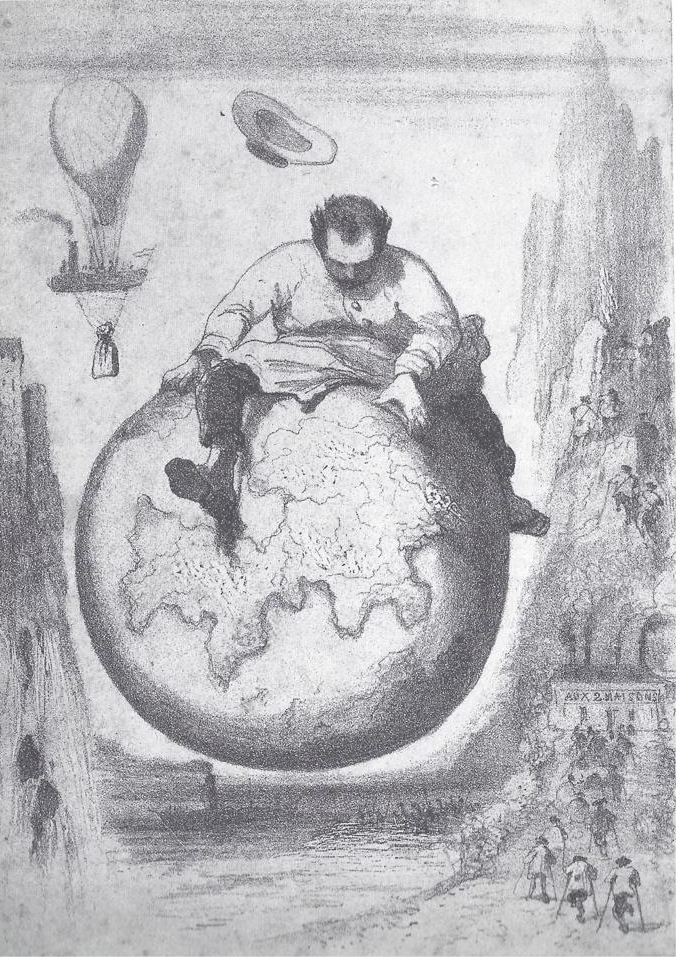
To my surprise, this nineteenth century French lithograph did not produce much reaction, let alone self-recognition – despite the centrality of a stocky smocked worker (with a markedly receding hairline similar to Allan’s) who studies the globe while perched atop it. He simply ignored this one image I considered so emblematic of his insatiable quest to encompass the world and fathom its linked systems of politics, production, and communication.16
I don’t think this is a case of ‘Dorian Sekula’, the shameful repression of one’s own revelatory portrait. In fact, it seems to me just the opposite, revealing instead an image of a certain political ego ideal, a fantasy of the global working class as the vanguard of world revolution. Instead of holding up the world as a Herculean burden, the anarchist dockworker is riding on top of the world. Could it have been just a bit embarrassing in its explicit reminder of Allan’s own attachment to the lost world of maritime space during the industrial revolution, the age of the IWW and international workers solidarity? In today’s maritime space, the disastrous underbelly of Leviathan is hidden from view, as national flags are rented out by multi-national corporations to evade regulations, with disastrous consequences. Allan was constructing his ‘archive from below’, in the otherwise invisible spaces of the everyday in contemporary maritime space.
The Atlas-like dockworker astride the world might have been a bit too grandiose for Allan’s temperament. I do think he should have looked longer at this picture, where he could have seen in it a compelling portrait of his own paradoxical task. For it is undeniable that he was trying to ‘take it all in’, to mount the planet and recollect ‘everything’.17 He had seen the planetary madness, and now he had caught it, and was riding it like a runaway horse. The French worker is not securely positioned above the globe in the position of an unmoved mover or detached surveyor. He seems to be rolling atop it, and could be tossed off any moment, as indicated by the way his hat is flying off. His left hand is spread out in a measuring gesture, as if he is estimating distances, while his right-hand grips the edge of the world to keep him from falling off (fig. 2).
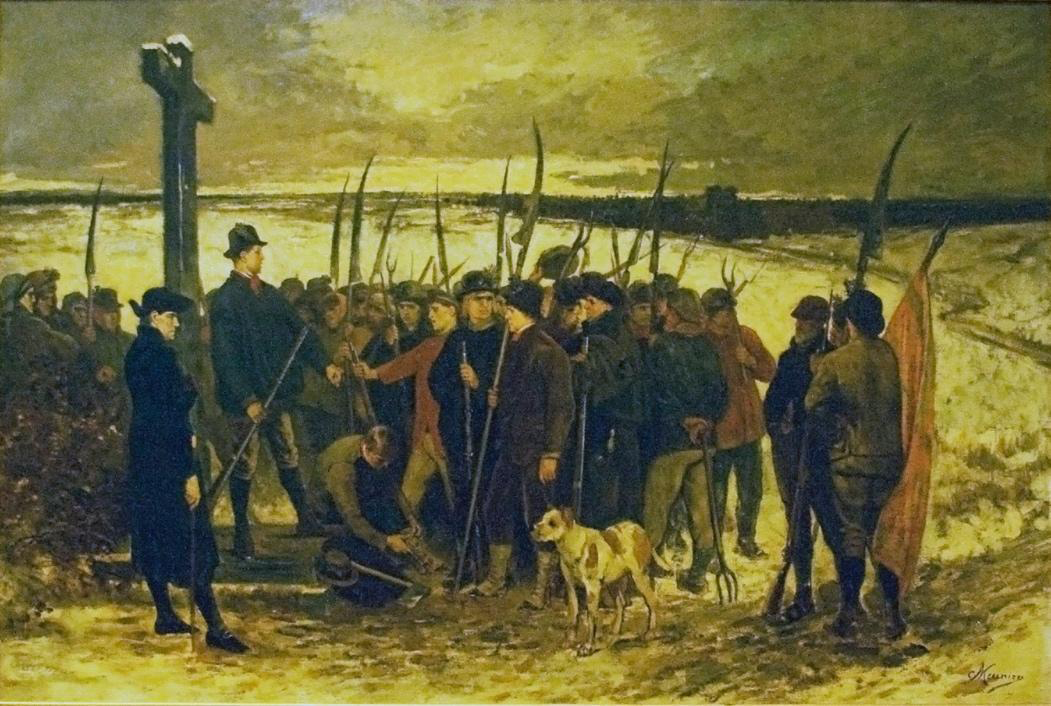
Sekula’s globe is advancing into a perilous fjord, a chasm between two steep cliffs, perhaps an echo of the ‘pillars of Hercules’, erected by the hero to hold up the sky. The left side is surmounted by a castle, the other with a procession of crippled workers marching uphill to a smoking factory called “Aux 2 Maison.” Above on the right, mountain climbers are clambering up the rock face, perhaps to join their globe-riding comrade, while on the left, three ghostly figures ascend the rock face toward the medieval castle at the top, perhaps echoing the theme of ascent to the heavenly city. Out in the harbor the vague outline of a steamship is on the horizon, and a body of men seems to be advancing down the beach brandishing pikes (fig. 3), perhaps an echo of Constantin Meunier’s monumental sculptures of 19th century workers which were a crucial inspiration for Sekula’s project; a portrait of the great Belgian realist is included in The Docker’s Museum (fig. 4).
And in the sky in the background, the new mode of planetary transport hovers a hot air balloon, anchored by a sandbag, Carrying, not the expected gondola, but a steamship (fig. 5).
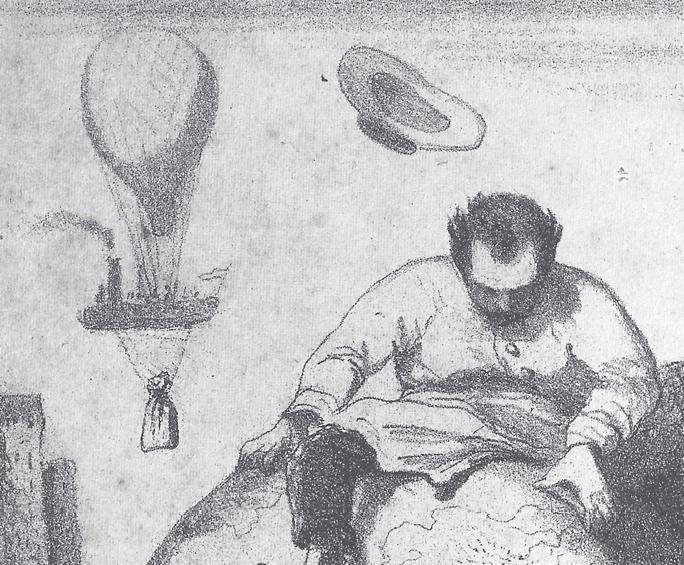
The airship is the ironic punctum complicating Allan’s project of an “Atlas from below.” Cyberspace and air freight are the communication and transportation media that made his Docker’s Museum collection possible. In the long, boring stretches of seafaring, Allan spent a lot of time ordering ‘objects of interest’ on eBay. Cyberspace was taking over his work as a hunter-gatherer of images and objects, leaving behind an amazing variety of objects, from crutches to a soccer ball signed by Pelé, the closest thing I can find in the The Docker’s Museum to a globe. I hope that future curators will not be parsimonious about displaying these objects; they should definitely not be treated as auratic singularities. I would try instead to show their abundance and fecundity; and overwhelm the beholder the way Sally was overwhelmed. Keep some of them in packing crates, unopened. There is no need for an exhibition of these objects to look orderly. My sense is that he was trying to bring these things together with the images to produce a kind of exhibitionary archive from below, perhaps a submarine space ‘below decks’, an ark of the history of maritime space. In a sense, then, the anonymous 19th century French print plays the role of archon for this archive, showing the worker as a young global knight errant astride his planetary steed. This image builds upon a whole genealogy of planetary, global iconography. And here I have to confess that I have come down with a serious case of the planetary madness that afflicted Allan Sekula, and found myself compiling a boundless archive of ‘world pictures’ that link images of the globe to seafaring, fortune, risk, and work, from the onset of early modern maritime space until the present day. My condition is not nearly as serious as that of Peter Sloterdijk, whose meditation on the philosophical status of the sphere (from bubbles to globes to foams) now occupies three capacious volumes.18 The following, then, should be taken as a provisional Bilderatlas of planetary madness that is purely speculative and improvisatory. Somehow this seems like the right place to take this risk.
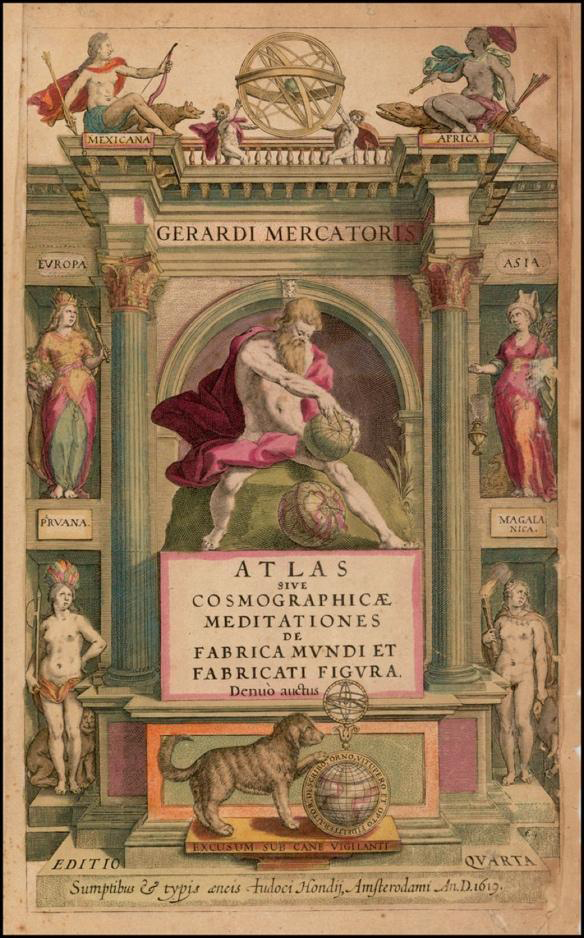
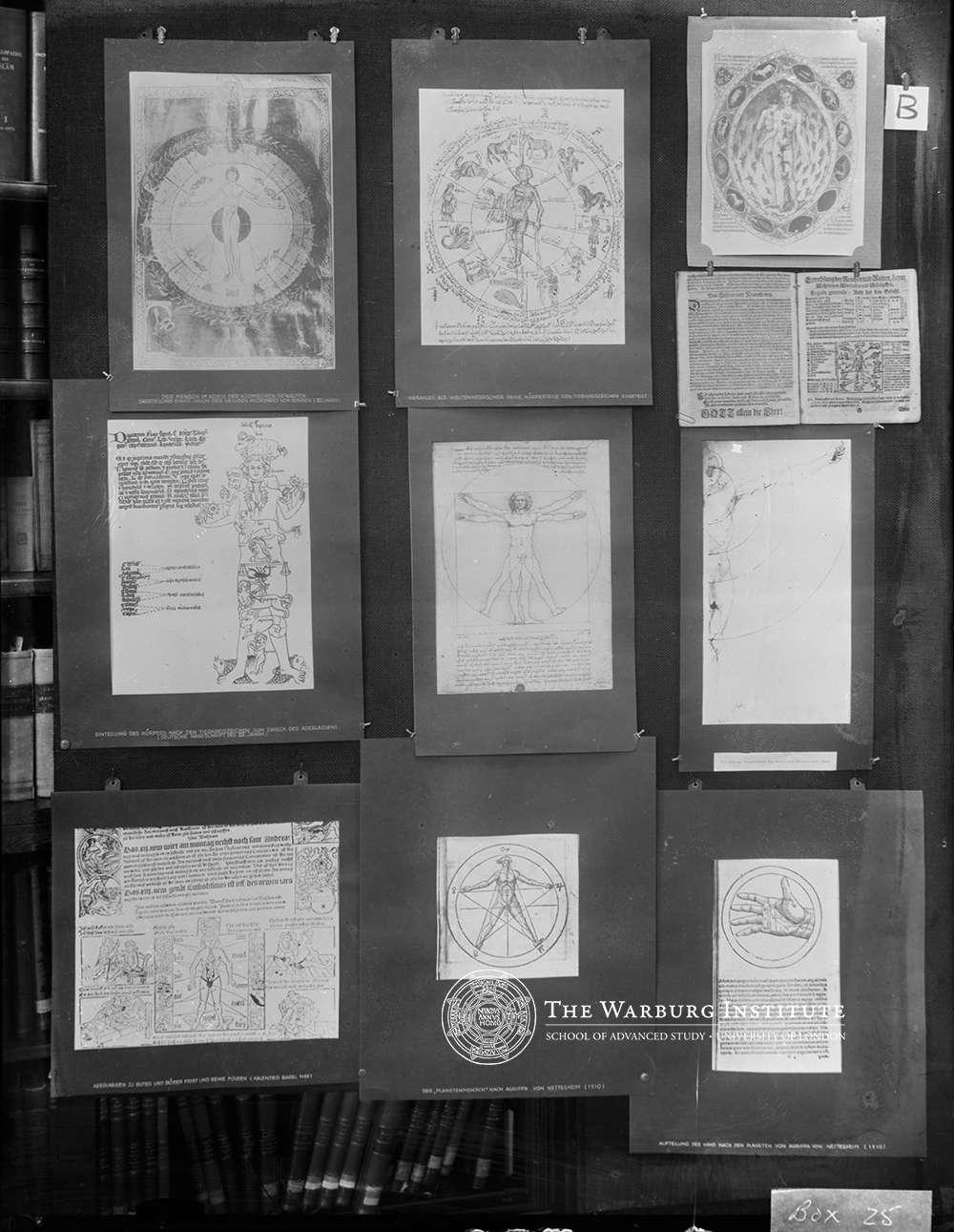
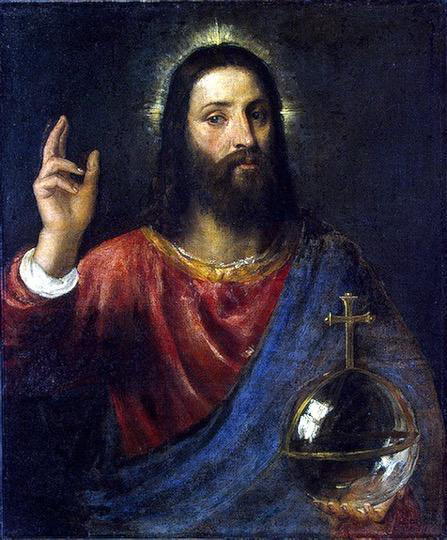
We could begin with Warburg himself, and with “Panel B,” (fig. 6) his ‘panel of panels’, a cosmological tableau linking the early modern seafaring discovery that ‘the world is round’, with the ancient belief that ‘man is the measure’ of that circumference, his body a microcosm of the macrocosm, ruled by the same elementary humours, earth, air, water, and fire.19 Leonardo’s Vitruvian man might be exhibit A, along with Hildegaard von Bingen’s and Blake’s Albion Rising. Portrayals of the planet as a kind of “hand-held device” in the firm grasp of Christ as salvator mundi, the savior of a planet bound together by Christian imperialism might serve as exhibit B (fig. 7).20
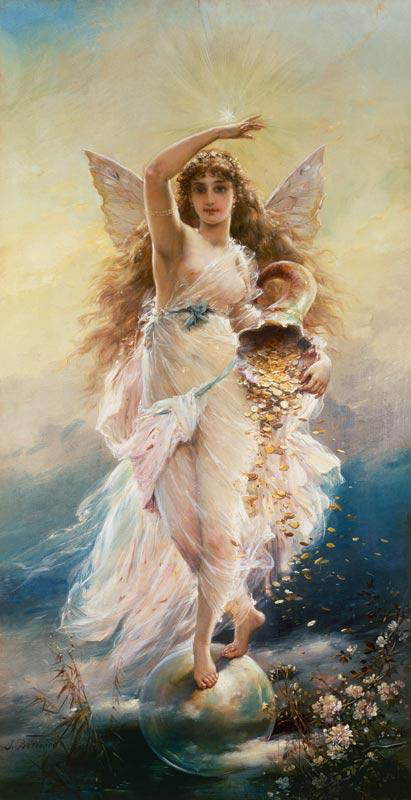
But, aside from Atlas, it is arguably the figure of the Roman goddess Fortuna that is the most apt predecessor for the thoroughly secular world in the French print. Fortuna is frequently portrayed as the goddess of the lucrative but risky world of maritime commerce. She is often shown standing precariously on the globe, buffeted by winds which she catches in her shawl, as if she were herself a sailing ship.
In her positive appearance as “Felicitas” and riches she pours forth an abundance of gold coins, as in Jean Francois Bernard’s (1829-1894). Goddess of Luck and Risk, she is the keeper of our destiny and the guiding power behind all fortunate and unfortunate turns of events (fig. 8).
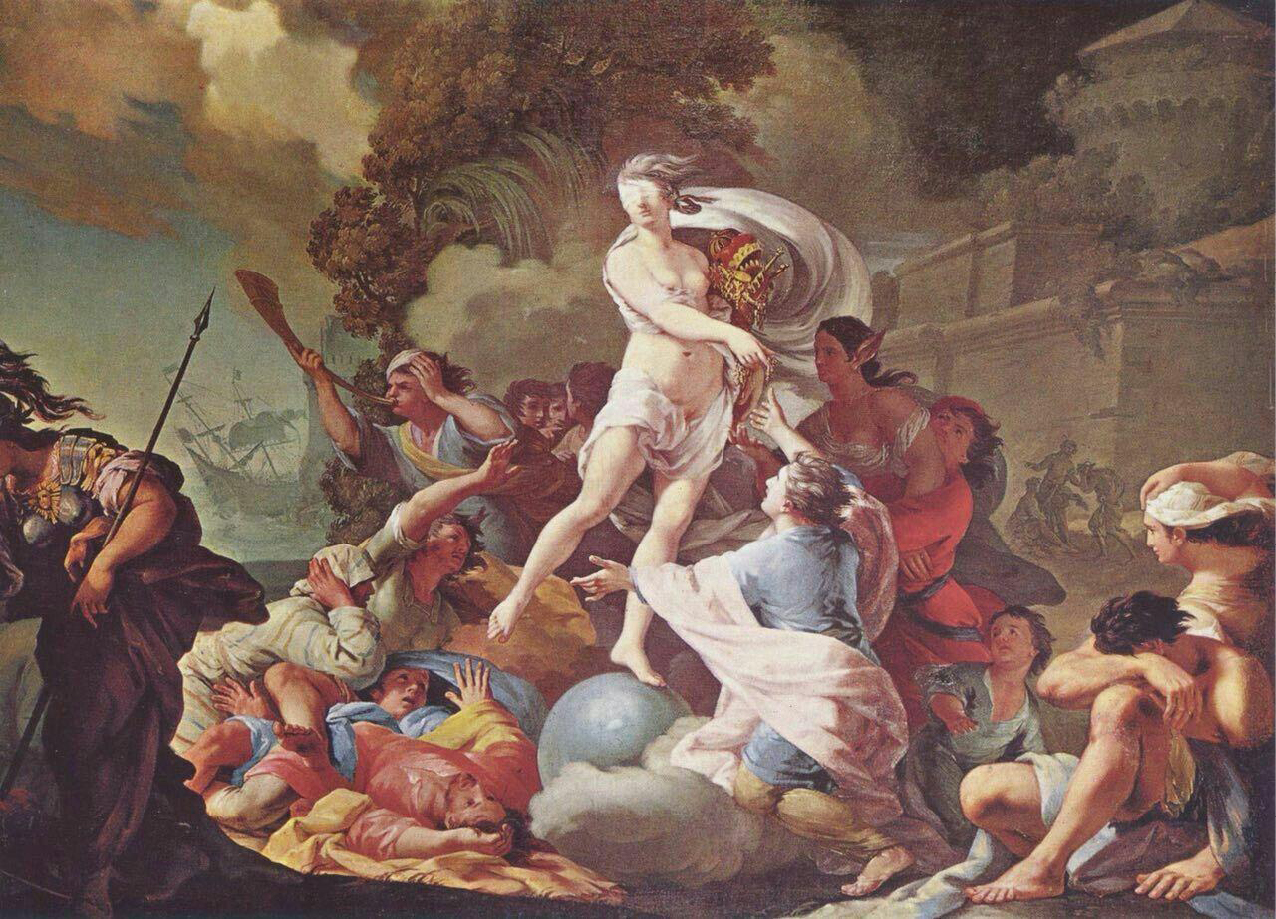
In Fortuna’s negative role as Tyche or Nemesis (fig. 9), she is a blind goddess who personifies chance, risk, and the ever-present possibility of disaster so central to the world of global commerce conducted in maritime space. Here she is seen standing on the globe, oblivious to the catastrophe unfolding at her feet, and the useless appeals of petitioners atop the heap of human bodies. In the background, the citadel seems to be going up in flames, the figure of Victory is mourning defeat at the left, and in the distance, we see a ship buffeted by storms. That is why Fortuna is so often associated with the sea or stands on a globe between the images of a sailing ship and a church, rather like the Ancient Mariner returning to his ‘home countree’.
One of the most interesting troves of ‘globalizing’ or ‘planetary’ images is to be found in a relatively little known Bilderbuch by the German artist, Andreas Friedrich, the Emblemata Nova of 1617.21 Published in the period of the first great voyages, Friedrich’s engravings depict the globe in ways that I think Allan Sekula would have found deeply resonant with his Ship of Fools understood as a planetary project. Perhaps most congenial to Sekula’s vision would have been this emblem of the globe as itself the cargo on a ship that is being rowed by the devil (fig. 10).
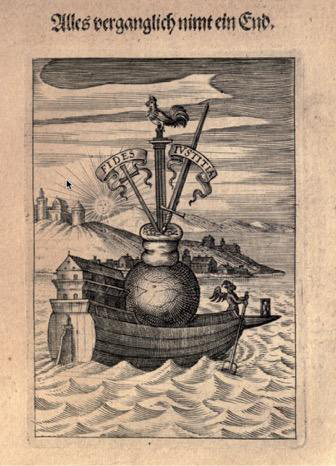
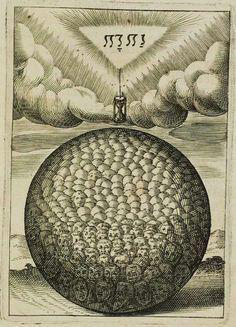
Instead of Fortuna, we find a literal ‘fortune’ atop the globe, in which the symbols of Faith and Justice have been planted. Atop the central pedestal is the Cock who crows the impending dawn of a Divine Providence that will replace the reign of money. The hour-glass on the bowsprit tells the devil that although he is in control at the moment, his time is running out. It is as if the Ship of fools has been globalized, as if all the world’s inhabitants are ‘in the same boat’, an idea that is made explicit in a subsequent emblem of the world as itself a kind of Leviathan comprised of the human multitudes22 (fig. 11).
Friedrich’s sardonic vision of a world driven by money is made most explicit in this image of the Christian imperial globus cruciger resting atop a bag of money, as the prize in a tug of war between the Devil and the Fool (fig. 12).
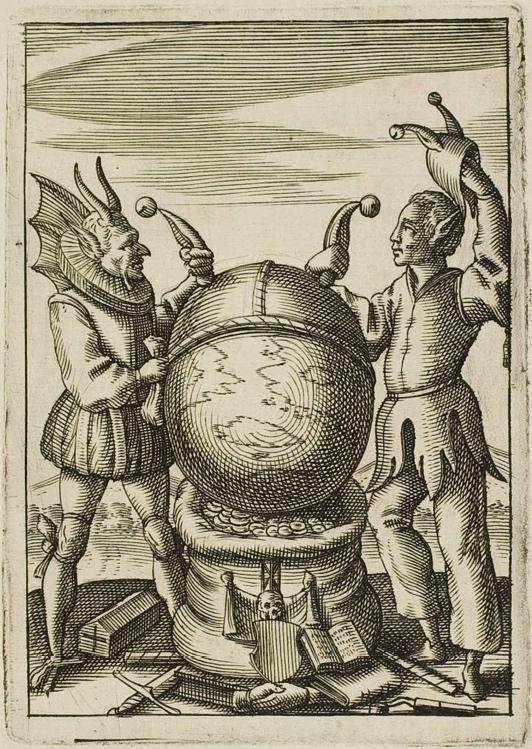
A blank heraldic shield is topped by a death’s head that supports the familiar hour-glass, and beneath the money bag are strewn various objects of interest: a casket with crucifix, a pair of staves, a sword and what might be the notorious torture instrument known as a cat of nine tails. At the bottom center are a pair of dismembered hands, locked in a handshake which I cannot resist reading as an emblem of the ‘art of the deal’. This bleak vision is reinforced by the next emblem, which portrays the world under the sovereignty of the devil, on an altar attended by a pair of burghers, one of whom is drinking to excess, flanked by figures of the Seven Deadly Sins.
What about the great masses of workers who hold up the world? They are shown in this emblem (fig. 13) like a crowd of Sekula’s dockworkers, anchoring the planet, staggering under its weight, and gesturing for relief.
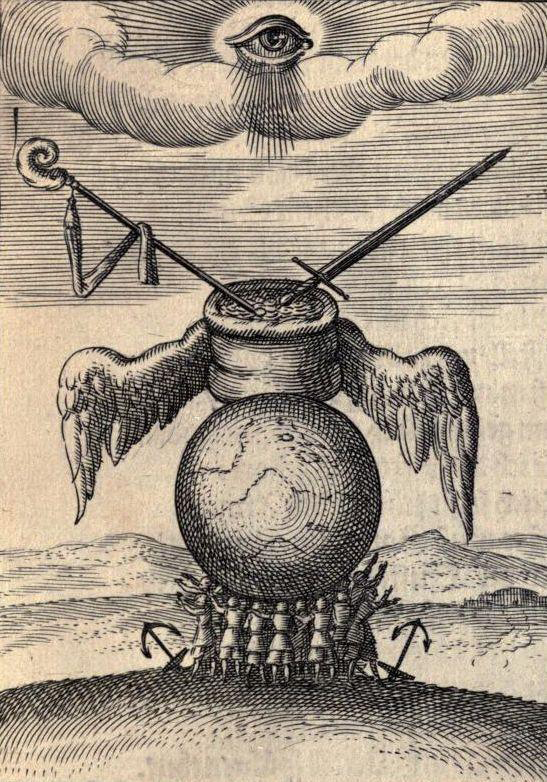
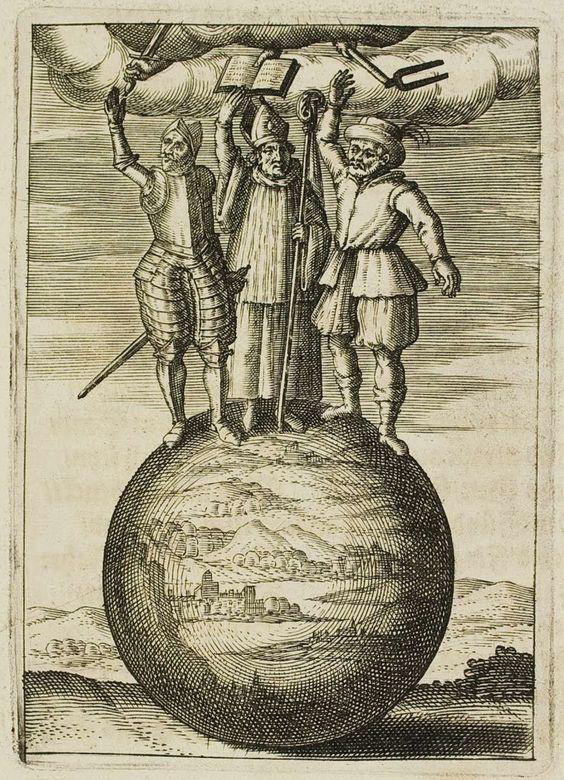
But the world they support with their labor is itself weighed down once again by the winged curse of money, which serves as the potting soil for a shepherd’s crook and a sword, the emblems of Religion and War. This is about as close as Friedrich comes to hinting at an impious message, relieved only by the all-seeing eye of God above, who presumably will set things right. If the masses of proletarian and peasant labor hold up the world in Friedrich’s planetary emblem, the figures of the dominant classes are shown in the following image where the soldier, the priest, and (probably) the farmer are shown receiving the instruments of their professions from on high (fig. 14).
One year after Emblemata Novus, Michael Maier’s Atalanta Fugiens appeared, featuring the following image (fig. 15).
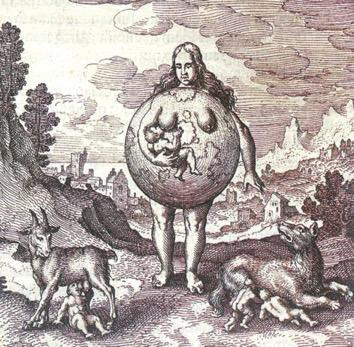
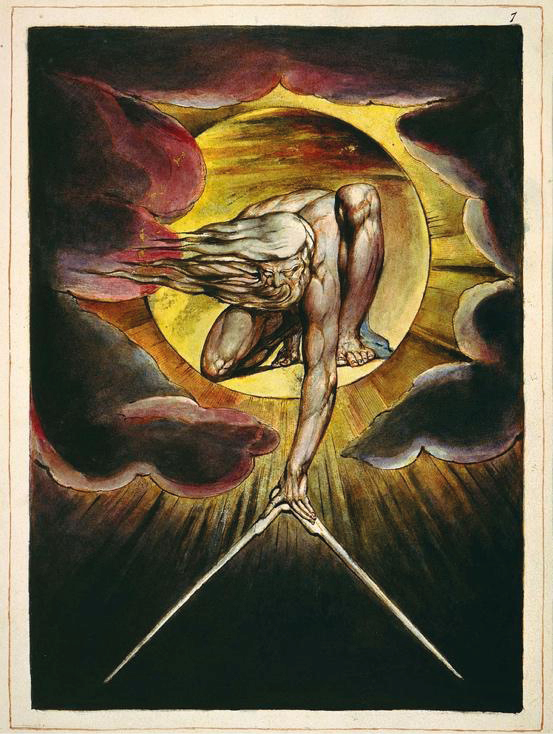
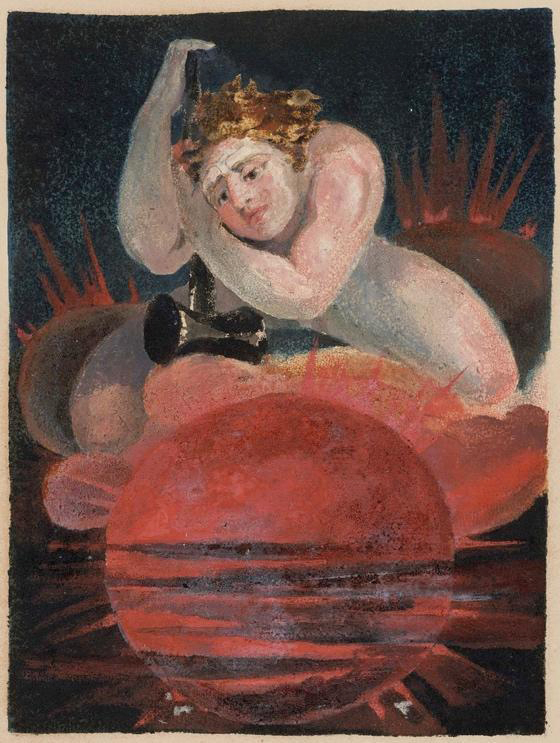
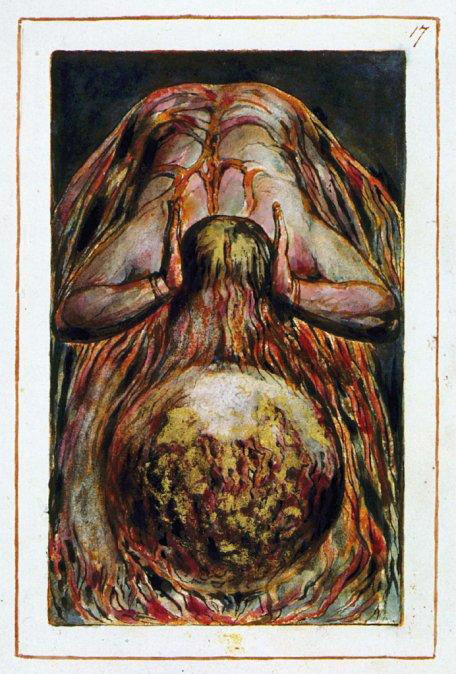
Instead of the earth as a globe dominated or upheld by men, or ridden by the fickle goddess of Fortune, she appears as what Bruno Latour calls Gaia, the Mother Earth who is the source of all the life-forms that we know. Peter Sloterdijk reads this as an emblem of Catholic Mariolatry, which places the mother at the center, only to render her subordinate to the divine child that she is nursing.23 I read this quite differently, as Destination Earth, the goal of human flourishing that has overcome both the false destinations of the national homeland and the abstract figure of a globalizing process driven by folly and vice, the madness and greed of neoliberalism. Probably I am being anachronistic in a reading that tries to bring us ‘down to earth’; but so is the image. It launches me forward to the period of the French Revolution when William Blake provided his own images of the global imaginary in the form of three figures. Instead of the trio of Warrior, Priest, and Farmer, Blake gives us three planetary deities: the rational Newtonian mathematician who measures the world as a geometric abstraction (fig. 16); the artisan blacksmith, who creates the world out of material labor (fig. 17); and his own version of the Terra nutrix, a maternal goddess who is giving birth to a world that is still in its embryonic form, the placenta still attached to the mother (fig. 18).
Conclusion: Back to Allan Sekula.
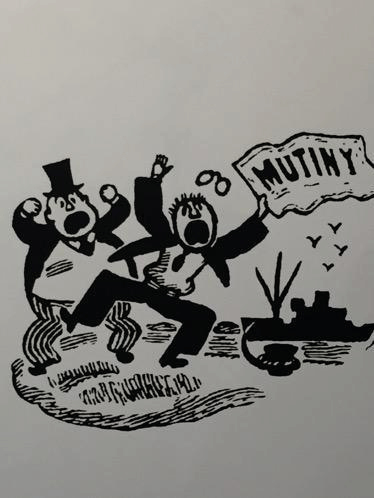
I have tried to envelope Allan Sekula’s ‘atlas from below’, within a complementary archive launched by reflections on Sally Stein’s portrait of the artist as a worker of the world. Sometimes these workers appear as Herculean figures or burdened masses lifting the world on their shoulders; more often, they seem to be ordinary folks – a drunken pilot, a cleaning woman, a coal miner – or ordinary objects: a soccer ball, a crutch, a wrench. At all times, I think, they are parts of what Gustave Courbet called ‘real allegories’, objects and images seized from the world to constitute that world ‘from below’. The presence of allegory seems to me especially undeniable in the explicit moral contrast between the ‘good’ and ‘bad’ ships, the Salamis Glory, like the traditional ‘Ship of fools’ dedicated to nothing but idleness, consumption, and oblivious distraction, and the good ship of Global Mariners, the ‘wise fools’ who carry no commodities around the world, just a body of critical thinking.24 Sekula did not shrink from vulgar Marxist moralizing, making sure that the modern devils and fools of capital would make their appearance (fig. 19).
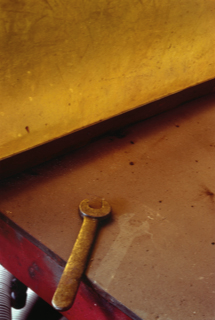
Andreas Friedrich would, I think, recognize the presence of emblematics in every image and object of Ship of Fools/Dockers Museum. But he would also understand that this artist has no need to literalize the image of the globe as he did, or as I have done, but can let the smallest detail stand for the totality. Even the simplest part-object – a wrench displaced on a welder’s bench – has the effect of putting this tool back to work in service of a photographic revelation of the fossilized detritus of capital (fig. 20).
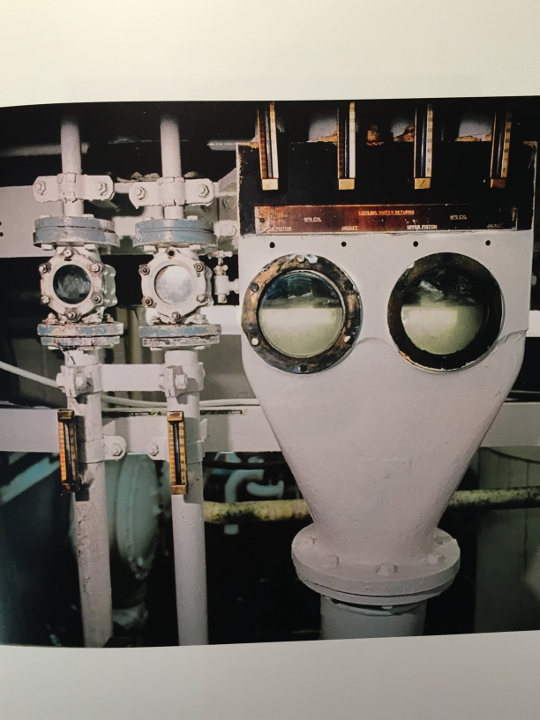
In place of the eye of God surveying the global Ship of fools, Sekula offers his own keen eye, seeing everything through the lens of a critical historical materialism and radically egalitarian politics. One wonders, at what point in his voyage of discovery, did this artist mariner-detective begin to notice that some of the ship’s equipment was starting to look back at him (fig. 21)?
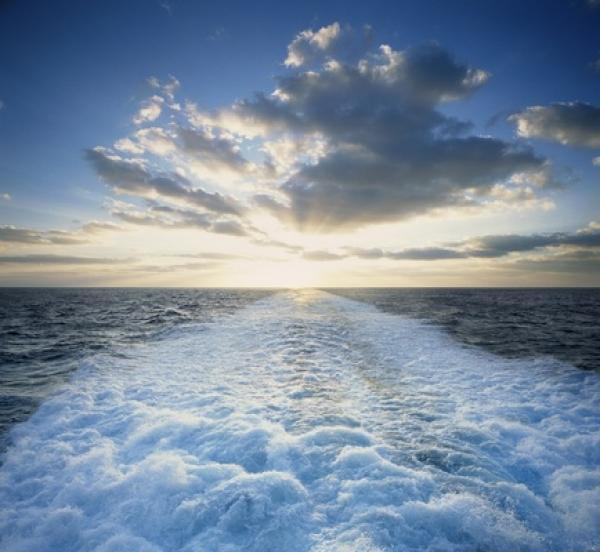
Was it before or after he spent a bit too long contemplating the ‘churn’ or wake left by the Ship of fools, and abandoned himself to the oceanic madness of his final work? (fig. 22)
References
Compton, Nic. Off the Deep End: A History of Madness at Sea. London: Adlard Coles, 2017.
Derrida, Jacques. Archive Fever: A Freudian Impression. Translated by Eric Prenowitz. Chicago: University of Chicago Press, 1996.
Laing, Ronald David. The Politics of Experience and The Bird of Paradise. London: Penguin Books, 1967.
Lapham, Lewis. Age of Folly: America Abandons Its Democracy. New York: Verso, 2016.
Latour, Bruno. “On a Possible Triangulation of Some Present Political Positions.” Critical Inquiry 44, no. 2 (2018): 213-226. https://doi.org/10.1086/695376.
Liu, Cixin. The Three-Body Problem. Translated by Ken Liu. New York: Tor Books, 2014.
Martin, Pierre. 2013. “Eschatological Perspective in Andreas Friedrich’s Emblemes nouveaux (1617).” Emblematica 20, 2013: 141-175. https://doi.org/10.4000/emblematica.169.
Mitchell, W.J.T. The Last Dinosaur Book: The Life and Times of a Cultural Icon. Chicago: University of Chicago Press, 1998.
Mitchell, W.J.T. “World Pictures: Globalization and Visual Culture.” Neohelicon 34, no. 2 (2007): 49-59. https://doi.org/10.1007/s11059-007-2005-7.
Mitchell, W.J.T. Image Science: Iconology, Visual Culture, and Media Aesthetics. Chicago: University of Chicago Press, 2015.
Papapetros, Spyros. “Panel B Introduction 1-3.” Warburg Library Digital Collections, available at: https://warburg.library.cornell.edu/pathways/panel-b-introduction-1-of-3 (accessed April 2026)
Schreber, Daniel Paul. Memoirs of My Nervous Illness. Translated and edited by Ida Macalpine and Richard A. Hunter. London: William Dawson & Sons, 1955.
Sekula, Allan. “The Body and the Archive.” October 39 (Winter 1986): 3-64.
Sekula, Allan. Fish Story. Düsseldorf: Richter Verlag, 2003.
Sloterdijk, Peter. Globes: Spheres Volume II: Macrospherology. Translated by Wieland Hoban. South Pasadena, CA: Semiotext(e), 2014.
Stein, Sally. “Collection and Recollection: Allan Sekula’s Nutcracker Suite.” In Ship of Fools / The Docker’s Museum: 95-101. Edited by Hilde Van Gelder. Leuven: Leuven University Press, 2015.
Stein, Sally. “Benjamin on Montage.” In Mining Section (Bureau des Mines): Collaborative Notes: 29-41. Edited by Hilde Van Gelder. Ghent: AraMER, 2016.
Van Gelder, Hilde. 2015. “Allan Sekula’s Panecasticism.” In Allan Sekula: Ship of Fools / The Docker’s Museum, a cura di Hilde Van Gelder, 21–29. Leuven: Leuven University Press, 2015.
Van Gelder, Hilde. Ground Sea: Photography and the Right to Be Reborn. Leuven: Leuven University Press, 2021.
Warburg, Aby. Der Bilderatlas Mnemosyne: The Original. Edited by Martin Warnke and Claudia Brink. Berlin: Akademie Verlag, 2000.
1 This essay first appeared as, W.J.T. Mitchell, “Planetary Madness: Globalizing the Ship of Fools,” in “Disassembled” Images: Allan Sekula and Contemporary Art, edited by Alexander Streitberger and Hilde Van Gelder, Leuven: Leuven University Press, 2019, (21–37).
2 The word ‘planet’ comes from the ancient Greek for ‘wanderer,’ applied to wandering stars (cf. classical Latin stellae errant – to lead astray [in passive] to wander, of uncertain origin). See Mitchell, “World Pictures: Globalization and Visual Culture,” 97.
3 Latour, “On a Possible Triangulation of Some Present Political Positions.”
4 Latour, “On a Possible Triangulation of Some Present Political Positions,” 217.
5 Van Gelder, Ground Sea.
6 Sekula, Fish Story, 50.
7 See Liu, The Three-Body Problem. Here he treats space travel and warfare on the model of maritime strategies.
8 Van Gelder, “Allan Sekula’s Panecasticism,” 76.
9 Van Gelder, “Allan Sekula’s Panecasticism,” 103.
10 Nevertheless, the contributors to Hilde Van Gelder’s marvelous catalog Ship of Fools/The Docker’s Museum make a heroic effort to reconstruct the lost stories and meanings that accompany the objects.
11 See Stein, “Benjamin on Montage,” 50 on Benjamin as a “revolutionary spy or detective” or as “critical journalist”; see also Sekula, “The Body and the Archive,” for Benjamin’s “mania of collecting.”
12 I am echoing here Derrida, Archive Fever.
13 Laing, The Politics of Experience, 129.
14 Schreber, Memoirs of My Nervous Illness.
15 Compton, Off the Deep End.
16 Stein, “Collection and Recollection,” 99.
17 The craving for totality, for the entire world that a collection represents, is shared across many disciplines, and even the State. Consider the NSA’s mad project of monitoring and archiving all network communication, CIA Director John Brennan’s ‘we want it all’. Ironically Brennan is now a slender line of defense against Trump’s treasonous behavior.
18 Peter Sloterdijk is the author of Spheres, a three-volume work that includes Globes as volume two, a world history and philosophy of globalization. Volume 1 is Bubbles; volume 3 is Foam.
19 See Papapetros, “Panel B Introduction 1-3.”
20 For further discussion of these images, see Mitchell, Image Science, 93.
21 Martin, “Eschatological Perspective.”
22 On the figure of the globe as etymologically a multitude, see Mitchell, “World Pictures.”
23 Sloterdijk, Globes, 102.
24 On Sekula’s egalitarian pedagogy and the imagery of Plato and the globe, see Van Gelder, “Allan Sekula’s Panecasticism,” 103.