

Tracing Electroadhesion from Classical Electrostatics to Smart Adhesives and Robo Grippers: Building the Bridges With ChatGPT
Published 2026-07-10
Keywords
- Electroadhesion,
- Material chemistry,
- Smart adhesive,
- Electrostatic robo gripper,
- ChatGPT
How to Cite
Copyright (c) 2026 Chitnarong Sirisathitkul, Yaowarat Sirisathitkul

This work is licensed under a Creative Commons Attribution 4.0 International License.




Abstract
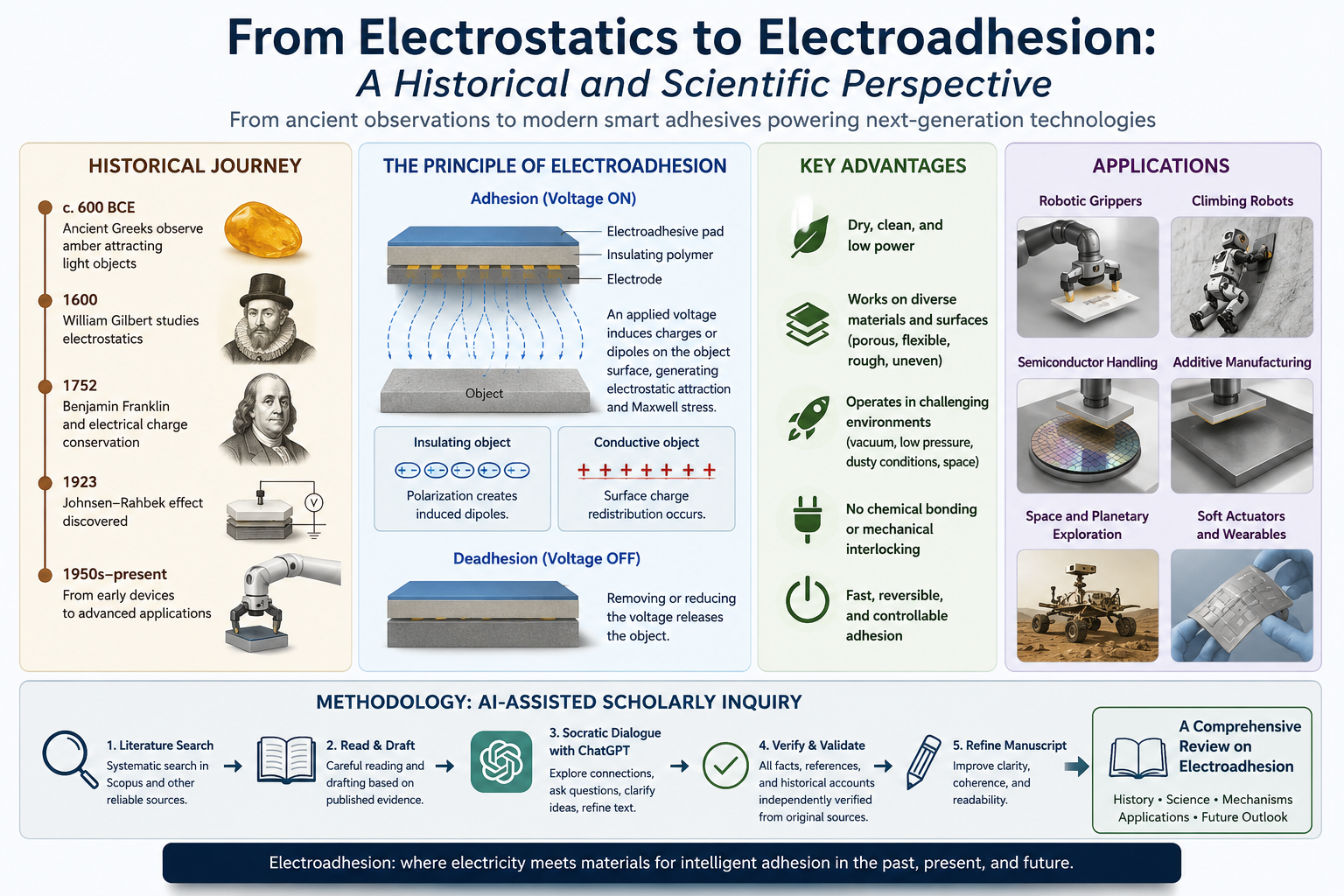
Electroadhesion has emerged as a promising mechanism in a growing range of applications, from smart adhesives and wall-climbing robots to robo grippers that reversibly grip or release objects with the flick of a switch. The development of autonomous and adaptive electroadhesive systems—capable of adjusting to varying materials and environmental conditions—represents a promising frontier in material science and robotics. These innovations are powered by electrostatic forces first observed millennia ago in rubbed amber. This article offers a synthetic and historically informed account tracing the evolution from early electrostatic observations to contemporary smart adhesive materials and robotic applications. Beyond consulting indexed journal articles, we engage in Socratic-style dialogue with ChatGPT to tap into its broad training corpus. This method helps uncover overlooked historical threads, cross-disciplinary linkages, and thematic continuities spanning centuries. In doing so, we also reflect on the emerging role of large language model (LLM) in scientific historiography. Our collaboration with ChatGPT not only shapes the structure of this narrative but also serves as a case study in how LLM can support integrative, cross-disciplinary writing in the history of material chemistry and technology.
References
- J. Comyn, Adhesion Science, UK: The Royal Society of Chemistry, 2021. DOI 10.1039/9781839169106
- P. Rajagopalan, M. Muthu, Y. Liu, J. Luo, X. Wang, C. Wan, Advancement of electroadhesion technology for intelligent and self-reliant robotic applications, Adv. Intell. Syst. 2022, 4, 2200064. DOI 10.1002/aisy.202200064
- J. Guo, J. Leng, J. Rossiter, Electroadhesion technologies for robotics: A comprehensive review. IEEE Trans. Robot. 2020, 36(2), 313–327, 8946902. DOI 10.1109/TRO.2019.2956869
- G. S. P. Castle, History of the electrostatic processes committee, IEEE Trans. Ind. Appl. 1984, 4, 1075–1077. DOI 10.1109/TIA.1984.4504547
- G. S. P. Castle, A century of development in applied electrostatics [History]. IEEE Ind. Appl. Mag. 2010, 16(4), 8–13. DOI 10.1109/MIAS.2010.937301
- G. S. P. Castle, A century of development in applied electrostatics; nothing static here. IEEE Trans. Dielectr. Electr. Insul. 2011, 18(5), 1361–1365. DOI 10.1109/TDEI.2011.6032803
- C. Sirisathitkul, Slow writing with ChatGPT: Turning the hype into a right way forward, Postdigit. Sci. Educ. 2024, 6, 431–438. DOI 10.1007/s42438-023-00441-5
- P. Iversen, D. J. Lacks, A life of its own: The tenuous connection between Thales of Miletus and the study of electrostatic charging, J. Electrost. 2012, 70(3), 309–311. DOI 10.1016/j.elstat.2012.03.002
- W. Gilbert, On the Magnet. Translated by P. F. Mottelay. Independently published, 2022. https://www.amazon.com/dp/B09S9QTFHN
- B. Baigire, Electricty and Magnetism: A Historical Perspective. Westport, CT: Greenwood Press, 2007. DOI 10.5040/9798400644498
- P. Fara, An Entertainment for Angels: Electricity in the Enlightenment. New York: Columbia University Press, 2002.
- Benjamin Franklin Historical Society, Kite Experiment. 2014. http://www.benjamin-franklin-history.org/kite-experiment/
- D. L. Lin, T. L. Welsher, From lightning to charged-device model electrostatic discharges, J. Electrost. 1993, 31, 199–213. DOI 10.1016/0304-3886(93)90009-V
- E. Popova, V. L. Popov, Note on the history of contact mechanics and friction: Interplay of electrostatics, theory of gravitation and elasticity from Coulomb to Johnson-Kendall-Roberts theory of adhesion. Phys. Mesomech. 2018, 21(1), 1–5. DOI 10.1134/S1029959918010010
- B. J. Hunt, Electrical theory and practice in the nineteenth century. In M. J. Nye (Ed.), The Cambridge history of science (Vol. 5). UK: Cambridge University Press, 2003, pp. 394–423. DOI 10.1017/CHOL9780521571999.018
- J. N. Israelachvili, Electrostatics in surface science. In Intermolecular and Surface Forces (3rd ed.). Academic Press, 2011, pp. 261–292. DOI 10.1016/C2009-0-21560-1
- A. J. Kinloch, J. F. Watts, Introduction to adhesion and adhesives. In Adhesion Science. UK: Royal Society of Chemistry, 2021, pp. 1–42.
- A. T. Florence, D. Attwood, Colloidal and coarse lyophobic dispersions. In Physicochemical Principles of Pharmacy. UK: Palgrave Macmillan, 1981, pp. 122–144.
- D. Driver, Adhesive bonding for aerospace applications. In: Flower, H.M. (eds) High Performance Materials in Aerospace. Dordrecht: Springer, 1995. DOI 10.1007/978-94-011-0685-6_11
- S. Mapari, S. Mestry, S. T. Mhaske, Developments in pressure-sensitive adhesives: A review. Polym. Bull. 2021, 78, 4075–4108. DOI 10.1007/s00289-020-03305-1
- S. Sun, M. Li, A. Liu, A review on mechanical properties of pressure sensitive adhesives. Int. J. Adhes. Adhes. 2013, 41, 98–106. DOI 10.1016/j.ijadhadh.2012.10.011
- Z. C. Zech, R. M. Ilker, Development trends in pressure-sensitive adhesive systems. Mater. Sci. Pol. 2005, 23(4), 605–623
- M. Bellis, Invention of the Post-It Note. ThoughtCo 2025. http://www.thoughtco.com/history-of-post-it-note-1992326
- A. Fattah-Alhosseini, R. Chaharmahali, S. Alizad, M. Kaseem, B. Dikici, A review of smart polymeric materials: Recent developments and prospects for medicine applications. Hybrid Adv. 2024, 5, 100178. DOI 10.1016/j.hybadv.2024.100178.
- J. Wang, Y. Y. Wan, X. W. Wang, Z. H. Xia, Bioinspired smart materials with externally-stmulated switchable adhesion. Front. Nanotechnol. 2021, 3, 667287. DOI 10.3389/fnano.2021.667287
- A. Johnsen, K. Rahbek, A physical phenomenon and its applications to telegraphy, telephony, etc. J. Inst. Elect. Eng. 1923, 61(320), 713–725.
- T. Bamber, J. Guo, J. Singh, M. Bigharaz, J. Petzing, P. A. Bingham, L. Justham, J. Penders, M. Jackson, Visualization methods for understanding the dynamic electroadhesion phenomenon. J. Phys. D: Appl. Phys. 2017, 50, 205304. DOI 10.1088/1361-6463/aa6be4
- M. Ciavarella, A. Papangelo. A simplified theory of electroadhesion for rough interfaces. Front. Mech. Eng. 2020, 6, 27. DOI 10.3389/fmech.2020.00027
- B. N. J. Persson, J. Guo. Electroadhesion for soft adhesive pads and robotics: Theory and numerical results. Soft Matter 2019,15, 8032–8039. DOI 10.1039/c9sm01560d
- K. I. Sharov, V. Y. Stepanenko, U. V. Nikulova, A. V. Shapagin, Influence of polymer nature on electroadhesion. Polymers 2024, 16(23), 3344. DOI 10.3390/polym16233344
- Q. Zhang, W. Yu, J. Zhao, C. Meng, S. Guo. A review of the applications and challenges of dielectric elastomer actuators in soft robotics. Machines 2025, 13(2), 101. DOI 10.3390/machines13020101
- J. D. Rosario, K. Satheesh, A. M. Shanmugharaj, R. K. Pai, A materials’ centered review of electroadhesive polymers for robotic and emerging applications. J. Mater. Sci. 2026, 61, 8365–8390. DOI 10.1007/s10853-026-12440-5
- G. Monkman, Compliant robotic devices, and electroadhesion. Robotica, 1992, 10(2), 183–185.
- P. Huang, Y. Xin, P. S. Lee, Soft electroadhesion systems for soft robotics. npj Robot. 2025, 3, 29. DOI 10.1038/s44182-025-00046-z
- C. Xiang, Y. Guan, H. Zhu, S. Lin, Y. Song, All 3D printed ready-to-use flexible electroadhesion pads. Sens. Actuators A: Phys. 2022, 344, 113747. DOI 10.1016/j.sna.2022.113747
- L. K. Borden, A. Gargava, U. J. Kokilepersaud, S. R. Raghavan, Universal way to “glue” capsules and gels into 3D structures by electroadhesion. ACS Appl. Mater. Interfaces 2023, 15(13), 17070–17077. DOI 10.1021/acsami.2c20793
- G. Monkman, Electroadhesive microgrippers. Ind. Robot. 2003, 30(4), 326–330.
- J. Guo, C. Xiang, J. Rossiter, A soft and shape-adaptive electroadhesive composite gripper with proprioceptive and exteroceptive capabilities. Mater. Des. 2018, 156, 586–587. DOI 10.1016/j.matdes.2018.07.027
- S. An, C. Xiang, C. Ji, S. Liu, L. He, L. Li, Y. Wang, Design and development of a variable structure gripper with electroadhesion. Smart Mater. Struct. 2024, 33(5), 055035. DOI 10.1088/1361-665X/ad3bf8
- G. Monkman, P. M. Taylor, G. J. Farnworth, Principles of electroadhesion in clothing robotics. Int. J. Clothing Sci. Technol. 1989, 1(3), 14–20.
- H. He, G. Saunders, J. T. Wen, Robotic fabric fusing using a novel electroadhesion gripper. in Proc. IEEE Trans. Autom. Sci. Eng. 2022, 2407–2414. DOI 10.1109/CASE49997.2022.9926477
- C. Xiang, J. Guo, J. Rossiter, ContinuumEA: A soft continuum electroadhesive manipulator. in Proc. 2018 IEEE Int. Conf. Robot. Biomim. (ROBIO 2018), 2018, 2473–2478. DOI 10.1109/ROBIO.2018.8664717
- R. P. Krape, Applications Study of Electroadhesive Devices. Washington, DC, USA: NASA, 1968.
- M. Ritter, D. Barnhart, Geometry characterization of electroadhesion samples for spacecraft docking application. in Proc. IEEE Aerosp. Conf. Proc. 2017, 1–8. DOI 10.1109/AERO.2017.7943683
- H. Prahlad, R. Pelrine, S. Stanford, J. Marlow, R. Kornbluh, Electroadhesive robots-wall climbing robots enabled by a novel, robust, and electrically controllable adhesion technology, in Proc. IEEE Int. Conf. Robot. Autom. 2008, 3028–3033.
- C. Cao, X. Gao, J. Guo, A. Conn, De-electroadhesion of flexible and lightweight materials: An experimental study. Appl. Sci. 2019, 9(14), 2796. DOI 10.3390/app9142796
- Y. Jeong, K. Kim, H. Huh, Robot application of electroadhesion pads with dual insulation. J. Korean Soc. Precis. Eng. 2020, 37(10), 743–750. DOI 10.7736/JKSPE.020.055
- R. Liu, R. Chen, H. Shen, R. Zhang, Wall climbing robot using electrostatic adhesion force generated by flexible interdigital electrodes. Int. J. Adv. Robot. Syst. 2013, 10(1), 36. DOI 10.5772/54634
- R. Chen, R. Liu, H. Shen, Design of a double-tracked wall climbing robot based on electrostatic adhesion mechanism. in Proc. IEEE Workshop Adv. Robot. Soc. Impacts ARSO 2013, 212–216. DOI 10.1109/ARSO.2013.6705531
- Q. Wu, T. G. Diaz Jimenez, J. Qu, C. Zhao, X. Liu, Regulating surface traction of a soft robot through electrostatic adhesion control. in Proc. IEEE Int. Conf. Intell. Robots Syst. 2017, 488–493. DOI 10.1109/IROS.2017.8202198
- E. M. Thomas, M. K. McBride, O. A. Lee, R. C. Hayward, A. J. Crosby, Predicting the electrical, mechanical, and geometric contributions to soft electroadhesives through fracture mechanics. ACS Appl. Mater. Interfaces. 2023, 15(25), 30956–30963. DOI 10.1021/acsami.3c03392
- V. Cacucciolo, H. Shea, G. Carbone, Peeling in electroadhesion soft grippers. Extreme Mech. Lett. 2022, 50, 101529. DOI 10.1016/j.eml.2021.101529
- A. W. Colombo, T. Bangemann, S. Karnouskos, A system of systems view on collaborative industrial automation. in Proc. IEEE Int. Conf. Ind. Technol. (ICIT) 2013, 1968–1975. DOI 10.1109/ICIT.2013.6505980
- J. Germann, M. Dommer, R. Pericet-Camara, D. Floreano, Active connection mechanism for soft modular robots. Adv. Robot. 2012, 26(7), 785–798. DOI 10.1163/156855312X626325
- L. Xu, H. Wu, G. Yao, L. Chen, X. Yang, B. Chen, X. Huang, W. Zhong, X. Chen, Z. Yin, Z. L. Wang, Giant voltage enhancement via triboelectric charge supplement channel for self-powered electroadhesion. ACS Nano 2018, 12(10), 10262–10271. DOI 10.1021/acsnano.8b05359
- S. Liu, Y. Li, W. Guo, X. Huang, L. Xu, Y. C. Lai, C. Zhang, H. Wu, Triboelectric nanogenerators enabled sensing and actuation for robotics. Nano Energy 2019, 65, 104005. DOI 10.1016/j.nanoen.2019.104005
- R. Chen, Z. Zhang, J. Guo, J. Rossiter, Variable stiffness electroadhesion and compliant electroadhesive grippers. Soft Robot. 2022, 9(6), 1074–1082. DOI 10.1089/soro.2021.0083
- M. Castells, A. Konstantinidou, J. M. Cerveró, A teaching proposal on electrostatics based on the history of science through the reading of historical texts and argumentative discussions. Cimento Soc. Ital. Fis. C. 2015, 38(3), 89. DOI 10.1393/NCC/I2015-15089-X
- N. Jaroonchokanan, C. Sirisathitkul, Implementing ChatGPT as tutor, tutee, and tool in physics and chemistry. Substantia 2025, 9(1), 89–101. DOI 10.36253/Substantia-2808