

Modulating the AGE-RAGE Signaling Pathway in Degenerative Processes: Molecular Mechanisms and Therapeutic Prospect of Phytochemicals
Published 2026-04-10
Keywords
- AGE,
- RAGE,
- AGE–RAGE signaling,
- Ageing,
- Degenerative diseases
- Phytochemicals ...More
How to Cite
Copyright (c) 2026 Ikechukwu Achinihu, Chidi Duru

This work is licensed under a Creative Commons Attribution 4.0 International License.




Abstract
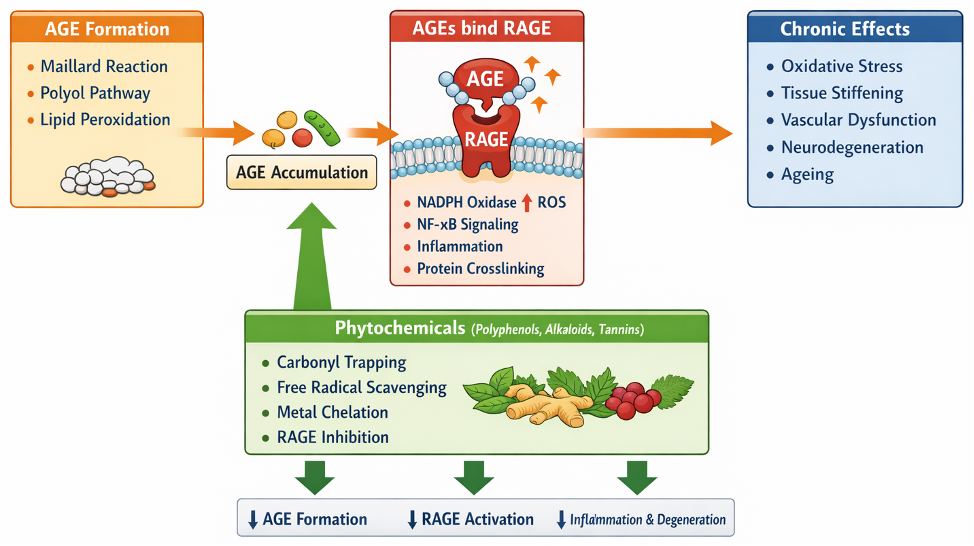
The Receptor for Advanced Glycation End Products (RAGE) is a multifunctional cell-surface receptor capable of binding a broad range of ligands, including advanced glycation end products (AGEs). While RAGE is constitutively expressed in various tissues, AGEs arise from non-enzymatic reactions between reducing sugars and proteins, lipids, or nucleic acids. The AGE–RAGE interaction activates multiple redox-sensitive and pro-inflammatory signaling pathways, thereby contributing significantly to ageing, chronic inflammatory conditions, and metabolic degenerative diseases. Consequently, targeting the AGE–RAGE axis has become an important focus of contemporary biomedical research. Although substantial progress has been made in elucidating this pathway and developing synthetic AGE–RAGE inhibitors, many of these agents present limitations related to safety, bioavailability, or therapeutic efficacy. Phytochemicals such as polyphenols, alkaloids, and tannins have exhibited promising antiglycation, antioxidant, and anti-inflammatory activities that may attenuate AGE–RAGE mediated cellular dysfunction. However, direct evidence of their capacity to inhibit RAGE at the receptor level remains limited. This review identifies critical knowledge gaps and demonstrates that structure-guided computational modeling combined with targeted experimental validation represents a promising strategy for the rational development of phytochemical-based RAGE modulators. These findings highlight the potential of natural products as safer and mechanistically informed therapeutic candidates for attenuating AGE–RAGE-mediated degenerative disease progression.
References
- Adamu, A., Li, S., Gao, F., & Xue, G. (2024). The role of neuroinflammation in neurodegenerative diseases: Current understanding and future therapeutic targets. Frontiers in Aging Neuroscience, 16, 1347987. https://doi.org/10.3389/fnagi.2024.1347987
- Ai, X., Yu, P., Peng, L., Luo, L., Liu, J., Li, S., Lai, X., Luan, F., & Meng, X. (2021). Berberine: A review of its pharmacokinetics properties and therapeutic potentials in diverse vascular diseases. Frontiers in Pharmacology, 12, 762654. https://doi.org/10.3389/fphar.2021.762654
- Al-Abbasy, O. Y., Younus, S. A., Rashan, A. I., & Sheej Ahmad, O. A. (2024). Maillard reaction: Formation, advantage, disadvantage and control. A review. Food Science and Applied Biotechnology, 7(1), 145. https://doi.org/10.30721/fsab2024.v7.i1.333
- Alharbi, H. O. A., Alshebremi, M., Babiker, A. Y., & Rahmani, A. H. (2025). The role of quercetin, a flavonoid in the management of pathogenesis through regulation of oxidative stress, inflammation, and biological activities. Biomolecules, 15(1), 151. https://doi.org/10.3390/biom15010151
- Andrés, C. M. C., Pérez De La Lastra, J. M., Andrés Juan, C., Plou, F. J., & Pérez-Lebeña, E. (2023). Polyphenols as antioxidant/pro-oxidant compounds and donors of reducing species: Relationship with human antioxidant metabolism. Processes, 11(9), 2771. https://doi.org/10.3390/pr11092771
- Arellanes-Lozada, P., Hernández-Cocoletzi, H., Lijanova, I. V., Olivares-Cuapa, J. C., Olivares-Cuapa, J. M., Calvillo-Muñoz, E. Y., & Likhanova, N. V. (2023). Effect of sulfonate anions on the performance of triethylmethylammonium-derived ionic liquids as corrosion inhibitors. Journal of Adhesion Science and Technology, 37(18), 2642–2666. https://doi.org/10.1080/01694243.2022.2163843
- Bastos, K. V. L. da S., De Souza, A. B., Tomé, A. C., & De Moura Souza, F. (2025). New strategies for the extraction of antioxidants from fruits and their by-products: A systematic review. Plants, 14(5), 755. https://doi.org/10.3390/plants14050755
- Bennici, G., Almahasheer, H., Alghrably, M., Valensin, D., Kola, A., Kokotidou, C., Lachowicz, J., & Jaremko, M. (2024). Mitigating diabetes associated with reactive oxygen species (ROS) and protein aggregation through pharmacological interventions. RSC Advances, 14(25), 17448–17460. https://doi.org/10.1039/D4RA02349H
- Bierhaus, A., & Nawroth, P. P. (2009). Multiple levels of regulation determine the role of the receptor for AGE (RAGE) as common soil in inflammation, immune responses and diabetes mellitus and its complications. Diabetologia, 52(11), 2251–2263. https://doi.org/10.1007/s00125-009-1458-9
- Blouin, T., & Saini, N. (2024). Aldehyde-induced DNA-protein crosslinks—DNA damage, repair and mutagenesis. Frontiers in Oncology, 14, 1478373. https://doi.org/10.3389/fonc.2024.1478373
- Bronowicka-Szydełko, A., Gostomska-Pampuch, K., Kuzan, A., Pietkiewicz, J., Krzystek-Korpacka, M., & Gamian, A. (2024). Effect of advanced glycation end-products in a wide range of medical problems including COVID-19. Advances in Medical Sciences, 69(1), 36–50. https://doi.org/10.1016/j.advms.2024.01.003
- Byun, K., Yoo, Y., Son, M., Lee, J., Jeong, G.-B., Park, Y. M., Salekdeh, G. H., & Lee, B. (2017). Advanced glycation end-products produced systemically and by macrophages: A common contributor to inflammation and degenerative diseases. Pharmacology & Therapeutics, 177, 44–55. https://doi.org/10.1016/j.pharmthera.2017.02.030
- Camarda, L., Budriesi, R., Corazza, I., Frosini, M., Marzetti, C., & Mattioli, L. B. (2026). Antioxidant and health-related effects of tannins: From agri-food by-products to human and animal health. Antioxidants, 15(1), 104. https://doi.org/10.3390/antiox15010104
- Ceramella, J., De Maio, A. C., Basile, G., Facente, A., Scali, E., Andreu, I., Sinicropi, M. S., Iacopetta, D., & Catalano, A. (2024). Phytochemicals involved in mitigating silent toxicity induced by heavy metals. Foods, 13(7), 978. https://doi.org/10.3390/foods13070978
- Chandimali, N., Bak, S. G., Park, E. H., Lim, H.-J., Won, Y.-S., Kim, E.-K., Park, S.-I., & Lee, S. J. (2025). Free radicals and their impact on health and antioxidant defenses: A review. Cell Death Discovery, 11(1), 19. https://doi.org/10.1038/s41420-024-02278-8
- Chen, Q. (2024). Neurobiological and anti-aging benefits of yoga: A comprehensive review of recent advances in non-pharmacological therapy. Experimental Gerontology, 196, 112550. https://doi.org/10.1016/j.exger.2024.112550
- Chen, Y., Meng, Z., Li, Y., Liu, S., Hu, P., & Luo, E. (2024). Advanced glycation end products and reactive oxygen species: Uncovering the potential role of ferroptosis in diabetic complications. Molecular Medicine, 30(1), 141. https://doi.org/10.1186/s10020-02400905-9
- Choi, J. Y., Ha, N. G., Lee, W. J., & Boo, Y. C. (2025). Synthetic and natural agents targeting advanced glycation end-products for skin anti-aging: A comprehensive review of experimental and clinical studies. Antioxidants, 14(4), 498. https://doi.org/10.3390/antiox14040498
- Clarke, D. M., Koutnik, A. P., Johnson, R. J., DeBlasi, J. M., Bikman, B. T., Arroyo, J. A., & Reynolds, P. R. (2024). Differential rates of glycation following exposure to unique monosaccharides. International Journal of Molecular Sciences, 25(13), 6921. https://doi.org/10.3390/ijms25136921
- Comajuncosa-Creus, A., Jorba, G., Barril, X., & Aloy, P. (2024). Comprehensive detection and characterization of human druggable pockets through binding site descriptors. Nature Communications, 15(1), 7917. https://doi.org/10.1038/s41467-024-52146-3
- Cosme, F., Aires, A., Pinto, T., Oliveira, I., Vilela, A., & Gonçalves, B. (2025). A comprehensive review of bioactive tannins in foods and beverages: Functional properties, health benefits, and sensory qualities. Molecules, 30(4), 800. https://doi.org/10.3390/molecules30040800
- Cross, K., Vetter, S. W., Alam, Y., Hasan, M. Z., Nath, A. D., & Leclerc, E. (2024). Role of the receptor for advanced glycation end products (RAGE) and its ligands in inflammatory responses. Biomolecules, 14(12), 1550. https://doi.org/10.3390/biom14121550
- Dascalu, A.-E., Furman, C., Landrieu, I., Cantrelle, F.-X., Mortelecque, J., Grolaux, G., Gillery, P., Tessier, F., Lipka, E., Billamboz, M., Boulanger, E., & Ghinet, A. (2024). Development of receptor for advanced glycation end products (RAGE) ligands through target directed dynamic combinatorial chemistry: A novel class of possible antagonists. Chemistry – A European Journal, 30(20), e202303255. https://doi.org/10.1002/chem.202303255
- Dash, U. C., Bhol, N. K., Swain, S. K., Samal, R. R., Nayak, P. K., Raina, V., Panda, S. K., Kerry, R. G., Duttaroy, A. K., & Jena, A. B. (2025). Oxidative stress and inflammation in the pathogenesis of neurological disorders: Mechanisms and implications. Acta Pharmaceutica Sinica B, 15(1), 15–34. https://doi.org/10.1016/j.apsb.2024.10.004
- Deepu, V., Rai, V., & Agrawal, D. K. (2024). Quantitative assessment of intracellular effectors and cellular response in RAGE activation. Archives of Internal Medicine Research, 07(02). https://doi.org/10.26502/aimr.0168
- Delannoy, Peter, Dean R. Tolan, Miguel A. Lanaspa, Iñigo San Millán, So Young Bae, and Richard J. Johnson. 2025. “Aldose Reductase, Fructose and Fat Production in the Liver.” Biochemical Journal 482(05):295–307. doi:10.1042/BCJ20240748.
- deRamon, Edward A., Venkata R. Sabbasani, Matthew D. Streeter, Yannan Liu, Timothy R. Newhouse, David M. McDonald, and David A. Spiegel. 2022. “Pentosinane, a Post-Translational Modification of Human Proteins with Underappreciated Stability.” Journal of the American Chemical Society 144(48):21843–47. doi:10.1021/jacs.2c09626.
- El Hosry, Leina, Vanessa Elias, Vanessa Chamoun, Malda Halawi, Philippe Cayot, Anthony Nehme, and Elias Bou-Maroun. 2025. “Maillard Reaction: Mechanism, Influencing Parameters, Advantages, Disadvantages, and Food Industrial Applications: A Review.” Foods 14(11):1881. doi:10.3390/foods14111881.
- Feng, Chao, Xianglong Chen, Xiuqing Yin, Yanfei Jiang, and Chunyue Zhao. 2024. “Matrix Metalloproteinases on Skin Photoaging.” Journal of Cosmetic Dermatology 23(12):3847–62. doi:10.1111/jocd.16558.
- García-Muñoz, Ana María, Desirée Victoria-Montesinos, Pura Ballester, Begoña Cerdá, and Pilar Zafrilla. 2024. “A Descriptive Review of the Antioxidant Effects and Mechanisms of Action of Berberine and Silymarin.” Molecules 29(19):4576. doi:10.3390/molecules29194576.
- Giridharan, Vijayasree V., Jaqueline S. Generoso, Allan Collodel, Diogo Dominguini, Cristiano Julio Faller, Flavio Tardin, Gursimrat S. Bhatti, Fabricia Petronilho, Felipe Dal-Pizzol, and Tatiana Barichello. 2021. “Receptor for Advanced Glycation End Products (RAGE) Mediates Cognitive Impairment Triggered by Pneumococcal Meningitis.” Neurotherapeutics 18(1):640–53. doi:10.1007/s13311-020-00917-3.
- Gomes, Ricardo, Marta Sousa Silva, Alexandre Quintas, Carlos Cordeiro, António Freire, Paulino Pereira, Américo Martins, Estela Monteiro, Eduardo Barroso, and Ana Ponces Freire. 2005. “Argpyrimidine, a Methylglyoxal-Derived Advanced Glycation End-Product in Familial Amyloidotic Polyneuropathy.” Biochemical Journal 385(2):339–45. doi:10.1042/BJ20040833.
- Gulcin, İlhami. 2025. “Antioxidants: A Comprehensive Review.” Archives of Toxicology 99(5):1893–1997. doi:10.1007/s00204-025-03997-2.
- Gutowska, Klaudia, Krzysztof Czajkowski, and Alina Kuryłowicz. 2023. “Receptor for the Advanced Glycation End Products (RAGE) Pathway in Adipose Tissue Metabolism.” International Journal of Molecular Sciences 24(13):10982. doi:10.3390/ijms241310982.
- Hidalgo, Francisco J., and Rosario Zamora. 2023. “Carbonyl-Trapping by Phenolics and the Inhibition of the Formation of Carcinogenic Heterocyclic Aromatic Amines with the Structure of Aminoimidazoazaarene in Beef Patties.” Food Chemistry 425:136505. doi:10.1016/j.foodchem.2023.136505.
- Ho, Keat Lam, Phaik Har Yong, Chee Woon Wang, Siew Huah Lim, Umah Rani Kuppusamy, Bavani Arumugam, Chek Tung Ngo, and Zhi Xiang Ng. 2024. “In Vitro Anti-Inflammatory Activity and Molecular Docking of Peperomia pellucida (L.) Kunth Extract via the NF-κB and PPAR-γ Signalling in Human Retinal Pigment Epithelial Cells.” Bioorganic Chemistry 153:107969. doi:10.1016/j.bioorg.2024.107969.
- Huang, Qianqian, Xiuli Liu, Guoqi Zhao, Tianming Hu, and Yuxi Wang. 2018. “Potential and Challenges of Tannins as an Alternative to In-Feed Antibiotics for Farm Animal Production.” Animal Nutrition 4(2):137–50. doi:10.1016/j.aninu.2017.09.004.
- Huang, Yu, and Jiewen Yang. 2021. “Degradation of Sulfamethoxazole by the Heterogeneous Fenton-like Reaction between Gallic Acid and Ferrihydrite.” Ecotoxicology and Environmental Safety 226:112847. doi:10.1016/j.ecoenv.2021.112847.
- Ijaz, Siddra, Imran Ul Haq, Riffat Malik, Ghalia Nadeem, Hayssam M. Ali, and Sukhwinder Kaur. 2023. “In Silico Characterization of Differentially Expressed Short-Read Nucleotide Sequences Identified in Dieback Stress-Induced Transcriptomic Analysis Reveals Their Role as Antimicrobial Peptides.” Frontiers in Plant Science 14:1168221. doi:10.3389/fpls.2023.1168221.
- Ikezu, U. M., Duru, C. E., Ikpa, C. B., and Ibe, F. C. (2025). In silico discovery of dual-targeting molecules from Acalypha wilkesiana against hypertension and hyperglycemia. Discover Chemistry, 2, 86. doi:10.1007/s44371-025-00175-2
- Jiang, Chunjie, Guojuan Lao, Jianmin Ran, and Ping Zhu. 2024. “Berberine Alleviates AGEs-Induced Ferroptosis by Activating NRF2 in the Skin of Diabetic Mice.” Experimental Biology and Medicine 249:10280. doi:10.3389/ebm.2024.10280.
- Jomova, Klaudia, Renata Raptova, Suliman Y. Alomar, Saleh H. Alwasel, Eugenie Nepovimova, Kamil Kuca, and Marian Valko. 2023a. “Reactive Oxygen Species, Toxicity, Oxidative Stress, and Antioxidants: Chronic Diseases and Aging.” Archives of Toxicology 97(10):2499–2574. doi:10.1007/s00204-023-03562-9.
- Jomova, Klaudia, Renata Raptova, Suliman Y. Alomar, Saleh H. Alwasel, Eugenie Nepovimova, Kamil Kuca, and Marian Valko. 2023b. “Reactive Oxygen Species, Toxicity, Oxidative Stress, and Antioxidants: Chronic Diseases and Aging.” Archives of Toxicology 97(10):2499–2574. doi:10.1007/s00204-023-03562-9.
- Kanti Das, Tushar, Mas Rina Wati, and Kaneez FatimaShad. 2014. “Oxidative Stress Gated by Fenton and Haber Weiss Reactions and Its Association With Alzheimer’s Disease.” Archives of Neuroscience 2(3). doi:10.5812/archneurosci.20078.
- Karamać, Magdalena. 2009. “Chelation of Cu(II), Zn(II), and Fe(II) by Tannin Constituents of Selected Edible Nuts.” International Journal of Molecular Sciences 10(12):5485–97. doi:10.3390/ijms10125485.
- Khan, Sameer Ullah, Kaneez Fatima, Shariqa Aisha, and Fayaz Malik. 2024. “Unveiling the Mechanisms and Challenges of Cancer Drug Resistance.” Cell Communication and Signaling 22(1):109. doi:10.1186/s12964023-01302-1.
- Khateri, Somayeh, Maryam Mehrabi, and Reza Khodarahmi. 2024. “Inhibitory Effects of Quercetin and Resveratrol and Their Sulfonamide Derivatives on the Carbonic Anhydrase Activity: Spectroscopic Studies of the Binding Process.” Chemical Papers 78(1):151–63. doi:10.1007/s11696-023-03048-z.
- Kinscherf, Noah Alexander, and Mariana Pehar. 2022. “Role and Therapeutic Potential of RAGE Signaling in Neurodegeneration.” Current Drug Targets 23(12):1191–1209. doi:10.2174/1389450123666220610171005.
- Kong, Linghong, Hui Wang, Weiwei Jiang, Yun Chen, Zhuoling Du, Qiong Zhang, Jianyue Dong, Changchun Zeng, and Hanping Liu. 2025. “Network Pharmacology-Based Study in Polymetformin’s New Function of Blocking AGEs/RAGE Pathway Curing Diabetic Complications.” Scientific Reports 15(1):19632. doi:10.1038/s41598-025-00956-w.
- Láng, Léonie, Simon McArthur, Alpar S. Lazar, Line Pourtau, David Gaudout, Matthew G. Pontifex, Michael Müller, and David Vauzour. 2024. “Dietary (Poly)Phenols and the Gut–Brain Axis in Ageing.” Nutrients 16(10):1500. doi:10.3390/nu16101500.
- Lee, Jeongmin, Jae-Seung Yun, and Seung-Hyun Ko. 2022. “Advanced Glycation End Products and Their Effect on Vascular Complications in Type 2 Diabetes Mellitus.” Nutrients 14(15):3086. doi:10.3390/nu14153086.
- Lee, Vanessa J., Samuel E. Janisse, and Marie C. Heffern. 2023. “Plant-Derived Chelators and Ionophores as Potential Therapeutics for Metabolic Diseases.” Chemical Society Reviews 52(11):3927–45. doi:10.1039/D3CS00167A.
- Li, Wen, Qiuping Chen, Chengjie Peng, Dan Yang, Si Liu, Yanwen Lv, Langqi Jiang, Shijun Xu, and Lihua Huang. 2025. “Roles of the Receptor for Advanced Glycation End Products and Its Ligands in the Pathogenesis of Alzheimer’s Disease.” International Journal of Molecular Sciences 26(1):403. doi:10.3390/ijms26010403.
- Lin, Jianguo, Youcai Tang, Qiaohua Kang, Yunfeng Feng, and Anping Chen. 2012. “Curcumin Inhibits Gene Expression of Receptor for Advanced Glycation End‐ Products (RAGE) in Hepatic Stellate Cells In Vitro by Elevating PPARγ Activity and Attenuating Oxidative Stress.” British Journal of Pharmacology 166(8):2212–27. doi:10.1111/j.1476-5381.2012.01910.x.
- Liu, Sixuan, Jiachen Liu, Yinhuai Wang, Fei Deng, and Zebin Deng. 2025. “Oxidative Stress: Signaling Pathways, Biological Functions, and Disease.” MedComm 6(7):e70268. doi:10.1002/mco2.70268.
- Meiliana, Anna, Nurrani Mustika Dewi, and Andi Wijaya. 2024. “Molecular Mechanisms of Methylglyoxal in Diabetes-Related Macrovascular Complications.” The Indonesian Biomedical Journal 16(5):411–26. doi:10.18585/inabj.v16i5.3242.
- Misra, Radhika, Emily Deehan, Kelly Frasier, Esther Nwozo, Renee Chang, Travis Jackson, and Bailey Patrick. 2025. “Advanced Glycation End Products (AGEs) in Non-Alcoholic Fatty Liver Disease (NAFLD) and Their Contribution to Skin Aging.”
- Moldogazieva, Nurbubu T., Innokenty M. Mokhosoev, Tatiana I. Mel’nikova, Yuri B. Porozov, and Alexander A. Terentiev. 2019. “Oxidative Stress and Advanced Lipoxidation and Glycation End Products (ALEs and AGEs) in Aging and Age-Related Diseases.” Oxidative Medicine and Cellular Longevity 2019:1–14. doi:10.1155/2019/3085756.
- Montserrat Corona-España, Ana, Mario Alberto GarciaRamirez, Regina Romo-Gonzalez, Ingrid Mayanin Rodriguez-Buenfil, and Orfil González Reynoso. 2024. “Phytochemicals from Secondary Metabolism and Their Role as Antioxidant and Anti-Inflammatory Molecules.” In Biochemistry, vol. 64, edited by M. Kamran Khan. IntechOpen.
- Nagai, Ryoji, Jun-ichi Shirakawa, Rei-ichi Ohno, Narumi Moroishi, and Mime Nagai. 2014. “Inhibition of AGEs Formation by Natural Products.” Amino Acids 46(2):261–66. doi:10.1007/s00726-013-1487-z.
- Nair, Arathi, Prashant Chauhan, Bhaskar Saha, and Katharina F. Kubatzky. 2019. “Conceptual Evolution of Cell Signaling.” International Journal of Molecular Sciences 20(13):3292. doi:10.3390/ijms20133292.
- Napolitano, Gaetana, Gianluca Fasciolo, and Paola Venditti. 2021. “Mitochondrial Management of Reactive Oxygen Species.” Antioxidants 10(11):1824. doi:10.3390/antiox10111824.
- Navarro-Cruz, Addí Rhode, Daniel Juárez-Serrano, Ivan Cesar-Arteaga, Ashuin Kammar-García, Jorge Alberto Guevara-Díaz, Obdulia Vera-López, Martin Lazcano-Hernández, Ivonne Pérez-Xochipa, and Orietta Segura-Badilla. 2024. “Oral Administration of Resveratrol Reduces Oxidative Stress Generated in the Hippocampus of Wistar Rats in Response to Consumption of Ethanol.” Frontiers in Behavioral Neuroscience 17:1304006. doi:10.3389/fnbeh.2023.1304006.
- Ngcobo, Nokwanda N. 2025. “Influence of Ageing on the Pharmacodynamics and Pharmacokinetics of Chronically Administered Medicines in Geriatric Patients: A Review.” Clinical Pharmacokinetics. doi:10.1007/s40262-024-01466-0.
- Nwofor, O. K., Duru, C. E., and Nwofor, C. N. (2025). In-vitro, bioinformatics and computational biophysical analyses of antifungal phytochemicals from Acalypha wilkesiana variants targeting Malassezia lipase. Tropical Journal of Drug Research, 2(9), 231–244. doi:10.26538/tjdr/v2i9.3
- Ohiagu, Franklyn Okechukwu, Paul Chidoka Chikezie, Tochukwu Oluwatosin Maduka, Chinwendu Mauren Chikezie, Ogueri Nwaiwu, and Keshav Raj Paudel. 2025. “Antioxidants, Radical Scavengers, and Their Impact on Oxidative Stress.” Free Radicals and Antioxidants 14(2):62–85. doi:10.5530/fra.2024.2.7.
- Olufunmilayo, Edward O., Michelle B. Gerke-Duncan, and R. M. Damian Holsinger. 2023. “Oxidative Stress and Antioxidants in Neurodegenerative Disorders.” Antioxidants 12(2):517. doi:10.3390/antiox12020517.
- Ouamnina, Abdoussadeq, Abderrahim Alahyane, Imane Elateri, Mourad Ouhammou, and Mohamed Abderrazik. 2024. “In Vitro and Molecular Docking Studies of Antiglycation Potential of Phenolic Compounds in Date Palm (Phoenix dactylifera L.) Fruit: Exploring Local Varieties in the Food Industry.” Horticulturae 10(6):657. doi:10.3390/horticulturae10060657.
- Page, M. J., McKenzie, J. E., Bossuyt, P. M., Boutron, I., Hoffmann, T. C., Mulrow, C. D., Shamseer, L., Tetzlaff, J. M., Akl, E. A., Brennan, S. E., Chou, R., Glanville, J., Grimshaw, J. M., Hróbjartsson, A., Lalu, M. M., Li, T., Loder, E. W., Mayo-Wilson, E., McDonald, S., McGuinness, L. A., Stewart, L. A., Thomas, J., Tricco, A. C., Welch, V. A., Whiting, P., and Moher, D. (2021). The PRISMA 2020 statement: An updated guideline for reporting systematic reviews. BMJ, 372, n71. doi:10.1136/bmj.n71
- Pathomthongtaweechai, Nutthapoom, and Somchai Chutipongtanate. 2020. “AGE/RAGE Signaling-Mediated Endoplasmic Reticulum Stress and Future Prospects in Non-Coding RNA Therapeutics for Diabetic Nephropathy.” Biomedicine & Pharmacotherapy 131:110655. doi:10.1016/j.biopha.2020.110655.
- Peng, Huan, Yuqi Gao, Chenye Zeng, Rui Hua, Yannan Guo, Yida Wang, and Zhao Wang. 2024. “Effects of Maillard Reaction and Its Product AGEs on Aging and Age-Related Diseases.” Food Science and Human Wellness 13(3):1118–34. doi:10.26599/FSHW.2022.9250094.
- Perrone, Anna, Antonio Giovino, Jubina Benny, and Federico Martinelli. 2020. “Advanced Glycation End Products (AGEs): Biochemistry, Signaling, Analytical Methods, and Epigenetic Effects.” Oxidative Medicine and Cellular Longevity 2020:1–18. doi:10.1155/2020/3818196.
- Piras, S., A. L. Furfaro, C. Domenicotti, N. Traverso, U. M. Marinari, M. A. Pronzato, and M. Nitti. 2016. “RAGE Expression and ROS Generation in Neurons: Differentiation versus Damage.” Edited by K. V. Ramana. Oxidative Medicine and Cellular Longevity 2016(1):9348651. doi:10.1155/2016/934865
- Pizzino, G., Irrera, N., Cucinotta, M., Pallio, G., Mannino, F., Arcoraci, V., Squadrito, F., Altavilla, D., & Bitto, A. (2017). Oxidative stress: Harms and benefits for human health. In V. M. Victor (Ed.), Oxidative Medicine and Cellular Longevity, 2017(1), 8416763. https://doi.org/10.1155/2017/8416763
- Pohanka, M., & Dobes, P. (2013). Caffeine inhibits acetylcholinesterase, but not butyrylcholinesterase. International Journal of Molecular Sciences, 14(5), 9873–9882. https://doi.org/10.3390/ijms14059873
- Radziszewski, M., Galus, R., Łuszczyński, K., Winiarski, S., Wąsowski, D., Malejczyk, J., Włodarski, P., & Ścieżyńska, A. (2024). The RAGE pathway in skin pathology development: A comprehensive review of its role and therapeutic potential. International Journal of Molecular Sciences, 25(24), 13570. https://doi.org/10.3390/ijms252413570
- Ramasamy, R., Yan, S. F., and Schmidt, A. M. (2012). The diverse ligand repertoire of the receptor for advanced glycation end-products and pathways to the complications of diabetes. Vascular Pharmacology, 57(5–6), 160–167. doi:10.1016/j.vph.2012.06.004
- Ramasamy, R., Shekhtman, A., & Schmidt, A. M. (2022). The RAGE/DIAPH1 signaling axis & implications for the pathogenesis of diabetic complications. International Journal of Molecular Sciences, 23(9), 4579. https://doi.org/10.3390/ijms23094579
- Ramasamy, R., Vannucci, S. J., Shi Du Yan, S., Herold, K., Yan, S. F., & Schmidt, A. M. (2005). Advanced glycation end products and RAGE: A common thread in aging, diabetes, neurodegeneration, and inflammation. Glycobiology, 15(7), 16R–28R. https://doi.org/10.1093/glycob/cwi053
- Ravindranath, N. H., & Ravindranath, M. H. (2011). Green tea catechins suppress NF-κB-mediated inflammatory responses: Relevance to nutritional management of inflammation. British Journal of Nutrition, 105(12), 1715–1717. https://doi.org/10.1017/S0007114510005611
- Reddy, V. P., Aryal, P., & Soni, P. (2023). RAGE inhibitors in neurodegenerative diseases. Biomedicines, 11(4), 1131. https://doi.org/10.3390/biomedicines11041131
- Rodríguez-Negrete, E. V., Morales-González, Á., Madrigal-Santillán, E. O., Sánchez-Reyes, K., Álvarez-González, I., Madrigal-Bujaidar, E., Valadez-Vega, C., Chamorro-Cevallos, G., Garcia-Melo, L. F., & Morales-González, J. A. (2024). Phytochemicals and their usefulness in the maintenance of health. Plants, 13(4), 523. https://doi.org/10.3390/plants13040523
- Rojas, A., Lindner, C., Schneider, I., Gonzalez, I., & Uribarri, J. (2024). The RAGE axis: A relevant inflammatory hub in human diseases. Biomolecules, 14(4), 412. https://doi.org/10.3390/biom14040412
- Sadeghi, M., Miroliaei, M., Kamyabiamineh, A., Taslimi, P., & Ghanadian, M. (2023). The impact of AGEs on human health and the development of their inhibitors based on natural compounds. Arabian Journal of Chemistry, 16(10), 105143. https://doi.org/10.1016/j.arabjc.2023.105143
- Sadowska-Bartosz, I., & Bartosz, G. (2015). Prevention of protein glycation by natural compounds. Molecules, 20(2), 3309–3334. https://doi.org/10.3390/molecules20023309
- Salazar, J., Navarro, C., Ortega, Á., Nava, M., Morillo, D., Torres, W., Hernández, M., Cabrera, M., Angarita, L., Ortiz, R., Chacín, M., D’Marco, L., & Bermúdez, V. (2021). Advanced glycation end products: New clinical and molecular perspectives. International Journal of Environmental Research and Public Health, 18(14), 7236. https://doi.org/10.3390/ijerph18147236
- Santiago-Fernández, O., Coletto, L., Tasset, I., Kaushik, S., Concepcion, A. R., Qaisar, R., Macho-González, A., Lindenau, K., Diaz, A., Khawaja, R. R., Donega, S., Banskota, N., Ubaida-Mohien, C., Pharaoh, G., Ahn, B., Hartnell, L. M., Ramírez-Pardo, I., Chavda, B., Gazteluiturri, A., Kinter, M., Ferrucci, L., Reisz, J. A., D’Alessandro, A., Van Remmen, H., Muñoz-Cánoves, P., Feske, S., & Cuervo, A. M. (2025). Age-related decline of chaperone-mediated autophagy in skeletal muscle leads to progressive myopathy. Nature Metabolism, 7(12), 2589–2611. https://doi.org/10.1038/s42255-025-01412-9
- Schröder, K. (2024). Specific signaling by nicotinamide adenine dinucleotide oxidases – Role of their site of action. Current Opinion in Chemical Biology, 81, 102461. https://doi.org/10.1016/j.cbpa.2024.102461
- Sell, D. R., Biemel, K. M., Reihl, O., Lederer, M. O., Strauch, C. M., & Monnier, V. M. (2005). Glucosepane is a major protein cross-link of the senescent human extracellular matrix. Journal of Biological Chemistry, 280(13), 12310–12315. https://doi.org/10.1074/jbc.M500733200
- Semchyshyn, H. (2024). Fructose-mediated AGE-RAGE axis: Approaches for mild modulation. Frontiers in Nutrition, 11, 1500375. https://doi.org/10.3389/fnut.2024.1500375
- Senatus, L. M., & Schmidt, A. M. (2017). The AGE-RAGE axis: Implications for age-associated arterial diseases. Frontiers in Genetics, 8, 187. https://doi.org/10.3389/fgene.2017.00187
- Sharma, C., Kaur, A., Thind, S. S., Singh, B., and Raina, S. (2015). Advanced glycation end-products (AGEs): An emerging concern for processed food industries. Journal of Food Science and Technology, 52(12), 7561–7576. doi:10.1007/s13197-015-1851-y
- Smita, B., Jain, P., Saini, L., & Modi, Y. (2025). Distinguish between reducing and non-reducing sugars V1.
- Song, J., Zhu, L., Yu, S., Li, G., & Wang, D. (2024a). The synergistic effect of adsorption and Fenton oxidation for organic pollutants in water remediation: An overview. RSC Advances, 14(45), 33489–33511. https://doi.org/10.1039/D4RA03050H
- Song, X., Singh, M., Lee, K. E., Vinayagam, R., & Kang, S. G. (2024b). Caffeine: A multifunctional efficacious molecule with diverse health implications and emerging delivery systems. International Journal of Molecular Sciences, 25(22), 12003. https://doi.org/10.3390/ijms252212003
- Srivastava, A. K., & Singh, V. K. (2020). Physiological role of some alkaloids.
- Stevenson, B. C., Berden, G., Martens, J., Oomens, J., & Armentrout, P. B. (2023). Spectroscopic investigation of the metal coordination of the aromatic amino acids with zinc and cadmium. The Journal of Physical Chemistry A, 127(16), 3560–3569. https://doi.org/10.1021/acs.jpca.2c08940
- Sugawa, H., Ikeda, T., Tominaga, Y., Katsuta, N., & Nagai, R. (2024). Rapid formation of Nε-(carboxymethyl) lysine (CML) from ribose depends on glyoxal production by oxidation. RSC Chemical Biology, 5(11), 1140–1146. https://doi.org/10.1039/D4CB00183D
- Takeuchi, M., Takino, J., and Yamagishi, S. (2010). Involvement of the toxic AGEs (TAGE)-RAGE system in the pathogenesis of diabetic vascular complications: A novel therapeutic strategy. Current Drug Targets, 11(11), 1468–1482. doi:10.2174/1389450111009011468
- Terao, J. (2023). Potential role of quercetin glycosides as anti-atherosclerotic food-derived factors for human health. Antioxidants, 12(2), 258. https://doi.org/10.3390/antiox12020258
- Thakor, P. M., Patel, J. D., Patel, R. J., Chaki, S. H., Khimani, A. J., Vaidya, Y. H., Chauhan, A. P., Dholakia, A. B., Patel, V. C., Patel, A. J., Bhavsar, N. H., & Patel, H. V. (2024). Exploring new Schiff bases: Synthesis, characterization, and multifaceted analysis for biomedical applications. ACS Omega, 9(33), 35431–35448. https://doi.org/10.1021/acsomega.4c02007
- Twarda-Clapa, A., Olczak, A., Białkowska, A. M., & Koziołkiewicz, M. (2022). Advanced glycation end-products (AGEs): Formation, chemistry, classification, receptors, and diseases related to AGEs. Cells, 11(8), 1312. https://doi.org/10.3390/cells11081312
- Uceda, Ana Belén, Laura Mariño, Rodrigo Casasnovas, and Miquel Adrover. 2024a. “An Overview on Glycation: Molecular Mechanisms, Impact on Proteins, Pathogenesis, and Inhibition.” Biophysical Reviews 16(2):189–218. doi:10.1007/s12551-024-01188-4.
- Uceda, Ana Belén, Laura Mariño, Rodrigo Casasnovas, and Miquel Adrover. 2024b. “An Overview on Glycation: Molecular Mechanisms, Impact on Proteins, Pathogenesis, and Inhibition.” Biophysical Reviews 16(2):189–218. doi:10.1007/s12551-024-01188-4.
- Valgimigli, L. (2023). Lipid peroxidation and antioxidant protection. Biomolecules, 13(9), 1291. doi:10.3390/biom13091291
- Wang, Bijian, Taidou Jiang, Yaoyu Qi, Sha Luo, Ying Xia, Binyan Lang, Bolan Zhang, and Shuzhan Zheng. 2024. “AGE-RAGE Axis and Cardiovascular Diseases: Pathophysiologic Mechanisms and Prospects for Clinical Applications.” Cardiovascular Drugs and Therapy. doi:10.1007/s10557-024-07639-0.
- Watanabe, Haruki, and Myoungsun Son. 2021. “The Immune Tolerance Role of the HMGB1-RAGE Axis.” Cells 10(3):564. doi:10.3390/cells10030564.
- Wu, Yuncheng, Xinqun Li, Julie Xiaohong Zhu, Wenjie Xie, Weidong Le, Zhen Fan, Joseph Jankovic, and Tianhong Pan. 2011. “Resveratrol-Activated AMPK/SIRT1/Autophagy in Cellular Models of Parkinson’s Disease.” Neurosignals 19(3):163–74. doi:10.1159/000328516.
- Yadav, Neera, Jyoti Dnyaneshwar Palkhede, and Sun-Yeou Kim. 2023. “Anti-Glucotoxicity Effect of Phytoconstituents via Inhibiting MGO-AGEs Formation and Breaking MGO-AGEs.” International Journal of Molecular Sciences 24(8):7672. doi:10.3390/ijms24087672.
- Yamaguchi, Hiroko, and Ryoji Nagai. 2025. “Insights from the Fructose‐derived Product Glucoselysine: Revisiting the Polyol Pathway in Diabetic Complications.” Journal of Diabetes Investigation 16(4):569–77. doi:10.1111/jdi.70000.
- Yammine, Aline, Imen Ghzaiel, Vivien Pires, Amira Zarrouk, Omar Kharoubi, Hélène Greige-Gerges, Lizette Auezova, Gérard Lizard, and Anne Vejux. 2024. “Cytoprotective Effects of α-Linolenic Acid, Eicosapentaenoic Acid, Docosahexaenoic Acid, Oleic Acid and α-Tocopherol on 7-Ketocholesterol – Induced Oxiapoptophagy: Major Roles of PI3-K /PDK-1 / Akt Signaling Pathway and Glutathione Peroxidase Activity in Cell Rescue.” Current Research in Toxicology 6:100153. doi:10.1016/j.crtox.2024.100153.
- Yang, Jianying, Juyue Luo, Xutong Tian, Yaping Zhao, Yumeng Li, and Xin Wu. 2024. “Progress in Understanding Oxidative Stress, Aging, and Aging-Related Diseases.” Antioxidants 13(4):394. doi:10.3390/antiox13040394.
- Yue, Qing, Yu Song, Zi Liu, Lin Zhang, Ling Yang, and Jinlong Li. 2022. “Receptor for Advanced Glycation End Products (RAGE): A Pivotal Hub in Immune Diseases.” Molecules 27(15):4922. doi:10.3390/molecules27154922.
- Zhang, Yihan, Zhen Zhang, Chuyue Tu, Xu Chen, and Ruikun He. 2025. “Advanced Glycation End Products in Disease Development and Potential Interventions.” Antioxidants 14(4):492. doi:10.3390/antiox14040492.
- Zhao, Yang, Matthew Simon, Andrei Seluanov, and Vera Gorbunova. 2023. “DNA Damage and Repair in Age-Related Inflammation.” Nature Reviews Immunology 23(2):75–89. doi:10.1038/s41577-022-00751-y.
- Zheng, Yongxin, Junlu Sun, Zhiting Luo, Yimin Li, and Yongbo Huang. 2024. “Emerging Mechanisms of Lipid Peroxidation in Regulated Cell Death and Its Physiological Implications.” Cell Death & Disease 15(11):859. doi:10.1038/s41419-024-07244-x.
- Zych, Maria, Weronika Wojnar, Magdalena Kielanowska, Joanna Folwarczna, and Ilona Kaczmarczyk-Sedlak. 2020. “Effect of Berberine on Glycation, Aldose Reductase Activity, and Oxidative Stress in the Lenses of Streptozotocin-Induced Diabetic Rats In Vivo— A Preliminary Study.” International Journal of Molecular Sciences 21(12):4278. doi:10.3390/ijms21124278.