Genome size and cytogenetic features of the critically endangered Glehnia littoralis F. Schmidt ex Miq. (Apiaceae): Implications for conservation and future genomic research
DOI:
https://doi.org/10.36253/caryologia-3782Keywords:
Glehnia littoralis, genome size, flow cytometry, K-mer analysis, PloidyAbstract
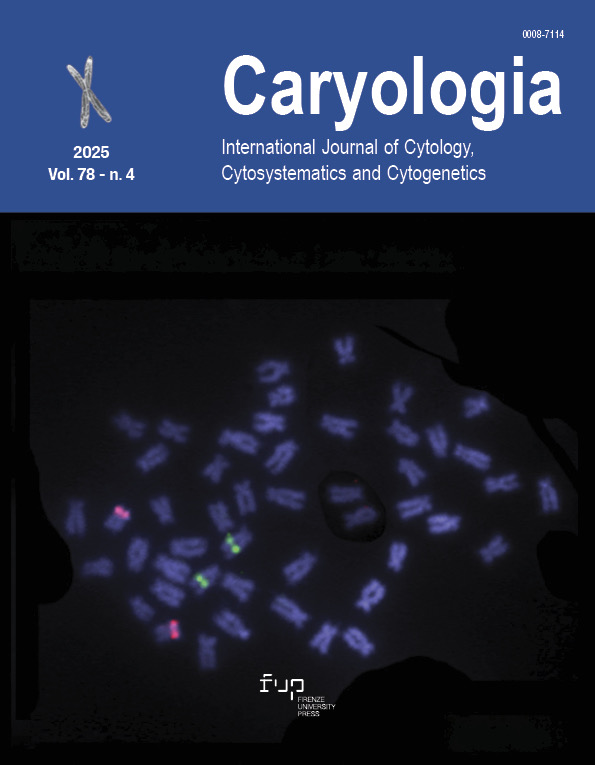
Glehnia littoralis, a critically endangered coastal plant endemic to sandy beach habitats, plays a unique role in the ecology of fragile coastal ecosystems. Its genome was characterized using an integrated approach combining flow cytometry, high-throughput sequencing, k-mer analysis, Smudgeplot, and cytogenetic validation. Flow cytometry estimated the genome size at ~2,913 Mb, while k-mer analysis under a diploid model (p = 2) revealed low heterozygosity (1.15%) and a high repeat content (80.87%), reflecting a relatively homogeneous yet highly repetitive genome shaped by historical whole-genome duplication events and transposon expansion. Smudgeplot patterns and cytogenetic analysis further confirmed the diploid status (2n = 22, x = 11) with a karyotype of 2n = 2x = 18m + 4sm (type 2A). These findings not only illuminate the evolutionary history and genomic architecture of this rare Apiaceae species but also offer critical insights into its adaptation to extreme coastal environments, providing valuable information for conservation strategies aimed at preserving this highly vulnerable, ecologically significant plant.
Downloads
References
Assessment Team for China’s Biodiversity Red List: Higher Plants. (2013). China’s biodiversity red list: Higher plants. Beijing: Science Press.
Bai, M. Z., Jiang, S. J., Chu, S. S., et al. (2024). The telomere-to-telomere (T2T) genome of Peucedanum praeruptorum Dunn provides insights into genome evolution and coumarin biosynthesis. GigaScience, 13, giae025. DOI: https://doi.org/10.1093/gigascience/giae025
Bainard, J. D., & Villarreal, J. C. (2013). Genome size increases in recently diverged hornwort clades. Genome, 56(8), 431–435. DOI: https://doi.org/10.1139/gen-2013-0041
Bennett, M. D., & Leitch, I. J. (2005). Plant genome size research: A field in focus. Annals of Botany, 95(1), 1–6. DOI: https://doi.org/10.1093/aob/mci001
Cock, P. J., Fields, C. J., Goto, N., et al. (2010). The Sanger FASTQ file format for sequences with quality scores, and the Solexa/Illumina FASTQ variants. Nucleic Acids Research, 38(6), 1767. DOI: https://doi.org/10.1093/nar/gkp1137
David, F. S., Antonio, R. C. J., de Jesus, P. B. J., Francisco, S. B. U., Jennifer, S. H., Alfredo, C. R., … & Lucina, B. M. (2024). Evaluation of ploidy and the DNA index by flow cytometry in central nervous system tumors: a review. Molecular Biology Reports, 51(1), 1141. DOI: https://doi.org/10.1007/s11033-024-10095-6
Dolezel J (2005) Plant DNA Flow Cytometry and Estimation of Nuclear Genome Size. Ann Bot 95:99–110. DOI: https://doi.org/10.1093/aob/mci005
Doležel, J., Greilhuber, J., & Suda, J. (2007). Estimation of nuclear DNA content in plants using flow cytometry. Nature Protocols, 2(9), 2233–2244.Fu, L. G. (1992). China plant red data book: Rare and endangered plants (p. 699). Beijing: Science Press. DOI: https://doi.org/10.1038/nprot.2007.310
Gong, N., Tian, X. M., & Zhou, X. Y. (2011). Applications of flow cytometry in plant research—Analysis of nuclear DNA content and ploidy level in plant cells. Chinese Agricultural Science Bulletin, 27(9), 21–27.
Han, X. X., Li, C., Sun, S. C., et al. (2022). The chromosome-level genome of female ginseng (Angelica sinensis) provides insights into molecular mechanisms and evolution of coumarin biosynthesis. Plant Journal, 112, 1224–1237. https://doi.org/10.1111/tpj.16007 DOI: https://doi.org/10.1111/tpj.16007
Iorizzo, M., Ellison, S., Senalik, D., et al. (2016). A high-quality carrot genome assembly provides new insights into carotenoid accumulation and asterid genome evolution. Nature Genetics, 48(6), 657–666. DOI: https://doi.org/10.1038/ng.3565
Lee, S. I., Kim, N. S. (2014). Transposable elements and genome size variations in plants. Genomics & informatics, 12(3), 87. DOI: https://doi.org/10.5808/GI.2014.12.3.87
Leitch, I. J., Johnston, E., Pellicer, J., et al. (2019). Angiosperm DNA C-values database (release 9.0, Apr 2019). https://cvalues.science.kew.org. Accessed 29 July 2025.
Levan, A., Fredga, K., & Sandberg, A. A. (1964). Nomenclature for centromeric position on chromosomes. Hereditas, 52, 201–220. DOI: https://doi.org/10.1111/j.1601-5223.1964.tb01953.x
Li, M. Y., Feng, K., Hou, X. L., et al. (2020). The genome sequence of celery (Apium graveolens L.), an important leaf vegetable crop rich in apigenin in the Apiaceae family. Horticulture Research, 7, 9. https://doi.org/10.1038/s41438-019-0235-2 DOI: https://doi.org/10.1038/s41438-019-0235-2
Liu B H, Shi Y J, Yuan J Y, et al. (2013). Estimation of genomic characteristics by analyzing k-mer frequency in de novo genome projects. Quantitative Biology, 35(s1–3), 62–67.
Liu, J.-X., Jiang, Q., Tao, J.-P., et al. (2021). Integrative genome, transcriptome, microRNA, and degradome analysis of water dropwort (Oenanthe javanica) in response to water stress. Horticulture Research, 8, 262. https://doi.org/10.1038/s41438-021-00707-8 DOI: https://doi.org/10.1038/s41438-021-00707-8
Liu, Q. X., Hui, H., & Liu, M. H. (1999). Chromosomal characteristics and evolutionary status of a rare and endangered plant Glehnia littoralis. Guihaia, (4), 344–348.
Loureiro, J., Čertner, M., Lučanová, M., Sliwinska, E., Kolář, F., Doležel, J., … & Galbraith, D. W. (2023). The use of flow cytometry for estimating genome sizes and DNA ploidy levels in plants. Plant cytogenetics and cytogenomics: methods and protocols (pp. 25-64). New York, NY: Springer US. DOI: https://doi.org/10.1007/978-1-0716-3226-0_2
Marcais, G., & Kingsford, C. (2011). A fast, lock-free approach for efficient parallel counting of occurrences of k-mers. Bioinformatics, 27(6), 764–770. DOI: https://doi.org/10.1093/bioinformatics/btr011
Ministry of Environmental Protection & Chinese Academy of Sciences. (2013). China red list of biodiversity: Higher plants [Internal document].
Mumbrú, M., Garnatje, T., Vallès, J. (2025). Methods of internal standards’ preservation for genome size assessments: a comparative study. Caryologia, 78(1), 53-58. DOI: https://doi.org/10.36253/caryologia-3323
National Forestry and Grassland Administration & Ministry of Agriculture and Rural Affairs. (2021, September 7). National key protected wild plants list (Announcement No. 15; approved by the State Council on August 7, 2021).
Ranallo-Benavidez, T. R., Jaron, K. S., & Schatz, M. C. (2020). GenomeScope 2.0 and Smudgeplot for reference-free profiling of polyploid genomes. Nature Communications, 11, 1432. DOI: https://doi.org/10.1038/s41467-020-14998-3
Radmanesh, P., Karimzadeh, G. (2025). Chromosome, ploidy analysis, and flow cytometric genome size of caper (Capparis spinosa) medicinal plant. Caryologia, 78(2), 3-19. DOI: https://doi.org/10.36253/caryologia-3633
Shan, R. H., & She, M. L. (1979). Umbelliferae III: Flora of China (Vol. 55, p. 316). Beijing: Science Press.
Song, X., Wang, J., Li, N., et al. (2020). Deciphering the high-quality genome sequence of coriander that causes controversial feelings. Plant Biotechnology Journal, 18, 1444–1456. https://doi.org/10.1111/pbi.13310 DOI: https://doi.org/10.1111/pbi.13310
Stebbins, G. L. (1971). Chromosomal evolution in higher plants. London: Edward Arnold.
Tamura, Y., Kubo, N., & Ohsako, T. (2022). Genetic diversity among Japanese local populations of an edible and medicinal coastal plant Glehnia littoralis F. Schmidt ex Miq. Genetic Resources and Crop Evolution, 69(1), 85–97. DOI: https://doi.org/10.1007/s10722-021-01205-5
Su X, Wang BA, Geng XL, Du YF, Yang QQ, Liang B et al (2021) A high-continuity and annotated tomato reference genome. BMC Genomics 22:898. DOI: https://doi.org/10.1186/s12864-021-08212-x
The Angiosperm Phylogeny Group. (2016). An update of the Angiosperm Phylogeny Group classification for the orders and families of flowering plants: APG IV. Botanical Journal of the Linnean Society, 181, 1–20. DOI: https://doi.org/10.1111/boj.12385
Vurture, G. W., Sedlazeck, F. J., Nattestad, M., et al. (2017). GenomeScope: Fast reference-free genome profiling from short reads. Bioinformatics, 33(14), 2202–2204. DOI: https://doi.org/10.1093/bioinformatics/btx153
Wang, Y.-H., Liu, P.-Z., Liu, H., et al. (2023). Telomere-to-telomere carrot (Daucus carota) genome assembly reveals carotenoid characteristics. Horticulture Research, 10, uhad103. https://doi.org/10.1093/hr/uhad103 DOI: https://doi.org/10.1093/hr/uhad103
Wen, J., Xie, D.-F., Price, M., et al. (2021). Backbone phylogeny and evolution of Apioideae (Apiaceae): New insights from phylogenomic analyses of plastome data. Molecular Phylogenetics and Evolution, 161, 107183. https://doi.org/10.1016/j.ympev.2021.107183 DOI: https://doi.org/10.1016/j.ympev.2021.107183
Xie, D. F., Xie, C., Ren, T., et al. (2022). Plastid phylogenomic insights into relationships, divergence, and evolution of Apiales. Planta, 256, 117. https://doi.org/10.1007/s00425-022-04031-w DOI: https://doi.org/10.1007/s00425-022-04031-w
Yang, H. X., Chu, J. M., & Zhang, J. T. (2011). Wild plants on the fore-edge of coastal sandy beaches in the Shandong Peninsula. Acta Botanica Boreali-Occidentalia Sinica, 46(1), 50–58. DOI: https://doi.org/10.3724/SP.J.1259.2011.00050
Zarco, C. R. (1986). A new method for estimating karyotype asymmetry. Taxon, 35(3), 526–530. DOI: https://doi.org/10.2307/1221906
Záveský, L., Jarolímová, V., & Štěpánek, J. (2005). Nuclear DNA content variation within the genus Taraxacum (Asteraceae). Folia Geobotanica, 40(1), 91–104. DOI: https://doi.org/10.1007/BF02803047
Zhang, G. F., Xiong, T. S., Sun, T., et al. (2022). Diversity, distribution, and conservation of rare and endangered plants in Jiangsu. Biodiversity Science, 30(2), 21335. DOI: https://doi.org/10.17520/biods.2021335
Zhang LM, Yuan JM, Pu TL, Qu WL, Lei X, Ma KH, et al. Chromosome-scale genome assembly of Phyllanthus emblica L. ‘Yingyu.’ DNA Res. 2025;32:dsaf006. DOI: https://doi.org/10.1093/dnares/dsaf006
Zhou, C. X., Zhang, J. S., & An, K. (2022). Chromosome karyotype and variation of coral vegetables from different places. Molecular Plant Breeding, 1–11.
Zhu, C. (1982). Plant chromosomes and chromosome techniques (p. 82). Beijing: Science Press.
Downloads
Published
How to Cite
Issue
Section
License
Copyright (c) 2025 Yi Zhong, Hui-min Li, Jun Wen, Bao-cheng Wu, Wei Zhou, Naiwei Li, Chunfeng song

This work is licensed under a Creative Commons Attribution 4.0 International License.
- Copyright on any open access article in a journal published byCaryologia is retained by the author(s).
- Authors grant Caryologia a license to publish the article and identify itself as the original publisher.
- Authors also grant any third party the right to use the article freely as long as its integrity is maintained and its original authors, citation details and publisher are identified.
- The Creative Commons Attribution License 4.0 formalizes these and other terms and conditions of publishing articles.
- In accordance with our Open Data policy, the Creative Commons CC0 1.0 Public Domain Dedication waiver applies to all published data in Caryologia open access articles.