
About

Call for Papers: Cultural relations between Italy and Latin America from the 1920s to the 1940s

The Cultural Secretariat of the IILA - International Italo-Latin American Organisation, opens the call for participation in the 6th issue of the journal "Quaderni Culturali IILA" - 2024. The proposed monographic issue of Quaderni Culturali IILA seeks to investigate the artistic, literary and intellectual exchanges between the Italian peninsula and the Latin American continent through the inter-textual and inter-artistic relationship between works and authors in the decades between 1920 and 1940.

Deadline for Submission of Articles: June 1, 2024

Download here the PDF of the Call and visit our Call for Papers webpage


Quaderni Culturali IILA is a freely available international magazine founded by the Cultural Secretary of IILA - Italo-Latin American Organization (international organization, of which Italy and twenty Latin American countries are members) in 2018. The magazine offers thematic issues and is published annually with contributions in Spanish, Italian, Portuguese, and English.

Quaderni Culturali IILA publishes studies and analyses of the arts and different Latin American cultures. The journal aims to promote intellectual discussion and critically innovative subjects and methodologies from a  interdisciplinary point of view.

Quaderni Culturali IILA - ONLINE ISSN 2785-5031

Editor in Chief - Claudia Barattini,  IILA Cultural Secretary


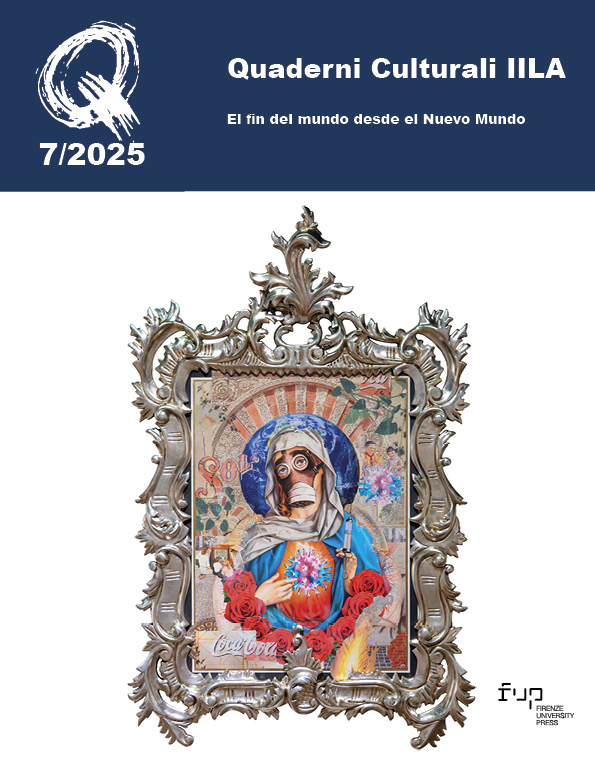
Current IssueVol 7, No 7 (2025): El fin del mundo desde el Nuevo Mundo

Published December 2, 2025
##issue.tableOfContents##

Table of Contents

Editorial
3
DOI: https://doi.org/10.36253/qciila-3830

Introduction

Introduction
Francesco Fasano
5-9
DOI: https://doi.org/10.36253/qciila-3831

Articles

Dispossessed States, migrant idioms and subalternity without frontiers in Yuri Herrera’s Señales que precederán al fin del mundo
Riccardo Lanza
43-52
DOI: https://doi.org/10.36253/qciila-3514
Ecology and contemporary art in Latin America: a critical view throughout painting and Land Art
Raúl Armando Amorós Hormazabal
117-126
DOI: https://doi.org/10.36253/qciila-3419
When Times Flow Together: Anticolonial Temporalities and Geological Intimacies in Matías Rendón’s Pluma de agua y fuego
Ariadna N. Tenorio López
87-95
DOI: https://doi.org/10.36253/qciila-3310
Lost and Imagined Futures in the Anthropocene: Human Action Before the Apocalypse
Tommaso Luperto
11-20
DOI: https://doi.org/10.36253/qciila-3305
The apocalypse as colonial legacy: nomadic ruptures and the crisis of the posnorteño in Northern Mexico
Jesús Rojas López, Sebastián Samuel Ubaldo Serratos
21-31
DOI: https://doi.org/10.36253/qciila-3301
Tecnosolutions for the future: Trap or possibility? An approach from Ygdrasil by Jorge Baradit
Federica Moscatelli
67-76
DOI: https://doi.org/10.36253/qciila-3288
The Prietopunk anthology: caribbean afrofuturism at its limits
Andrea Pezzè
77-85
DOI: https://doi.org/10.36253/qciila-3482
Creating networks in Latin American “sacrifice zones”: an analysis of two short stories by Liliana Colanzi
Isabella Locaputo
53-65
DOI: https://doi.org/10.36253/qciila-3311
The matter that shapes the world: a reading proposal of Chamanes eléctricos en la fiesta del sol by Mónica Ojeda
Mateo Orrego López
107-115
DOI: https://doi.org/10.36253/qciila-3306
The utopian question in Hispano america
Héctor Augusto Jiménez Esclusa
33-41
DOI: https://doi.org/10.36253/qciila-3303
Un lugar sin límites: Post-Apocalyptic, Hopepunk Memories in Elisa de Gortari’s Todo lo que amamos y lo que dejamos atrás
Kevin M. Anzzolin
97-106
DOI: https://doi.org/10.36253/qciila-3293
View All Issues