

Polyvalent Antivenom Potential of Cnestis ferruginea Root Extracts: Chromatographic Analysis and In Vivo Efficacy Against Snake Venoms
 Gloria Ndukwe
- Judith Nkedishu
- Joshua Konne
Published 2026-05-07
Keywords
- Polyvalent,
- Antivenom,
- Naja spp.,
- Echis ocellatus,
- Cnestis ferruginea
- Snake bite ...More
How to Cite
Copyright (c) 2026 Gloria Ndukwe, Judith Nkedishu, Joshua Konne

This work is licensed under a Creative Commons Attribution 4.0 International License.




Abstract
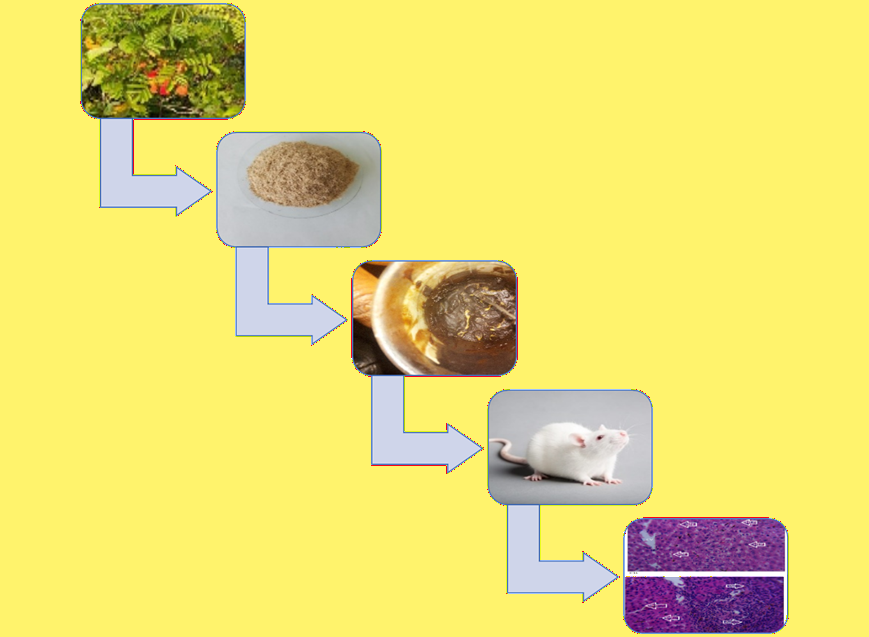
Snakebite is a major challenge in the world. Venoms of different snakes exert haemotoxic, neurotoxic and cytotoxic effects on the victims. Despite the successful use of serum therapy, antivenom has limitations especially in neutralizing tissue damage and being unavailable for use when needed. In this study, Cnestis ferruginea root extracts were investigated for antisnake venom properties against Naja melanoleuca, Naja haje, Naja kateinsis and Echis ocellatus venoms in albino rats. Concentrations used were found to have neutralized almost all toxic effects induced by the venoms. In vivo assessment of venom lethality (LD50) for all four venoms was determined using probit analysis and found to be 0.455 and 0.465 mg/kg. The extracts neutralized the lethality of the venoms with effective dose at 50% survival (ED50) found to be 1.4 mg/kg. Haematology and histopathology of liver and kidney of test rats were conducted to show the venom toxic effect and the ameliorative effect of the extract on envenomation. Phytochemical analysis of C. ferruginea root extract showed that it contains biochanin A, formononetin, genistein, anethole, myristicin, quercetin and chlorogenic acid which have antivenom properties. The root extracts have inhibitory action against hemorrhagic, inflammatory, and myotoxic activities of the venoms; and can be considered as polyvalent antivenom.
References
- J. P. Chippaux, A. Massougbodji, A. G. Habib, *J Ven Anim Toxins Incl Trop Dis* 2019, 25, 83-88. [https://doi.org/10.1590/1678-9199-JVATITD-2019-0083](https://doi.org/10.1590/1678-9199-JVATITD-2019-0083)
- WHO Snakebite Envenoming, [https://who.int/health-topics/snakebite#tab=tab_1](https://who.int/health-topics/snakebite#tab=tab_1).
- T. S. Kang, D. Georgieva, N. Genov, M. T. Murakami, M. Sinha, R. P. Kumar, *FEBS J* 2011, 278(23), 4544-4576. [https://doi.org/10.1111/j.1742-4658.2011.08115.x](https://doi.org/10.1111/j.1742-4658.2011.08115.x)
- A. G. Habib, *J Venom Anim Toxins Incl Trop Dis* 2013, 19(27), 1-7. [https://jvat.biomedcentral.com/articles/10.1186/1678-9199-19-27](https://jvat.biomedcentral.com/articles/10.1186/1678-9199-19-27)
- S. Spawls, B. Branch Ralph Curtis Books Oriental Press 1995, 91.
- A. G. Habib, S. B. Abubakar, I. S. Abubakar, S. Larnyang, N. Durfa, A. Nasidi, *J Trop Med Int Health* 2008, 13(9), 1172-1175. [https://doi.org/10.1111/j.1365-3156.2008.02122.x](https://doi.org/10.1111/j.1365-3156.2008.02122.x)
- L. P. Lauridsen, A. H. Lausten, B. Lomonte, J. M. Gutierrez, *J Proteomics* 2017, 150, 98-108. [https://doi.org/10.1016/j.jprot.2016.08.024](https://doi.org/10.1016/j.jprot.2016.08.024)
- H. A. de Silva, N. M. Ryan, H. J. de Silva, *Br J Clin Pharmacol* 2016, 81(3), 446–452. [https://doi.org/10.1111/bcp.12739](https://doi.org/10.1111/bcp.12739).
- J. M. Gutiérrez, D. A. Warrell, D. J. Williams, S. Jensen, N. Brown, J. J. Calvete, *PLoS Negl Trop Dis* 2013, 7(6), 2162-2166. [https://doi.org/10.1371/journal.pntd.0002162](https://doi.org/10.1371/journal.pntd.0002162).
- F. C. Akharaiyi, B. Boboye, F. C. Adetuyi, *JMBFS* 2012, 2(2), 592-609. [http://www.jmbfs.org/issue/october-november-2012-vol-2-no-3/jmbfs0101/?issue_id=1498&article_id=18](http://www.jmbfs.org/issue/october-november-2012-vol-2-no-3/jmbfs0101/?issue_id=1498&article_id=18)
- I. O. Ishola, A. J. Akindele, O. O. Adeyemi, *J Ethnopharmacol* 2011, 135(1), 55–62. [https://doi.org/10.1016/j.jep.2011.02.024](https://doi.org/10.1016/j.jep.2011.02.024).
- F. R. Irvine, Oxford University press, London 1961, 1, 570–572.
- P. K. Goswani, M. Samant, R. S. Srivastava, *Inter J Pharm Pharma Sci* 2014, 6(5), 4-7. [https://www.researchgate.net/publication/288067425_Snake_venom_anti-snake_venom_potential_of_snake_venom](https://www.researchgate.net/publication/288067425_Snake_venom_anti-snake_venom_potential_of_snake_venom).
- Y. Y. Zhang, Y. F. Huang, J. Liang, H. Zhou, *BMC Pharmacol Toxicol* 2022, 23(3), 541-547. [https://doi.org/10.1186/s40360-021-00541-7](https://doi.org/10.1186/s40360-021-00541-7)
- R. D. G. Theakston, H. A. Reid, *Bull World Health Organ* 1983, 61(6), 949-956.
- I. Aguilar, E. E. Sánchez, M. E. Girón, A. Estrella, B. Guerrero, F. A. Rodriguez-Acosta, *Rev Inst de Med Trop Sao Paulo* 2014, 56(1), 61-66. [https://doi.org/10.1590/S0036-46652014000100009](https://doi.org/10.1590/S0036-46652014000100009)
- E. S. Iful, 2021, Available from [https://afribary.com/works/studies-on-antivenom-activities-of-the-aqueous-extracts-of-paullinia-pinnata-and-detarium-microcarpum-against-echis-carinatus-carpet-viper-venom-1](https://afribary.com/works/studies-on-antivenom-activities-of-the-aqueous-extracts-of-paullinia-pinnata-and-detarium-microcarpum-against-echis-carinatus-carpet-viper-venom-1).
- G. I. Ndukwe, S. Y. Garba, E. A. Adelakun, *IOSR-JAC* 2016, 9(9), 118-1131. [https://doi.org/10.9790/5736-090902118131](https://doi.org/10.9790/5736-090902118131)
- L. C. Wang, *Sci Dir* 1971, 42(1), 296-298. [https://doi.org/10.1016/0003-2697(71)90041-8](https://doi.org/10.1016/0003-2697%2871%2990041-8)
- A. J. Harborne, *Phytochemical Methods: A guide to modern techniques of plant analysis*, 1998, pp 56-57.
- S. G. Ćetković, S. M. Dilas, J. M. Čanadanović-Brunet, V. T. Tumbas, *Acta periodica technologica* 2003, 34, 93-102. [https://doi.org/10.2298/APT0334093C](https://doi.org/10.2298/APT0334093C)
- S. E. Gasanov, R. K. Dagda, E. D. Rael, *J Clin Toxicol* 2014, 4(1), 495-498. [https://doi.org/10.4172/2161-0495.1000181](https://doi.org/10.4172/2161-0495.1000181)
- T. Sivaraman, N. S. Sreedevi, S. Meenachisundharam, R. Vadivelan, *Braz J Pharm Sci* 2020, 56, e18050. [https://doi.org/10.1590/s2175-97902019000418050](https://doi.org/10.1590/s2175-97902019000418050)
- C. K. Enenebeaku, S. C. Umerie, M. U. Nwankwo, U. E. Enenebeaku, *WNOFNS* 2018, 16, 33-41. [https://www.researchgate.net/profile/Enenebeaku-Uchechi/publication/327070897_Anti-snake_venom_activities_of_the_leaf_extracts_of_Asystasia_gangetica_L_and_Newbouldia_Leavis_PBeauv/links/5b76bb22a6fdcc0d4ee1a71d/Anti-snake-venom-activities-of-the-leaf-extracts-of-Asystasia-gangetica-L-and-Newbouldia-Leavis-PBeauv.pdf](https://www.researchgate.net/profile/Enenebeaku-Uchechi/publication/327070897_Anti-snake_venom_activities_of_the_leaf_extracts_of_Asystasia_gangetica_L_and_Newbouldia_Leavis_PBeauv/links/5b76bb22a6fdcc0d4ee1a71d/Anti-snake-venom-activities-of-the-leaf-extracts-of-Asystasia-gangetica-L-and-Newbouldia-Leavis-PBeauv.pdf)
- C. H. Ernst, G. R. Zug, *Snakes in Question: The Smithsonian answer book*. Washington, Smithsonian Institution Scholarly Press, 1996, pp 112.
- U. K. Ranawaka, D. G. Lalloo, H. J. de Silva, *PLoS Negl Trop Dis* 2013, 7(10), 919-24. [https://doi.org/10.1371/journal.pntd.0002302](https://doi.org/10.1371/journal.pntd.0002302)
- Y. G. Zhang, X. L. Guo, Y. Song, C. F. Miao, C. Zhang, N. H. Chen, *Open Biomed Eng J* 2015, 9, 250-255. [https://doi.org/10.2174/1874120701509010250](https://doi.org/10.2174/1874120701509010250)
- S. R. Fattepur, S. P. Gawade, *Pharm Mag* 2007, 3(9), 56-60. [https://www.scinapse.io/papers/2528875971](https://www.scinapse.io/papers/2528875971)
- V. Lala, M. Zubair, D. A. Minter, 2022, *Liver function tests*. In: *StatPearls* [Internet]. Treasure Island (FL): StatPearls Publishing. Available from [https://www.ncbi.nlm.nih.gov/books/NBK482489/](https://www.ncbi.nlm.nih.gov/books/NBK482489/).
- P. Hall, J. Cash, *Ulster Med J* 2012, 81(1), 30-36. [https://www.ncbi.nlm.nih.gov/pmc/articles/PMC3609680/](https://www.ncbi.nlm.nih.gov/pmc/articles/PMC3609680/)
- R. A. Adisa, M. I. Choudhary, E. O. Adewoye, O. O. Olorunsogo, *Afr J Tradit Complement Altern Med* 2010, 7(3), 185-194. [https://doi.org/10.4314/ajtcam.v7i3.54774](https://doi.org/10.4314/ajtcam.v7i3.54774).
- A. I. Okafor, N. N. Ogban, A. A. Odinigwe, *Toxicol Rep* 2022, 9, 1869-76. [https://doi.org/10.1016/j.toxrep.2022.10.003](https://doi.org/10.1016/j.toxrep.2022.10.003)
- A. O. Adeyi, S. B. Ajisebiola, E. O. Adeyi, C. G. Alimba, U. G. Okorie, *Sci Afr* 2020, 8, 10-12. [https://doi.org/10.1016/j.sciaf.2020.e00356](https://doi.org/10.1016/j.sciaf.2020.e00356).
- N. Chaiyabutr, L. Chanhome, T. Vasaruchapong, P. Laoungbua, O. Khow, A. S. Runsipipat, *Toxicon* 2020, 7(7), 146-150. [https://doi.org/10.1016/j.toxcx.2020.100046](https://doi.org/10.1016/j.toxcx.2020.100046).
- J. W. Daly, *J Nat Prod* 2003, 66(6), 901-902.
- W. B. Mors, M. C. Nascimento, B. M. Pereira, N. A. Pereira, *Phytochemistry* 2000, 55(6), 627-642. [https://doi.org/10.1016/S0031-9422(00)00229-6](https://doi.org/10.1016/S0031-9422%2800%2900229-6)
- J. A. Pereañez, V. Núñez, A. C. Patiño, M. Londoño, J. C. Quintana, *Vitae* 2011, 18(3), 295-304. [https://doi.org/10.17533/udea.vitae.10653](https://doi.org/10.17533/udea.vitae.10653)
- A. Khalid, T. H. Mallhi, Y. H. Khan, A. Khokhar, S. Chaman, M. Ali, *Brazilian J Pharm Sc* 2022, 58, 1-16. [https://doi.org/10.1590/s2175-97902022e191124](https://doi.org/10.1590/s2175-97902022e191124)
- K. Gopi, K. Renu, G. Jayaraman, *Toxicol Rep* 2014, 1, 667-673. [https://doi.org/10.1016/j.toxrep.2014.08.012](https://doi.org/10.1016/j.toxrep.2014.08.012)
- M. Maqbool, K. Shenmar, A. Akther, R. H. Mir, A. F. Wali, R. Mohi-ud-din, In: Arunachalam, K., Yang, X., Puthanpura Sasidharan, S. (eds) *Bioprospecting of Tropical Medicinal Plants*. Springer Cham 2023. [https://doi.org/10.1007/978-3-031-28780-0_32](https://doi.org/10.1007/978-3-031-28780-0_32)
- P. Singh, M. Yasir, R. Hazarika, S. Sugunan, R. Shrivastava, *J Pharmacopuncture* 2017, 20(3), 173–178. doi:10.3831/KPI.2017.20.020