

Occurrence, Abundance, and Distribution of Microplastics in the basins of Kabani River, Wayanad, Western Ghats, India: A Baseline Assessment
Published 2026-01-29
Keywords
- Kabani,
- Microplastics,
- River,
- Wayanad,
- Western Ghats
How to Cite
Copyright (c) 2026 Sruthi Rajeevan, Sanu Francis Vengasseril, Alinda Shaji, Jorphin Joseph, Lathika Cicily Thomas, Aishwarya Purushothaman , Jimly C. Jacob

This work is licensed under a Creative Commons Attribution 4.0 International License.




Abstract
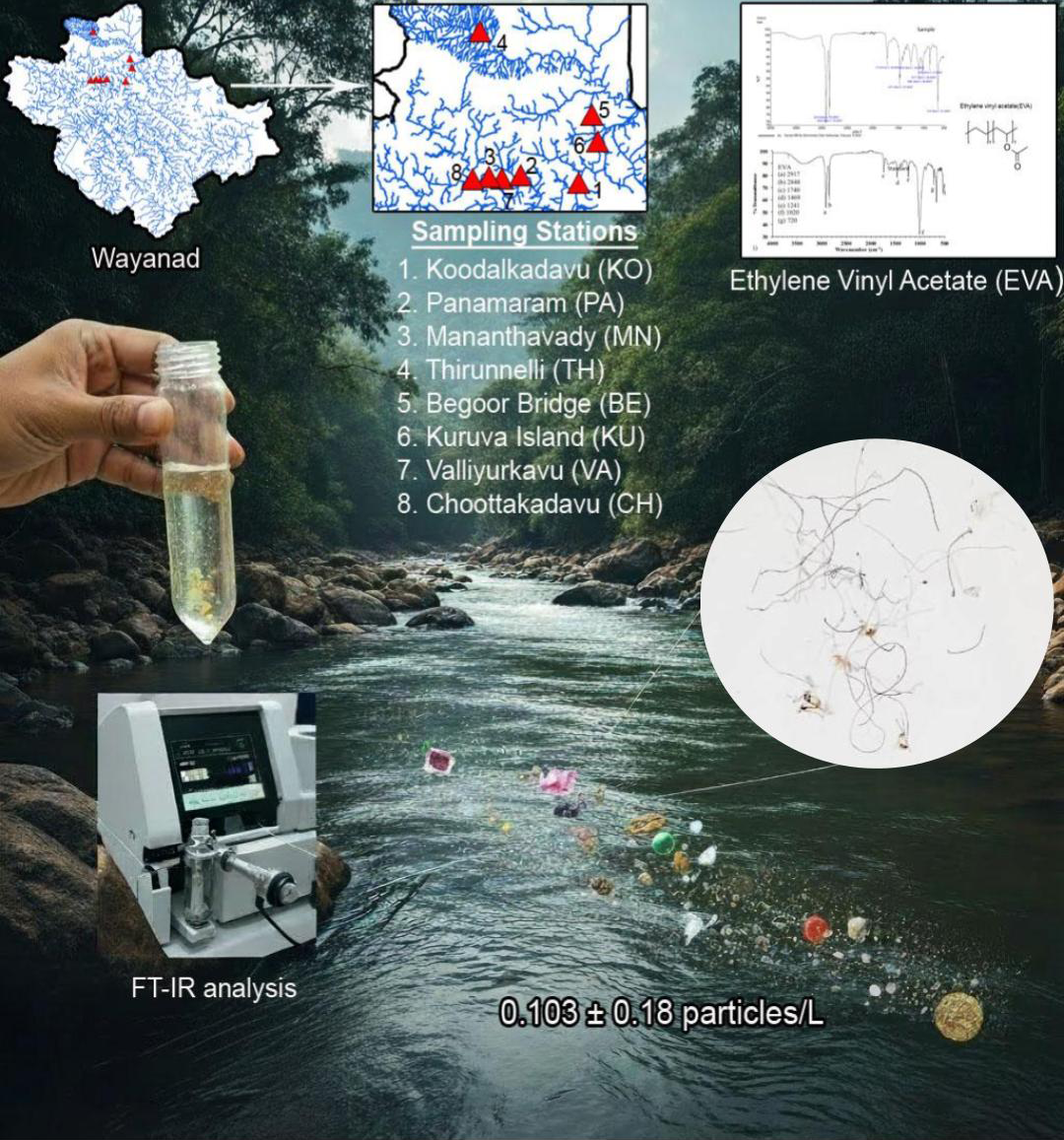
The large-scale production of plastics and their subsequent dispersal into water bodies have harmful impacts on aquatic environments. Despite being major manufacturers of plastic waste, developing countries have inadequate research on microplastics in freshwater ecosystems. This study examines the occurrence, abundance, and distribution of microplastic particles in the basins of the Kabani River, a region of the Western Ghats in Wayanad. The sampling was conducted at eight study stations across the Kabani River basin and analysed for microplastics using a density separation method. Identification of the microplastic particles was made using Fourier Transform Infrared spectroscopy (FTIR) with Attenuated Total Reflectance (ATR). The average abundance of microplastics collected from the major tributaries of the Kabani River was 0.103 ± 0.18 particles/L (median 0.0135 particles/L) during the study. Ethylene Vinyl Acetate (EVA) was the prevalent polymer collected in the samples. As Wayanad's first report on microplastic particles in the Kabani River, this study catalyzes additional investigation into the distribution and effects of this new contaminant on the biota of several aquatic systems throughout Kerala and India.
References
- 1. Thompson, R.C., Swan, S.H., Moore, C.J., and Vom, S.F.S., (2009), “Our plastic age”, Philos Trans R So. B: Biol Sci, 364, 1973−1976. https://doi.org/10.1098/rstb.2009.0054
- 2. Mulder, K.F., (1998), “Sustainable consumption and production of plastics?” Technol Forecast Soc Change, 58 (1-2), 105−124. https://doi.org/10.1016/S0040-1625(97)00129-7
- 3. Bhat, M.A., Eraslan, F.N., Gaga, E.O., Gedik, K.: Scientometric analysis of microplastics across the globe. In: Vithanage, M., Vara Prasad, M.N. (ed.) Microplastics in the ecosphere: air, water, soil, and food, Willey, New York (2023). https:// doi. org/ 10. 1002/ 97811 19879 534. ch1
- 4. Rubio, L., Marcos, R., and Hernández, A., (2019), “Potential adverse health effects of ingested micro- and nanoplastics on humans. Lessons learned from in vivo and in vitro mammalian models”, J Toxicol Environ Health Part B, 23(2), 1−18. https://doi.org/10.1080/10937404.2019.1700598
- 5. Andrady, A.L., (2011), “Microplastics in the marine environment”, Marine Poll Bull, 62 (8), 1596–1605.
- 6. Geyer, R., Jambeck, J.R., and Law, K.L., (2017), “Production, use, and fate of all plastics ever made”, Sci Adv, 3(7), e1700782.
- 7. Issac, M.N., and Kandasubramanian, B., (2021), “Effect of microplastics in water and aquatic systems”, Environ Sci Pollut Res, 28, 19544−19562. https://doi.org/10.1007/s11356-021-13184-2
- 8. Cai, Y., Li, C., and Zhao, Y., (2021), “A review of the migration and transformation of microplastics in inland water systems”, Int J Environ Res Public Health, 19(1), 148. https://doi.org/10.3390/ijerph19010148
- 9. Lechner, A., Keckeis, H., Lumesberger, L.F., Zens, B., Krusch, R., Tritthart, M., Glas, M., and Schludermann, E., (2014), “The Danube so colourful: a potpourri of plastic litter outnumbers fish larvae in Europe's second largest river”, Environ Pollut, 188, 177−181. https://doi.org/10.1016/j.envpol.2014.02.006
- 10. Eerkes-Medrano, D., Thompson, R.C., and Aldridge, D.C., (2015), “Microplastics in freshwater systems: a review of the emerging threats, identification of knowledge gaps and prioritisation of research needs”, Water Res, 75, 63−82. https://doi.org/10.1016/j.watres.2015.02.012
- 11. Su, L., Xiong, X., Zhang, Y., Wu, C., Xu, X., Sun, C., and Shi, H., (2022), “Global transportation of plastics and microplastics: A critical review of pathways and influences”, Sci Total Environ, 831, 154884. https://doi.org/10.1016/j.scitotenv.2022.154884
- 12. Patidar, K., Ambade, B., Younis, A.M., and Alluhayb, A.H., (2024), “Characteristics, fate, and sources of microplastics contaminant in surface water and sediments of river water”, Phys Chem Earth (Pt A B C), 134, 103596. https://doi.org/10.1016/j.pce.2024.103596
- 13. Auta, H.S., Emenike, C.U., and Fauziah, S.H., (2017), “Distribution and importance of microplastics in the marine environment: A review of the sources, fate, effects, and potential solutions”, Environ Int, 102, 165−176. https://doi.org/10.1016/j.envint.2017.02.013
- 14. Miller, M.E., Hamann, M., and Kroon, F.J., (2020), “Bioaccumulation and biomagnification of microplastics in marine organisms: A review and meta-analysis of current data”, PloS One, 15(10), e0240792. https://doi.org/10.1371/journal.pone.0240792
- 15. Junaid, M., Siddiqui, J.A., Sadaf, M., Liu, S., and Wang, J., (2022), “Enrichment and dissemination of bacterial pathogens by microplastics in the aquatic environment”, Sci Total Environ, 830, 154720. https://doi.org/10.1016/j.scitotenv.2022.154720
- 16. Rajendran, S., (2015), Identification of potential landslide vulnerable zones of Wayanad district, kerala using remote sensing and GIS. PhD Thesis, Kerala University of Fisheries and Ocean Studies, Kerala, India.
- 17. Thomas, J., Joseph, S., and Thrivikramaji, K.P., (2010), “Morphometric aspects of a small tropical mountain river system, the southern Western Ghats, India”, Int J Digit Earth, 3(2), 135−156. https://doi.org/10.1080/17538940903464370
- 18. Times of India, (2018), “Quiet die the Kerala’s rivers”, Times of India. https://timesofindia.indiatimes.com/city/kochi/quiet-die-the-keralas-rivers/articleshow/62878503.cms
- 19. Star of Mysore, (2021), Cauvery, Kabini among polluted rivers. Star of Mysore.
- https://starofmysore.com/cauvery-kabini-among-polluted-rivers/
- 20. Manoj, E.M., (2022, April 18). “Algal bloom poses threat to Kabani river ecosystem”, The Hindu. https://www.thehindu.com/news/national/kerala/algal-bloom-poses-threat-to-kabani-river-ecosystem/article65331989.ece
- 21. Li, C., Luo, D., Shi, Y., Bai, X., Krause, S., Wang, R., and Li, K., (2025), “Advances in quantifying the drivers of the occurrence, transport, and fate of freshwater microplastics”, Crit Rev Env Sci Tec, 55(1), 49–71. https://doi.org/10.1080/10643389.2024.2380537
- 22. Sarijan, S., Azman, S., Said, M.I.M., and Jamal, M.H., (2021), “Microplastics in freshwater ecosystems: a recent review of occurrence, analysis, potential impacts, and research needs”, Environ Sci Pollut Res, 28, 1341−1356. https://doi.org/10.1007/s11356-020-11171-7
- 23. John, J., Bindu, G., Srimuruganandam, B., Wadhwa, A., Rajan, P., (2020), “Land use/land cover and land surface temperature analysis in Wayanad district, India, using satellite imagery”, Ann GIS, 26(4), 343−360. https://doi.org/10.1080/19475683.2020.1733662
- 24. Thampy, D.R., Sethu, M.R., Paul, M.B., and Shaji, C.P., (2021), “Ichthyofaunal diversity in the upper-catchment of Kabini River in Wayanad part of Western Ghats, India”, J Threat Taxa, 13, 17651−17669. https://doi.org/10.11609/jott.6159.13.2.17651-17669
- 25. Government of Kerala., (2024), “Economic Review 2023 (Vol. I & II)”, State Planning Board, Thiruvananthapuram, Kerala, India.
- 26. USBR, (1997): United States Bureau of Reclamation, Water Measurement Manual. 3rd ed. U.S. Department of the Interior, Bureau of Reclamation, Denver, CO. https://www.usbr.gov/tsc/techreferences/mands/wmm/WMM_3rd_2001.pdf
- 27. FAO, “Food and Agriculture Organization of the United Nations. 1992. Annex 1: Measurement of stream velocity by floats and determination of discharge. In: Simple methods for aquaculture: Annexes. FAO Training Series No. 21/1. Rome, Italy (1992). https://www.fao.org/4/AC061E/AC061E07.htm
- 28. Free, C.M., Jensen, O.P., Mason, S.A., Eriksen, M., Williamson, N.J., and Boldgiv, B., (2014), “High-levels of microplastic pollution in a large, remote, mountain lake”, Mar. Pollut. Bull, 85 (1), 156−163. https://doi.org/10.1016/j.marpolbul.2014.06.001
- 29. Masura, J., Baker, J.E., Foster, G.D., Arthur, C., and Herring, C. (2015). Laboratory methods for the analysis of microplastics in the marine environment: Recommendations for quantifying synthetic particles in waters and sediments (NOAA Technical Memorandum NOS-OR&R-48). National Oceanic and Atmospheric Administration, U.S. Department of Commerce, Silver Spring, MD. 31 pp. DOI: 10.25607/OBP-604.
- 30. Naidu, B.C., Xavier, K.M., Shukla, S.P., Jaiswar, A.K., and Nayak, B.B., (2022a), “Comparative study on the microplastics abundance, characteristics, and possible sources in yellow clams of different demographic regions of the northwest coast of India”, J Hazard Mater Lett, 3, 100051. https://doi.org/10.1016/j.hazl.2022.100051
- 31. Naidu, B.C., Xavier, K.M., Shukla, S.P., Jaiswar, A.K., and Nayak, B.B., (2022b), “Microplastics in the foreshore coastal waters, sediment, and coastal fauna of a highly populated megacity-A study on the effect of anthropogenic discharge on clams”, Mar. Pollut. Bull, 185, 114262. https://doi.org/10.1016/j.marpolbul.2022.114262
- 32. Aneesh, M. R., Mani, K., Prasad, T. K., and Robert, H., (2019), “Land use effect on water quality in a tropical river basin of Kerala, India”, Geo Eye, 8, 28−36.
- 33. Goswami, G., Mandal, S., Basack, S., Mukherjee, R., and Karakouzian, M., (2023), “Assessing the impacts of land use and land cover changes on the water quality of River Hooghly, West Bengal, India: a case study”, Hydrology, 10, 71.
- 34. Ajay, K., Kumar, S., Kaushal, S., Resmi, M. R., Singh, A., and Anoop, A., (2025), “Source-to-sink dynamics of microplastics and heavy metals along a land-use gradient in the tropical river system of India”, J Hazard Mater Adv, 100899.
- 35. Kumar, R., Verma, A., Shome, A., Sinha, R., Sinha, S., Jha, P.K., and Vara, P.P.V., (2021), “Impacts of plastic pollution on ecosystem services, sustainable development goals, and need to focus on circular economy and policy interventions”, Sustainability, 13 (17), 9963. https://doi.org/10.3390/su13179963
- 36. Ganesan, M., Gobi, N., and Seshachalam, S., (2019), “Fate and transport of microplastics from water sources”, Curr Sci, 117(11), 1879−1885.
- 37. Zhang, Q., Xu, E.G., Li, J., Chen, Q., Ma, L., and Zeng, E.Y., (2020), “A review of microplastics in table salt, drinking water, and air: direct human exposure”, Environ Sci Technol, 54 (7), 3740−51. https://doi.org/10.1021/acs.est.9b04535
- 38. Ma, H., Pu, S., Liu, S., Bai, Y., Mandal, S., and Xing, B., (2020), “Microplastics in aquatic environments: toxicity to trigger ecological consequences”, Environ Pollut., 261, 114089. https://doi.org/10.1016/j.envpol.2020.114089
- 39. Rillig, M.C., and Lehmann, A., (2020), “Microplastic in terrestrial ecosystems”, Science, 368(6498), 1430−1431.
- 40. Dodson, G.Z., Shotorban, A.K., Hatcher, P.G., Waggoner, D.C., Ghosal, S., and Noffke, N., (2020), “Microplastic fragment and fibre contamination of beach sediments from selected sites in Virginia and North Carolina, USA”, Mar Pollut Bull, 151, 110869.
- 41. McNeish, R.E., Kim, L.H., Barrett, H.A., Mason, S. A., Kelly, J. J., and Hoellein, T. J., (2018), “Microplastic in riverine fish is connected to species traits”, Sci Rep, 8, 11639. https://doi.org/10.1038/s41598-018-29980-9
- 42. Anagha, P,L., Viji, N.V., Devika, D., and Ramasamy, E.V., (2023), “Distribution and abundance of microplastics in the water column of Vembanad Lake-A Ramsar site in Kerala, India”, Mar Pollut Bul, 194, 15433. doi: 10.1016/j.marpolbul.2023.115433.
- 43. Begum, M., Nagalakshmi, R., Joseph, A., Balaji, A., Saichand, V., Kaviarasan, T., and Mishra, P., (2024), “Abundance, distribution and characterisation of microplastics in Tropical River Estuary, South East Coast of India”, Water Air Soil Poll, 235(8), 486. https://doi.org/10.1007/s11270-024-07207-0
- 44. Mukhopadhyay, P., and Valsalan, S.A., (2024), “Seasonal variation, spatial distribution and risk assessment of microplastics in surface waters of Periyar River, Kerala, India”, Environ Monit Assess, 196, 679. https://doi.org/10.1007/s10661-024-12820-x
- 45. Neelavannan, K., and Sen, I.S., (2023), “Microplastics in freshwater ecosystems of India: current trends and future perspectives”, ACS omega, 8(38), 34235−34248. https://doi.org/10.1021/acsomega.3c01214
- 46. Acharya, S., Rumi, S.S., Hu, Y., and Abidi, N., (2021), “Microfibres from synthetic textiles as a major source of microplastics in the environment: A review” Text Res J, 91, 2136−2156.
- 47. Frost, H., Bond, T., Sizmur, T., and Felipe-Sotelo, M., (2022), “A review of microplastic fibres: generation, transport, and vectors for metal (loid) s in terrestrial environments”, Environ Sci: Processes Impacts, 24, 504−524.
- 48. Kumar, M., Kartha, S.K., Rajathy, A.R., Ratheesh Kumar S., Chandini, C.S., Vidya, P.K., Madhuraj, P.V., Sajith, P.K., and Anamika, S., (2023), “Characterisation of suspended microplastics in surface waters of Chalakudy River, Kerala, India”, Chem. Ecol, 39(3), 268−287, https://doi.org/10.1080/02757540.2023.2178648
- 49. Veerasingam, S., Mugilarasan, M., Venkatachalapathy, R., and Vethamony, P., (2016), “Influence of 2015 flood on the distribution and occurrence of microplastic pellets along the Chennai coast, India”, Mar Pollut Bull, 109, 196−204.
- 50. Sathish, N., Jeyasanta, K.I., and Patterson, J., (2020), “Microplastic contamination in River Kosasthalaiyar, associated creek and lake of Chennai, India”, J Aquat Biol Fish, 8, 68−76.
- 51. Shruti, V.C., Perez-Guevara, F., Elizalde-Martínez, I., and Kutralam-Muniasamy, G., (2020). First study of its kind on the microplastic contamination of soft drinks, cold tea and energy drinks-Future research and environmental considerations. Sci Total Environ, 726, 138580.
- 52. Amrutha, K., Shajikumar, S., Warrier, A.K., Sebastian, J.G., Sali, Y.A., Chandran, T., Sivadas, S., Naik, R., Amrish, V.N., Kumar, A., and Unnikrishnan, V., (2022), “Assessment of pollution and risks associated with microplastics in the riverine sediments of the Western Ghats: A heritage site in southern India”, Environ Sci Pollut Res Int, 30, 32301−32319.
- 53. Sathish, M.N., Immaculate J,K., and Patterson, J., (2020), “Microplastic contamination in River Kosasthalaiyar, associated creek and lake of Chennai, Tamil Nadu, India”, J Aquat Biol Fish, 8, 68−76.
- 54. Hurley, R., Woodward, J., and Rothwell, J.J., (2018), “Microplastic contamination of river beds significantly reduced by catchment-wide flooding”, Nat Geosci, 11, 251−257.
- 55. Zettler, E.R., Mincer, T.J., and Amaral, Z.L.A., (2013), “Life in the “Plastisphere”: Microbial communities on plastic marine debris”, Environ Sci Technol, 47, 7137−7146.
- 56. Deocaris, C.C., Allosada, J.O., Ardiente, L.T., Bitang, L.G.G., Dulohan, C.L., Lapuz, J.K.I., and Padolina, J.B.P., (2019), “Occurrence of microplastic fragments in the Pasig River”, H2OPEN J, 2 (1), 92−100. https://doi.org/10.2166/h2oj.2019.001
- 57. Egbeocha, C.O., Malek, S., Emenike, C.U., and Milow, P., (2018), “Feasting on microplastics: ingestion by and effects on marine organisms”, Aquat Biol, 27, 93−106.
- 58. Benson, N.U., Agboola, O.D., Fred-Ahmadu, O.H., De-la-Torre, G.E., Oluwalana, A., and Williams, A.B., (2022), “Micro (nano) plastics prevalence, food web interactions, and toxicity assessment in aquatic organisms: a review”, Front Mar Sci, 9, 851281.
- 59. Singh, P.K., Singh, A., Tripathi, K., Basniwal, R.K., Chauhan, R., and Chauhan, A., (2024), “Insights into the seasonal variation, distribution, composition and dynamics of microplastics in the Ganga River ecosystem of Varanasi City, Uttar Pradesh, India”, Environ Monit Assess., 196, 1134. https://doi.org/10.1007/s10661-024-13307-5
- 60. Gupta, P., Saha, M., Rathore, C., Suneel, V., Ray, D., Naik, A., and Daga, K., (2021), “Spatial and seasonal variation of microplastics and possible sources in the estuarine system from central west coast of India”, Environ. Pollut., 288, 117665. https://doi.org/10.1016/j.envpol.2021.117665
- 61. Kole, P.J., Lohr, A.J., Van Belleghem, F.G.A.J., and Raghupathy, L., (2017), “Wear and tear of tyres: A stealthy source of microplastics in the environment”, Int J Environ Res Public Health., 14, 1265.