Lead and copper toxicity affecting chromosome structure, cell death, and micronucleus formation in Glycine max Cv-JS-355 root tip cells
DOI:
https://doi.org/10.36253/caryologia-3423Keywords:
Heavy metals (Pb and Cu), seed germination, radicle length, mitotic index, genotoxicity, cell death, Glycine max Cv-JS-355Abstract
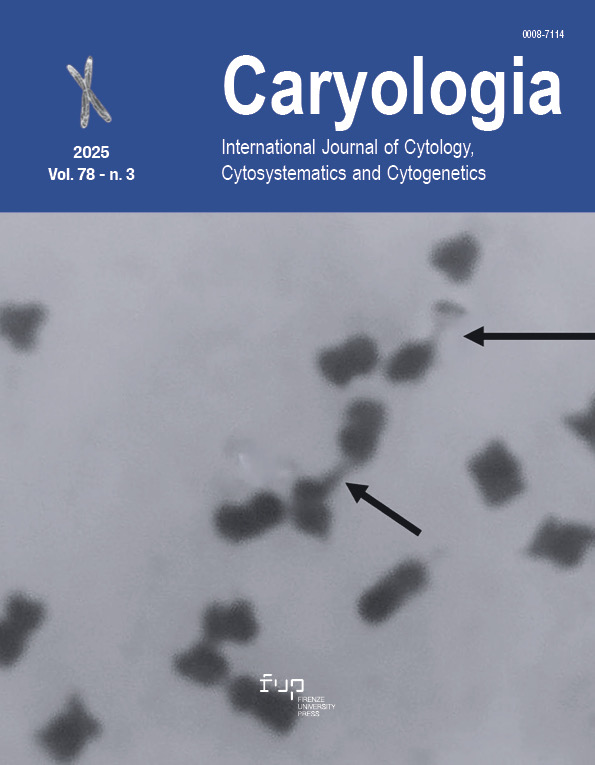
The rapid rise of heavy metals and their extensive industrial use have raised concerns because these metals are released into the environment from both intentional and unintentional sources. When present in the environment in high concentrations, heavy metals may threaten the plant kingdom, particularly staple food crops. Nevertheless, little research has been done to identify the effects of heavy metals. The current study aims to assess the cytological alterations caused by lead (Pb) and copper (Cu) heavy metals on Glycine max Cv-JS-355. For two hours, Glycine max seeds were subjected to different Pb and Cu concentrations (CN, 25, 50, 75, 100, and 125 ppm). They were examined for their effects on chromosomal aberrations (CAs), micronucleus index (MNI), radicle length (RL), mitotic index (MI), cell death (CD), and seed germination (SG). The findings show a dose-dependent rise in MNI, CAs, CD and a substantial decrease in SG, RL, and MI. Furthermore, the percentage of abnormal mitotic cells, including cell nucleic leaking (CNL), Multi-pole division (MPD), Chromosomal bridge at telophase (CBT), chromosome retarded in anaphase (CRA), Dissociate chromosome in metaphase (DCM), increased in the Pb and Cu treated groups.
Downloads
References
Abdelkader M, Geioushy RA, Fouad OA, Khaled AG. 2022. Investigation of the activities of photosynthetic pigments, antioxidant enzymes and inducing genotoxicity of cucumber seedling exposed to copper oxides nanoparticles stress. Sci. Hortic. 305:111364. DOI: https://doi.org/10.1016/j.scienta.2022.111364
Abdelsalam NR, Abdel-Megeed A, Ghareeb RY, Ali HM, Salem MZ, Akrami M, Al-Hayalif, MF, Desoky ESM. 2022. Genotoxicity assessment of amino zinc nanoparticles in wheat (Triticum aestivum L.) as cytogenetical perspective. Saudi J. Biol. Sci. 29: 2306–2313. DOI: https://doi.org/10.1016/j.sjbs.2021.11.059
Abdull SR, Rashid SH, Ghafoor BS, Khdhir BS. 2022. Effect of Ag Nanoparticles on morphological and physio-biochemical traits of the medicinal plant Stevia rebaudiana. Caryologia. 75(2): 15–22. DOI: https://doi.org/10.36253/caryologia-1447
Akbaş. 2024. effects of different concentrations OF Cu+, Mn+, and Ni+ ions on Glycine max germination. Bilim Armonisi. 7(2): 26–36. DOI: https://doi.org/10.37215/bilar.1422890
Anwar A, Akhtar J, Aleem S, Aleem M, Razzaq MK, Alamri S, Raza Q, Sharif I, Iftikhar A, Naseer S, Ahmed Z. 2025. Genome-wide identification of MGT gene family in soybean (Glycine max) and their expression analyses under magnesium stress conditions. BMC Plant Biology. 25(1): 83. DOI: https://doi.org/10.1186/s12870-024-05985-7
Bapi G, Kumar DA, Debadrito D, Vishambhar KD, Ankita P. 2018. Assessment of nanoparticles (copper, cadmium sulphide, copper oxide and zinc oxide) mediated toxicity in a plant system (Indigofera tinctoria L.; Fabaceae). Res. J. Chem. Environ. 22: 34–48.
Brighigna L, Papini A, Milocani E, Vesprini JL. 2006. Programmed cell death in the nucellus of Tillandsia (Bromeliaceae). Caryologia. 59(4): 334-9. DOI: https://doi.org/10.1080/00087114.2006.10797935
Colzi I, Pignattelli S, Giorni E, Papini A, Gonnelli C. 2015. Linking root traits to copper exclusion mechanisms in Silene paradoxa L.(Caryophyllaceae). Plant and Soil. 390(1): 1–5. DOI: https://doi.org/10.1007/s11104-014-2375-3
da Cunha Neto AR, Carvalho M, Morais GM, Guaraldo MM, Dos Santos HO, Pereira WV, Barbosa S. 2023. Changes in chromosome complement and germination of lettuce (Lactuca sativa L.) exposed to heavy metal stress. Water, Air, & Soil Pollution. 234(4): 243. DOI: https://doi.org/10.1007/s11270-023-06262-3
da Cunha Neto, AR, Ambrósio, ADS, Wolowski, M, Westin TB, Govêa, KP, Carvalho, M, Barbosa, S. 2020. Negative effects on photosynthesis and chloroplast pigments exposed to lead and aluminum: A meta-analysis. CERNE. 26(2): 232–37. https://doi.org/10.1590/01047 760202026022711
Das D, Bisht K, Chauhan A, Gautam S, Jaiswal JP, Salvi P, Lohani P. 2023. Morpho-physiological and biochemical responses in wheat foliar sprayed with zinc-chitosan-salicylic acid nanoparticles during drought stress. Plant Nano Biol. 4: 100034. DOI: https://doi.org/10.1016/j.plana.2023.100034
Dietrich M, Wolfe A, Burke M, Krekeler MPS. 2019. The first pollution investigation of road sediment in Gary, Indiana: anthropogenic metals and possible health implications for a socioeconomically disadvantaged area. Environ. Int. 128: 175–192. https://doi.org/10.1016/J.ENVINT.2019.04.042 DOI: https://doi.org/10.1016/j.envint.2019.04.042
Ditika K, Anila M. 2013. Assessment of cytotoxic and genotoxic potency of Cr (VI)-doped river water of Nen-Shkodra lowland, Albania, on Allium cepa L. J Environ. Res. Dev. 7(4): 1322–1332
Duan Y, Zhang W, Li B, Wang Y, Li K, Sodmergen, HC, Li X. 2010. An endoplasmic reticulum response pathway mediates programmed cell death of root tip induced by water stress in Arabidopsis. New Phytol. 186: 681–695. https://doi.org/10.1111/j.1469-8137.2010.03207.x DOI: https://doi.org/10.1111/j.1469-8137.2010.03207.x
Fenech M, Krisch-Volders M, Natarajan AT, Surralles J, Crott JW, Parry J, Noppa H, Eastmond DA, Tucker JD, Thomas P. 2011. Molecular mechanism of micronucleus, nucleoplasmic bridge and nuclear bud formation in mammalian and human cells. Mutagenesis. 26: 125–132. DOI: https://doi.org/10.1093/mutage/geq052
Hassan MM, Haleem N, Baig MA, JamalY. 2020. Phytoaccumulation of heavy metals from municipal solid waste leachate using different grasses under hydroponic condition. Sci. Rep. 10(1): 1–8. https://doi.org/10.1038/s41598-020-72800-2 DOI: https://doi.org/10.1038/s41598-020-72800-2
Hosseini, S. M., Kalatejari, S., Kafi, M., & Motesharezadeh, B. (2023). Assessment of the absorption ability of nitrate and lead by japanese raisin under salt stress conditions. Caryologia 75(4). https://doi.org/10.36253/caryologia-1827 DOI: https://doi.org/10.36253/caryologia-1827
Iqbal HH, Taseer R, Anwar S, Qadir A, Shahid N. 2016. Human health risk assessment: heavy metal contamination of vegetables in Bahawalpur, Pakistan Hafiza. Bull. Environ. Stud. 1(1): 10–17
Karmous I, Bellani LM, Chaoui A, El Ferjani E, Muccifora S. 2015. Effects of copper on reserve mobilization in embryo of Phaseolus vulgaris L. Environ. Sci. Pollut. Res. 22(13): 10159–10165. https://doi.org/10.1007/S11356-015-4208-1/FIGURES/7 DOI: https://doi.org/10.1007/s11356-015-4208-1
Leng Y, Niu ZB, Liu SH, Qiao FJ, Liu GF, Cheng B, Li SW. 2025. Characterisation of cytochrome c oxidase-coding genes from mung bean and their response to cadmium stress based on genome-wide identification and transcriptome analysis. Mol. Biol. Rep. 52(1): 17. DOI: https://doi.org/10.1007/s11033-024-10102-w
Liu C, Yu Y, Liu H, Xin H. 2021. Effect of different copper oxide particles on cell division and related genes of soybean roots. Plant Physiol. Biochem. 163: 205–14. DOI: https://doi.org/10.1016/j.plaphy.2021.03.051
Neto AR, da Ambrósio C, Wolowski ADS, Westin M, Govêa TB, Carvalho KP, Barbosa MS. 2020. Negative effects on photosynthesis and chloroplast pigments exposed to lead and aluminum: a meta-analysis. CERNE 26(2): 232–237. https://doi.org/10.1590/01047760202026022711 DOI: https://doi.org/10.1590/01047760202026022711
Nouri M, El Rasafi T, Haddioui A. 2019. Responses of two barley subspecies to induced heavy metal stress: seeds germination, seedlings growth and cytotoxicity assay. Agriculture 65(3) 107–18. DOI: https://doi.org/10.2478/agri-2019-0011
Nowicka B. 2022. Heavy metal–induced stress in eukaryotic algae—Mechanisms of heavy metal toxicity and tolerance with particular emphasis on oxidative stress in exposed cells and the role of antioxidant response. Environ. Sci. Pollut. Res. 29(12): 16860–16911. https://doi.org/10.1007/s11356-021-18419-w DOI: https://doi.org/10.1007/s11356-021-18419-w
Periakaruppan R, Vanathi P, Priyanka G, Vidhya D. 2023. Toxicity in plants by metal oxide nanoparticles. In Nanometal Oxides in Horticulture and Agronomy; Academic Press: Cambridge, MA, USA. 241–273. DOI: https://doi.org/10.1016/B978-0-323-91809-1.00012-3
Petrov V, Hille J, Mueller-Roeber B, Gechev TS. 2015. ROS-mediated abiotic stress-induced programmed cell death in plants. Front. Plant Sci. 6: 69. DOI: https://doi.org/10.3389/fpls.2015.00069
Pramanik A, Datta AK, Gupta S, Ghosh B. 2018. Copper oxide nanoparticles induced fertile desynaptic mutant line in Coriandrum sativum L. (Apiaceae). Cytologia. 83: 103–107. DOI: https://doi.org/10.1508/cytologia.83.103
Qin C, Lian H, Alqahtani FM, Ahanger MA. 2024. Chromium-mediated damaging effects on growth, nitrogen metabolism and chlorophyll synthesis in tomato can be alleviated by foliar application of melatonin and jasmonic acid priming. Sci. Hortic. 323: 112494. DOI: https://doi.org/10.1016/j.scienta.2023.112494
Sabeen M, Mahmood Q, Bhatti ZA, Irshad M, Bilal M, Hayat MT, Irshad U, Akbar TA, Arslan M, Shahid N. 2020. Allium cepa assay-based comparative study of selected vegetables and the chromosomal aberrations due to heavy metal accumulation. Saudi J. Biol. Sci. 27(5): 1368–4. DOI: https://doi.org/10.1016/j.sjbs.2019.12.011
Sarac I, Bonciu E, Butnariu M, Petrescu I, Madosa E. 2019. Evaluation of the cytotoxic and genotoxic potential of some heavy metals by use of allium test. Caryologia. 72(2): 37–43. https://doi.org/10.13128/cayologia-256. DOI: https://doi.org/10.13128/cayologia-256
Shobha G, Shashidhara KS, Naik C. 2020. Cuprous oxide nanoparticles induced antioxidant response and genotoxicity in Lycopersicum esculentum. Bio Nanosci. 10: 1128–1137 DOI: https://doi.org/10.1007/s12668-020-00796-0
Siddiqui S, 2023. Phenthoate toxicity evaluation in root meristem of Pisum sativum L. Caryologia. 76(1): 57–66. DOI: https://doi.org/10.36253/caryologia-2036
Siddiqui S, Al Amri SAM, Al Ghamdy HA, Alqahtani WSS, Alquyr SM, Yassin HM. 2021. Impact of Bisphenol A on seed germination, radicle length and cytogenetic alterations in Pisum sativum L. Caryologia. 74(2): 103–109. DOI: https://doi.org/10.36253/caryologia-1230
Siddiqui S, Al-Rumman S. 2020a. Clethodim induced pollen sterility and meiotic abnormalities in vegetable crop Pisum sativum L. Caryologia. 73: 37–44. DOI: https://doi.org/10.13128/caryologia-269
Siddiqui S, Al-Rumman S. 2020b. Cytological changes induced by clethodim in Pisum sativum plant. Bangladesh J. Bot. 49(2): 367–374. DOI: https://doi.org/10.3329/bjb.v49i2.49318
Siddiqui S, Al-Rumman S. 2022a. Methomyl, imbraclaobrid and clethodim induced cytomixis and syncytes behaviors in PMCs of Pisum sativum L: Causes and outcomes. Saudi J Biol Sci. 29(9): 103390. https://doi.org/10.1016/j.sjbs.2022.103390. DOI: https://doi.org/10.1016/j.sjbs.2022.103390
Siddiqui S, Al-Rumman S. 2022b. Exposure of Pisum sativum L. seeds to methomyl and imidacloprid cause genotoxic effects in pollen-mother cells. Biology. 11: 1549. https://doi.org/10.3390/ biology11111549
Siddiqui S, Al-Rumman S. 2022c. Methomyl has clastogenic and aneugenic effects and alters the mitotic kinetics in Pisum sativum L. Caryologia. 75(3): 91–99. DOI: https://doi.org/10.36253/caryologia-1895
Siddiqui S, Meghvansi MK, Hasan Z. 2007. Cytogenetic changes induced by sodium azide (NaN3) on Trigonella foenum-graecum L. seeds. S. Afr. J. Bot. 73(4): 632–5. DOI: https://doi.org/10.1016/j.sajb.2007.06.005
Siddiqui S, Meghvansi MK, Khan SS. 2012. Glyphosate, alachor and maleic hydrazide have genotoxic effect on Trigonella foenum-graecum L. Bull. Environ. Contam. Toxicol. 88(5): 659-65. DOI: https://doi.org/10.1007/s00128-012-0570-6
Siddiqui S, Meghvansi MK, Wani MA, Jabee F. 2009. Evaluating cadmium toxicity in the root meristem of Pisum sativum L. Acta Physiol. Plant. 31: 531–6. DOI: https://doi.org/10.1007/s11738-008-0262-3
Siddiqui S. 2012. Lead-induced genotoxicity in Vigna mungo var. HD-94. J. Saudi Soc. Agric. Sci. 11(2): 107–12. DOI: https://doi.org/10.1016/j.jssas.2012.01.001
Siddiqui S. 2013. Exposure of Cu and Mn to Cicer arietinum L. Var. BGD-72 seeds induces morphological and biochemical changes in the plant. South Asian J. Exp. Biol. 3(1): 31–36. DOI: https://doi.org/10.38150/sajeb.3(1).p31-36
Siddiqui S. 2015. DNA damage in Cicer plant grown on soil polluted with heavy metals. J. King Saud Univ. Sci. 27(3): 217–23. DOI: https://doi.org/10.1016/j.jksus.2015.02.004
Siddiqui S. 2018. Cytotoxicity induced by aluminum sulfate in cells of root meristem of Pisum sativum cv. arikil. Bangl. J. Bot. 1: 47:219.
Siddiqui S. 2024a. DNA Damage, cell death, and alteration of cell proliferation insights caused by copper oxide nanoparticles using a plant-based model. Biology. 13(10): 805. DOI: https://doi.org/10.3390/biology13100805
Siddiqui S. 2024b. Effects of cypermethrin on morphological, physiological and biochemical attributes of Cicer arietinum (Fabales: Fabaceae). Front. Sustain. Food Syst. 8: 1446308. DOI: https://doi.org/10.3389/fsufs.2024.1446308
Siddiqui S. 2025a. Global patterns and drivers of species and genera richness of Fabaceae. Front. Plant Sci. 16: 1581814. DOI: https://doi.org/10.3389/fpls.2025.1581814
Siddiqui S. 2025b. Unlocking the environmental potential of biochar: production, applications, and limitations. Frontiers in Sustainable Food Systems. 9: 1569941 DOI: https://doi.org/10.3389/fsufs.2025.1569941
Silveira GL, Lima MGF, Reis GB, Palmieri MJ, Andrade-Vieria LF. 2017. Toxic effects of environmental pollutants: a comparative investigation using Allium cepa L. and Lactuca sativa L. Chemosphere. 178: 359–367. https://doi.org/10.1016/J.CHEMOSPHERE.2017.03.048 DOI: https://doi.org/10.1016/j.chemosphere.2017.03.048
Tasar N. 2022. Mitotic effects of copper oxide nanoparticle on root development and root tip cells of Phaseolus vulgaris L. seeds. Microsc. Res. Tech. 85: 3895–3907. DOI: https://doi.org/10.1002/jemt.24239
Tolbert PE, Shy CM, Allen JW. 1992. Micronuclei and other nuclear anomalies in buccal smears: Methods development. Mutat. Res. 271: 69–77. DOI: https://doi.org/10.1016/0165-1161(92)90033-I
van Doorn WG, Beers EP, Dangl JL, Franklin-Tong VE, Gallois P, Hara-Nishimura I, Jones AM, Kawai-Yamada M, Lam E, Mundy J, Mur LA. 2011.Morphological classification of plant cell deaths. Cell Death Differ. 18(8): 1241–6. DOI: https://doi.org/10.1038/cdd.2011.36
Zhang Y, Li T, Fu Q, Hou R, Li M, Liu D, Shi G, Yang X, Xue P. 2024. Drip irrigation reduces the toxicity of heavy metals to soybean: By moving heavy metals out of the root zone and improving physiological metabolism. Agric. Water Manag. 292: 108670 DOI: https://doi.org/10.1016/j.agwat.2024.108670
Downloads
Published
How to Cite
Issue
Section
License
Copyright (c) 2025 Sazada Siddiqui

This work is licensed under a Creative Commons Attribution 4.0 International License.
- Copyright on any open access article in a journal published byCaryologia is retained by the author(s).
- Authors grant Caryologia a license to publish the article and identify itself as the original publisher.
- Authors also grant any third party the right to use the article freely as long as its integrity is maintained and its original authors, citation details and publisher are identified.
- The Creative Commons Attribution License 4.0 formalizes these and other terms and conditions of publishing articles.
- In accordance with our Open Data policy, the Creative Commons CC0 1.0 Public Domain Dedication waiver applies to all published data in Caryologia open access articles.