


Published 2026-06-10
Keywords
- DNA language,
- morphemes,
- codons,
- gene expression,
- linguistics
How to Cite
Copyright (c) 2026 Jack Cohen, Barak Akabayov

This work is licensed under a Creative Commons Attribution 4.0 International License.




Abstract
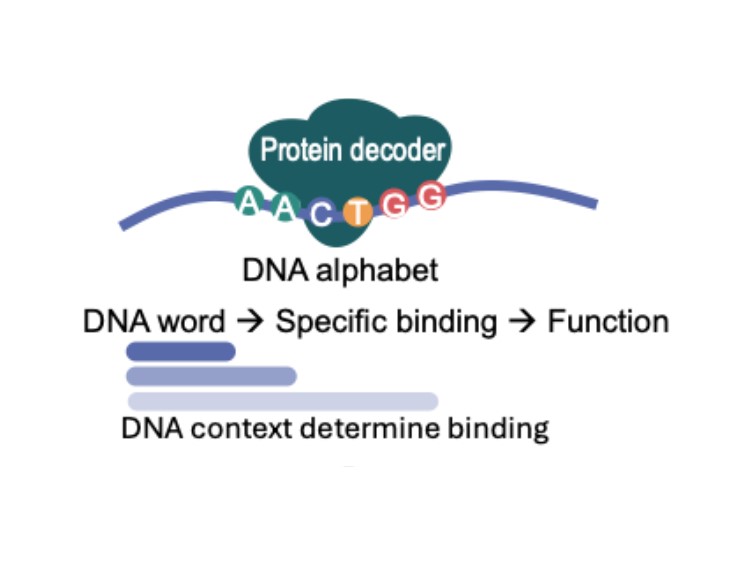
The traditional metaphor of DNA as a language is examined through systematic analysis, using formal linguistic categories rather than relying on heuristic analogies. By exploring aspects of phonology, morphology, syntax, semantics, pragmatics, and diachrony, the study investigates the structural parallels between genetic sequences and human spoken and written languages, while also identifying the fundamental limitations of this comparison. The analysis indicates that DNA displays distinct symbolic units, a combinatorial organization, strict ordering constraints, context dependence, and historical evolution. These characteristics resemble written language more closely than they do speech. However, DNA fundamentally differs from human language in several ways: it lacks intentionality, reference, generativity, and representational meaning. Genetic “meaning” is defined by its operational and causal roles, focusing on biochemical functions rather than semantic interpretations. This study emphasizes that DNA should not be viewed as a literal language but rather as a system of symbols grounded in chemistry. The comparison with linguistics is most useful for establishing distinctions rather than for expanding metaphorical interpretations.
References
- Hockett, C., The Origin of Speech. Scientific American, 1960. 203: p. 88-96.
- Saussure, F.d., Course in General Linguistics ed. T. W. Baskin. 1916/2011: Columbia University Press.
- Crick, F.H.C., On protein synthesis. Symposia of the Society for Experimental Biology, 1958. 12: p. 138–163.
- Alberts, B., et al., Molecular Biology of the Cell 7th ed. ed. 2022: Garland Science.
- Pattee, H.H., Cell psychology: An evolutionary approach to the symbol–matter problem. Cognition and Brain Theory, 1982. 5: p. 325–341.
- Inusa, B.P.D., et al., Sickle Cell Disease-Genetics, Pathophysiology, Clinical Presentation and Treatment. Int J Neonatal Screen, 2019. 5(2): p. 20.
- Jackendoff, R., Foundations of Language (Brain, Meaning,Grammar, Evolution). 1st ed. 2003: Oxford University Press. 477.
- Crick, F.H., The origin of the genetic code. J Mol Biol, 1968. 38(3): p. 367-79.
- Maynard Smith, J., The concept of information in biology. Philosophy of Science, 2000. 67(2): p. 177–194.
- Chomsky, N., Aspects of the Theory of Syntax. . 1965: MIT Press. 251.
- Kitano, T., A. Blancher, and N. Saitou, The functional A allele was resurrected via recombination in the human ABO blood group gene. Mol Biol Evol, 2012. 29(7): p. 1791-6.
- Soffer, A., et al., Inferring primase-DNA specific recognition using a data driven approach. Nucleic Acids Res, 2021. 49(20): p. 11447-11458.
- Saussure, F.d.W.B., Trans.). Columbia University Press., Course in General Linguistics (W. Baskin, Trans.). 1916/2011: Columbia University Press.
- Barbieri, M., The Organic Codes: An Introduction to Semantic Biology. . 2003: Cambridge University Press.
- Godfrey-Smith, P., Information, arbitrariness, and selection: Comments on Maynard Smith. . Philosophy of Science, 2000. 67(2): p. 202–207.
- Hoffmeyer, J., Biosemiotics: An Examination into the Signs of Life and the Life of Signs. 2008: University of Scranton Press.
- Labov, W., Principles of Linguistic Change, Volume 1: Internal Factors. . 1994: Blackwell.
- Croft, W., Explaining Language Change: An Evolutionary Approach. 2000: Longman.
- Kuchta, R.D. and G. Stengel, Mechanism and evolution of DNA primases. Biochim Biophys Acta, 2010. 1804(5): p. 1180-9.