

Pictorial-Based Learning (PcBL): Fostering Students' Argumentation Skills and Understanding of Chemistry
 Habiddin Habiddin
- Johari bin Surif
- Atikah Atikah
- Nur Candra Eka Setiawan
Published 2026-02-10
Keywords
- Model and Modelling in Chemistry,
- Visualization,
- Scientific Argument,
- Deep Understanding
How to Cite
Copyright (c) 2026 Habiddin Habiddin, Johari bin Surif, Atikah Atikah, Mudzuna Quraisyah Basimin, Shorihatul Inayah, Nur Candra Eka Setiawan, Ahan Al-Faruq Wuni

This work is licensed under a Creative Commons Attribution 4.0 International License.




Abstract
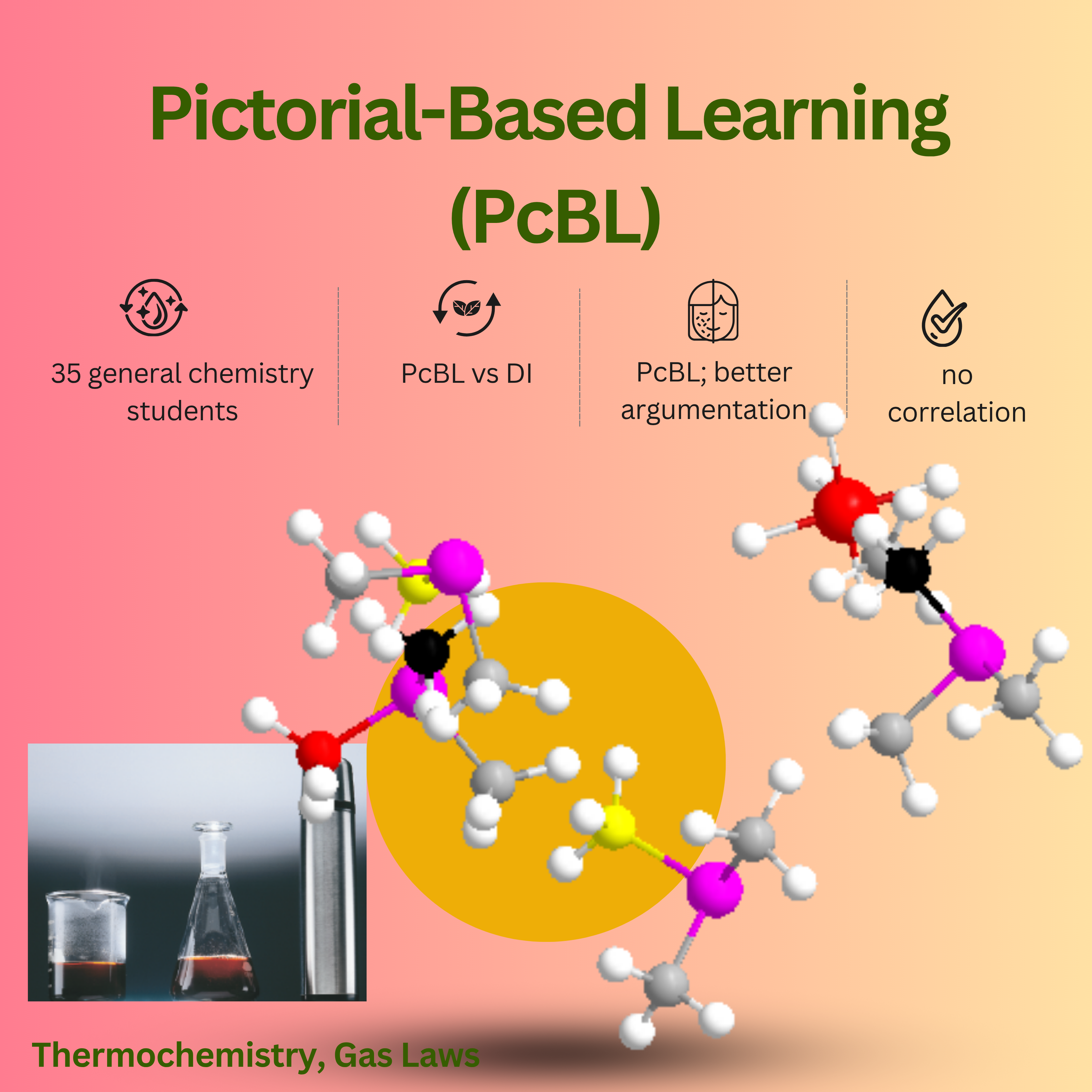
This study highlights the implementation of Pictorial-Based Learning (PcBL) in basic chemistry classes and assesses its contribution to students' argumentation skills and understanding of chemistry. Thirty-five students aged 19-21 years enrolled in general chemistry, covering solubility & intermolecular forces, gas laws, kinetic molecular theory, and thermochemistry, at Universitas Negeri Malang, East Java, Indonesia, participated in this study. The intervention was conducted over one term/semester. Students' argumentation skills were assessed at the end of each topic and classified using Toulmin's Argument Pattern (TAP), which comprises claims, data, warrants, backing, and rebuttals. This study uncovered the following outcomes. The implementation of PcBL contributed to improving students' argumentation skills. However, no students demonstrated the highest level (5). Most students' argumentation skills ranged from Level 3 to Level 4, with Level 3 being the most common. Therefore, it implies an adequate contribution of the approach in improving students' argumentation skills. However, the correlation between students' argumentation skills and their understanding of chemistry was not substantial. This study amplifies the need for the PcBL in broader chemistry teaching across cohorts and topics. Its contribution to forming other students' soft skills is also a worthwhile future exercise.
References
- [1] C. Martinez, “Developing 21st century teaching skills: A case study of teaching and learning through project-based curriculum,” Cogent Educ., vol. 9, no. 1, p. 2024936, Dec. 2022, doi: 10.1080/2331186X.2021.2024936.
- [2] T. Iñiguez-Berrozpe and E. Boeren, “Twenty-First Century Skills for All: Adults and Problem Solving in Technology Rich Environments,” Technol. Knowl. Learn., vol. 25, no. 4, pp. 929–951, 2020, doi: 10.1007/s10758-019-09403-y.
- [3] B. AL-Ajmi and A. Ambusaidi, “Scientific Argumentation The Level of Scientific Argumentation Skills in Chemistry Subject among Grade 11th Students: The Role of Logical Thinking,” Sci. Educ. Int., vol. 33, no. 1, pp. 66–74, 2022, [Online]. Available: https://www.icaseonline.net/journal/index.php/sei/article/view/366.
- [4] L. Lieber and N. Graulich, “Investigating students’ argumentation when judging the plausibility of alternative reaction pathways in organic chemistry,” Chem. Educ. Res. Pract., vol. 23, no. 1, pp. 38–54, 2022, doi: 10.1039/D1RP00145K.
- [5] V. Sampson and M. R. Blanchard, “Science teachers and scientific argumentation: Trends in views and practice,” J. Res. Sci. Teach., vol. 49, no. 9, pp. 1122–1148, Nov. 2012, doi: https://doi.org/10.1002/tea.21037.
- [6] N. Hasnunidah, H. Susilo, M. Irawati, and H. Suwono, “The contribution of argumentation and critical thinking skills on students’ concept understanding in different learning models,” J. Univ. Teach. Learn. Pract., vol. 17, no. 1 SE-Articles, 2020, doi: 10.53761/1.17.1.6.
- [7] K. M. Jegstad, “Inquiry-based chemistry education: a systematic review,” Stud. Sci. Educ., vol. 60, no. 2, pp. 251–313, Jul. 2024, doi: 10.1080/03057267.2023.2248436.
- [8] M. Evagorou and J. Osborne, “Exploring young students’ collaborative argumentation within a socioscientific issue,” J. Res. Sci. Teach., vol. 50, no. 2, pp. 209–237, Feb. 2013, doi: 10.1002/tea.21076.
- [9] P. S. Cetin, G. Eymur, and S. Erenler, “The development of pre-service teachers’ argumentation self-efficacy through argumentation-based chemistry instruction,” Chem. Educ. Res. Pract., vol. 25, no. 3, pp. 895–907, 2024, doi: 10.1039/D3RP00337J.
- [10] A. Crowell and D. Kuhn, “Developing Dialogic Argumentation Skills: A 3-year Intervention Study,” J. Cogn. Dev., vol. 15, no. 2, pp. 363–381, Apr. 2014, doi: 10.1080/15248372.2012.725187.
- [11] J. Jumadi, R. Perdana, R. Riwayani, and D. Rosana, “The impact of problem-based learning with argument mapping and online laboratory on scientific argumentation skill,” Int. J. Eval. Res. Educ., vol. 10, no. 1, pp. 16–23, 2019.
- [12] T. N. Ain, H. A. C. Wibowo, A. Rohman, and U. A. Deta, “The scientific argumentation profile of physics teacher candidate in Surabaya,” J. Phys. Conf. Ser., vol. 997, no. 1, p. 12025, 2018, doi: 10.1088/1742-6596/997/1/012025.
- [13] H. Habiddin, R. F. Ulfa, and Y. Utomo, “Interactive instructional teaching method (IITM); contribution towards students’ ability in answering unfamiliar types questions of buffer solution,” Chem. Teach. Int., vol. 6, no. 1, pp. 49–58, 2024, doi: doi:10.1515/cti-2022-0024.
- [14] C.-Y. Lin and H.-K. Wu, “Effects of different ways of using visualizations on high school students’ electrochemistry conceptual understanding and motivation towards chemistry learning,” Chem. Educ. Res. Pract., vol. 22, no. 3, pp. 786–801, 2021, doi: 10.1039/D0RP00308E.
- [15] K. W. McElhaney, H.-Y. Chang, J. L. Chiu, and M. C. Linn, “Evidence for effective uses of dynamic visualisations in science curriculum materials,” Stud. Sci. Educ., vol. 51, no. 1, pp. 49–85, Jan. 2015, doi: 10.1080/03057267.2014.984506.
- [16] R. Tasker and R. Dalton, “Research into practice: visualisation of the molecular world using animations,” Chem. Educ. Res. Pract., vol. 7, no. 2, pp. 141–159, 2006, doi: 10.1039/B5RP90020D.
- [17] R. Kozma, E. Chin, J. Russell, and N. Marx, “The Roles of Representations and Tools in the Chemistry Laboratory and Their Implications for Chemistry Learning,” J. Learn. Sci., vol. 9, no. 2, pp. 105–143, 2000, [Online]. Available: http://www.jstor.org/stable/1466853.
- [18] M. Kim and Q. Jin, “Studies on visualisation in science classrooms: a systematic literature review,” Int. J. Sci. Educ., vol. 44, no. 17, pp. 2613–2631, Nov. 2022, doi: 10.1080/09500693.2022.2140020.
- [19] T. Dickmann, M. Opfermann, E. Dammann, M. Lang, and S. Rumann, “What you see is what you learn? The role of visual model comprehension for academic success in chemistry,” Chem. Educ. Res. Pract., vol. 20, no. 4, pp. 804–820, 2019, doi: 10.1039/C9RP00016J.
- [20] K. M. Edens and E. F. Potter, “Promoting Conceptual Understanding Through Pictorial Representation,” Stud. Art Educ., vol. 42, no. 3, pp. 214–233, Mar. 2001, doi: 10.2307/1321038.
- [21] T. Gegios, K. Salta, and S. Koinis, “Investigating high-school chemical kinetics: the Greek chemistry textbook and students’ difficulties,” Chem. Educ. Res. Pract., vol. 18, no. 1, pp. 151–168, 2017, [Online]. Available: http://dx.doi.org/10.1039/C6RP00192K.
- [22] I. S. Rajpoot et al., “Review on Molecular Modelling in Chemistry Education,” Asian J. Dent. Heal. Sci., vol. 2, no. 4 SE-Review Articles, pp. 55–58, Dec. 2022, doi: 10.22270/ajdhs.v2i4.26.
- [23] C. Guy-Gaytán, J. S. Gouvea, C. Griesemer, and C. Passmore, “Tensions Between Learning Models and Engaging in Modeling,” Sci. Educ., vol. 28, no. 8, pp. 843–864, 2019, doi: 10.1007/s11191-019-00064-y.
- [24] P.-S. Hsu, M. Van Dyke, Y. Chen, and T. J. Smith, “A cross-cultural study of the effect of a graph-oriented computer-assisted project-based learning environment on middle school students’ science knowledge and argumentation skills,” J. Comput. Assist. Learn., vol. 32, no. 1, pp. 51–76, Feb. 2016, doi: https://doi.org/10.1111/jcal.12118.
- [25] W. Chen, Y. Han, J. Tan, A. S. C. Chai, Q. Lyu, and Lyna, “Exploring students’ computer-supported collaborative argumentation with socio-scientific issues,” J. Comput. Assist. Learn., vol. 40, no. 6, pp. 3324–3337, Dec. 2024, doi: https://doi.org/10.1111/jcal.13073.
- [26] M. Evagorou, S. Erduran, and T. Mäntylä, “The role of visual representations in scientific practices: from conceptual understanding and knowledge generation to ‘seeing’ how science works,” Int. J. STEM Educ., vol. 2, no. 1, p. 11, Dec. 2015, doi: 10.1186/s40594-015-0024-x.
- [27] E. Langbeheim, E. Ben-Eliyahu, E. Adadan, S. Akaygun, and U. D. Ramnarain, “Intersecting visual and verbal representations and levels of reasoning in the structure of matter learning progression,” Chem. Educ. Res. Pract., vol. 23, no. 4, pp. 969–979, 2022, doi: 10.1039/D2RP00119E.
- [28] H. Habiddin, A. Atikah, I. Husniah, A. Haetami, and M. Maysara, “Building scientific explanation: A study of acid-base properties of salt solution,” AIP Conf. Proc., vol. 2330, no. 1, p. 20047, Mar. 2021, doi: 10.1063/5.0043215.
- [29] H. Habiddin, H. Herunata, O. Sulistina, A. Haetami, M. Maysara, and D. Rodić, “Pictorial based learning: Promoting conceptual change in chemical kinetics: Scientific paper,” J. Serbian Chem. Soc., vol. 88, no. 1, pp. 97–111, 2023, doi: 10.2298/JSC220403070H.
- [30] H. Habiddin and E. M. Page, “Probing Students’ Higher Order Thinking Skills Using Pictorial Style Questions,” Maced. J. Chem. Chem. Eng., vol. 39, no. 2, pp. 251–263, Oct. 2020, doi: 10.20450/mjcce.2020.2133.
- [31] H. Habiddin and E. M. Page, “Examining Students’ Ability to Solve Algorithmic and Pictorial Style Questions in Chemical Kinetics,” Int. J. Sci. Math. Educ., vol. 19, no. 1, pp. 65–85, 2021, doi: 10.1007/s10763-019-10037-w.
- [32] N. H. S. Ruhizat, J. Surif, N. D. Abdul Halim, M. Reiss, and H. Habiddin, “A Systematic Literature Review on Visualisation Skills for Understanding Science,” J. Adv. Res. Appl. Sci. Eng. Technol., no. SE-Articles, pp. 303–313, Oct. 2024, doi: 10.37934/araset.55.2.303313.
- [33] M. Q. Basimin, H. Habiddin, and R. Joharmawan, “Higher Order Thinking Skills and Visual Representations of Chemical Concepts: A Literature Review,” Hydrog. J. Kependidikan Kim. Vol 11, No 6 December 2023, 2023, doi: 10.33394/hjkk.v11i6.10173.
- [34] S. Nkomo and A. Bly, “Developing a Threshold Concept Assessment Rubric: Using the Johnstone’s Triangle Framework for Understanding Intermolecular Forces,” J. Chem. Educ., vol. 101, no. 11, pp. 4694–4703, Nov. 2024, doi: 10.1021/acs.jchemed.4c00236.
- [35] N. Spitha et al., “Supporting submicroscopic reasoning in students’ explanations of absorption phenomena using a simulation-based activity,” Chem. Educ. Res. Pract., vol. 25, no. 1, pp. 133–150, 2024, doi: 10.1039/D3RP00153A.
- [36] J. Kotz, P. Treichel, J. Townsend, and David A. Treichel, Chemistry and Chemical Reactivity, 10th ed. Boston: Cengage Learning, 2019.
- [37] I. Nelsen, A. Farheen, and S. E. Lewis, “How ordering concrete and abstract representations in intermolecular force chemistry tasks influences students’ thought processes on the location of dipole–dipole interactions,” Chem. Educ. Res. Pract., vol. 25, no. 3, pp. 815–832, 2024, doi: 10.1039/D4RP00025K.
- [38] V. Prain and B. Waldrip, “An Exploratory Study of Teachers’ and Students’ Use of Multi‐modal Representations of Concepts in Primary Science,” Int. J. Sci. Educ., vol. 28, no. 15, pp. 1843–1866, Dec. 2006, doi: 10.1080/09500690600718294.
- [39] D. F. Treagust, G. Chittleborough, and T. L. Mamiala, “The role of submicroscopic and symbolic representations in chemical explanations,” Int. J. Sci. Educ., vol. 25, no. 11, pp. 1353–1368, 2003, doi: 10.1080/0950069032000070306.
- [40] M. Cerovac and T. Keane, “Early insights into Piaget’s cognitive development model through the lens of the Technologies curriculum,” Int. J. Technol. Des. Educ., vol. 35, no. 1, pp. 61–81, 2025, doi: 10.1007/s10798-024-09906-5.
- [41] L. Bird, “Logical Reasoning Ability and Student Performance in General Chemistry,” J. Chem. Educ., vol. 87, no. 5, pp. 541–546, May 2010, doi: 10.1021/ed8001754.
- [42] D. H. Schunk, Learning Theories: An Educational Perspective, 6th ed. Essex: Pearson, 2011.
- [43] R. E. Mayer, “The Past, Present, and Future of the Cognitive Theory of Multimedia Learning,” Educ. Psychol. Rev., vol. 36, no. 1, p. 8, 2024, doi: 10.1007/s10648-023-09842-1.
- [44] P. Wolfe, Brain Matters: Translating Research into Classroom Practice, 2nd ed. ASCD, 2010.
- [45] T. Pentecost, S. Weber, and D. Herrington, “Connecting the Visible World With the Invisible,” Sci. Teach., vol. 083, no. 05, 2016, doi: 10.2505/4/TST16_083_05_53.
- [46] H. Westbroek, K. Klaassen, A. Bulte, and A. Pilot, “Characteristics of Meaningful Chemistry Education BT - Research and the Quality of Science Education,” K. Boersma, M. Goedhart, O. de Jong, and H. Eijkelhof, Eds. Dordrecht: Springer Netherlands, 2005, pp. 67–76.
- [47] J. Sweller, “Cognitive load theory and educational technology,” Educ. Technol. Res. Dev., vol. 68, no. 1, pp. 1–16, 2020, doi: 10.1007/s11423-019-09701-3.
- [48] P. A. Kirschner, J. Sweller, F. Kirschner, and J. Zambrano R., “From Cognitive Load Theory to Collaborative Cognitive Load Theory,” Int. J. Comput. Collab. Learn., vol. 13, no. 2, pp. 213–233, 2018, doi: 10.1007/s11412-018-9277-y.
- [49] K. Popper, The Logic of Scientific Discovery. Routledge, Taylor Francis Ltd, 2002.
- [50] T. S. Kuhn, The structure of scientific revolutions. The University of Chicago Press, 1996.
- [51] B. Latour, S. Woolgar, and J. Salk, Laboratory Life: The Construction of Scientific Facts. Princeton University Press, 2013.
- [52] S. Xiao and D. Kuhn, “Inquiry and argumentation skill development work in conjunction,” Cogn. Dev., vol. 71, p. 101464, 2024, doi: https://doi.org/10.1016/j.cogdev.2024.101464.
- [53] S. Khan, “Reasoning in chemistry teacher education,” Chem. Teach. Int., 2024, doi: doi:10.1515/cti-2024-0099.
- [54] R. N. Giere, J. Bickle, and R. Mauldin, Understanding Scientific Reasoning, 5th ed. Thomson/Wadsworth, 2006.
- [55] S. Khan, “Model-based inquiries in chemistry,” Sci. Educ., vol. 91, no. 6, pp. 877–905, Nov. 2007, doi: https://doi.org/10.1002/sce.20226.
- [56] M. R. M. Bruce, A. E. Bruce, and J. Walter, “Creating Representation in Support of Chemical Reasoning to Connect Macroscopic and Submicroscopic Domains of Knowledge,” J. Chem. Educ., vol. 99, no. 4, pp. 1734–1746, Apr. 2022, doi: 10.1021/acs.jchemed.1c00292.
- [57] X. Li, W. Wang, and Y. Li, “Systematically reviewing the potential of scientific argumentation to promote multidimensional conceptual change in science education,” Int. J. Sci. Educ., vol. 44, no. 7, pp. 1165–1185, May 2022, doi: 10.1080/09500693.2022.2070787.
- [58] D. Zhou, “‘Learn to Argue’ and ‘Argue to Learn’: meta-analysis of effective instructional design for online scientific argumentation activities,” Interact. Learn. Environ., vol. 32, no. 9, pp. 4857–4880, Oct. 2024, doi: 10.1080/10494820.2023.2205904.
- [59] T. Abate, K. Michael, and C. Angell, “Assessment of Scientific Reasoning: Development and Validation of Scientific Reasoning Assessment Tool,” Eurasia J. Math. Sci. Technol. Educ., vol. 16, no. 12, pp. 1–15, Dec. 2020, doi: 10.29333/ejmste/9353.
- [60] R. Quintana and R. Correnti, “The right to argue: teaching and assessing everyday argumentation skills,” J. Furth. High. Educ., vol. 43, no. 8, pp. 1133–1151, Sep. 2019, doi: 10.1080/0309877X.2018.1450967.
- [61] T. A. Holme, C. J. Luxford, and A. Brandriet, “Defining Conceptual Understanding in General Chemistry,” J. Chem. Educ., vol. 92, no. 9, pp. 1477–1483, Sep. 2015, doi: 10.1021/acs.jchemed.5b00218.
- [62] P. S. Cetin, “Explicit argumentation instruction to facilitate conceptual understanding and argumentation skills,” Res. Sci. Technol. Educ., vol. 32, no. 1, pp. 1–20, Jan. 2014, doi: 10.1080/02635143.2013.850071.
- [63] B.-M. Lindgren, B. Lundman, and U. H. Graneheim, “Abstraction and interpretation during the qualitative content analysis process,” Int. J. Nurs. Stud., vol. 108, p. 103632, 2020, doi: https://doi.org/10.1016/j.ijnurstu.2020.103632.
- [64] A. J. Kleinheksel, N. Rockich-Winston, H. Tawfik, and T. R. Wyatt, “Demystifying Content Analysis,” Am. J. Pharm. Educ., vol. 84, no. 1, p. 7113, 2020, doi: https://doi.org/10.5688/ajpe7113.
- [65] B. L. Baldock, J. D. Blanchard, and A. L. Fernandez, “Student Discovery of the Relationship between Molecular Structure, Solubility, and Intermolecular Forces,” J. Chem. Educ., vol. 98, no. 12, pp. 4046–4053, Dec. 2021, doi: 10.1021/acs.jchemed.1c00851.
- [66] M. M. Cooper, L. C. Williams, and S. M. Underwood, “Student Understanding of Intermolecular Forces: A Multimodal Study,” J. Chem. Educ., vol. 92, no. 8, 2015, doi: 10.1021/acs.jchemed.5b00169.
- [67] L. C. Williams, S. M. Underwood, M. W. Klymkowsky, and M. M. Cooper, “Are Noncovalent Interactions an Achilles Heel in Chemistry Education? A Comparison of Instructional Approaches,” J. Chem. Educ., vol. 92, no. 12, 2015, doi: 10.1021/acs.jchemed.5b00619.
- [68] G. Lisensky, L. E. Kueffer, C. Livingston, and L. E. Parmentier, “Intermolecular Forces and the Languages of Chemistry,” J. Chem. Educ., vol. 101, no. 8, pp. 3584–3591, Aug. 2024, doi: 10.1021/acs.jchemed.4c00515.
- [69] P. G. Rodríguez Ortega, R. C. Jaraíces, M. Romero-Ariza, and M. Montejo, “Developing Students’ Scientific Reasoning Abilities with an Inquiry-Based Learning Methodology: Applying FTIR Spectroscopy to the Study of Thermodynamic Equilibria in Hydrogen-Bonded Species,” J. Chem. Educ., vol. 96, no. 5, pp. 1022–1028, May 2019, doi: 10.1021/acs.jchemed.8b00875.
- [70] S. Yamaguchi, K. Tominaga, and S. Saito, “Intermolecular vibrational mode of the benzoic acid dimer in solution observed by terahertz time-domain spectroscopy,” Phys. Chem. Chem. Phys., vol. 13, no. 32, pp. 14742–14749, 2011, doi: 10.1039/C1CP20912D.
- [71] L. Tarhan, H. Ayar-Kayali, R. O. Urek, and B. Acar, “Problem-Based Learning in 9th Grade Chemistry Class: ‘Intermolecular Forces,’” Res. Sci. Educ., vol. 38, no. 3, pp. 285–300, 2008, doi: 10.1007/s11165-007-9050-0.
- [72] K. W. Omari and J. B. Mandumpal, “A simple pedagogical limiting reactant kitchenette experiment including a simple algorithm,” Chem. Teach. Int., vol. 5, no. 1, pp. 75–81, 2023, doi: doi:10.1515/cti-2022-0028.
- [73] V. Rosa, N. E. States, A. Corrales, Y. Nguyen, and M. B. Atkinson, “Relevance and equity: should stoichiometry be the foundation of introductory chemistry courses?,” Chem. Educ. Res. Pract., vol. 23, no. 3, pp. 662–685, 2022, doi: 10.1039/D1RP00333J.
- [74] G. Papaphotis and G. Tsaparlis, “Conceptual versus algorithmic learning in high school chemistry: the case of basic quantum chemical concepts. Part 1. Statistical analysis of a quantitative study,” Chem. Educ. Res. Pract., vol. 9, no. 4, pp. 323–331, 2008, doi: 10.1039/B818468M.
- [75] J. D. Schuttlefield, J. Kirk, N. J. Pienta, and H. Tang, “Investigating the Effect of Complexity Factors in Gas Law Problems,” J. Chem. Educ., vol. 89, no. 5, pp. 586–591, Apr. 2012, doi: 10.1021/ed100865y.
- [76] F. Chen, S. Zhang, Y. Guo, and T. Xin, “Applying the Rule Space Model to Develop a Learning Progression for Thermochemistry,” Res. Sci. Educ., vol. 47, no. 6, pp. 1357–1378, 2017, doi: 10.1007/s11165-016-9553-7.
- [77] F. Gazali, S. Rahayu, M. Munzil, and S. Wonorahardjo, “Profile of The First Year Student’s Argumentation Skills on General Chemistry Courses at a Public University in West Sumatera: A Preliminary Study,” E3S Web Conf., vol. 481, 2024, [Online]. Available: https://doi.org/10.1051/e3sconf/202448104004.
- [78] R. Rusmini and R. A. Suyono, “Profile of Argumentation Ability of Undergraduate Students In Chemistry Education Based On Non-Routine Problems,” E3S Web Conf., vol. 328, 2021, [Online]. Available: https://doi.org/10.1051/e3sconf/202132806007.
- [79] C. T. Cox and O. Gulacar, “Examining the effect of categorized versus uncategorized homework on test performance of general chemistry students,” Chem. Teach. Int., 2024, doi: doi:10.1515/cti-2024-0083.
- [80] J. P. Walker and V. Sampson, “Learning to Argue and Arguing to Learn: Argument-Driven Inquiry as a Way to Help Undergraduate Chemistry Students Learn How to Construct Arguments and Engage in Argumentation During a Laboratory Course,” J. Res. Sci. Teach., vol. 50, no. 5, pp. 561–596, May 2013, doi: https://doi.org/10.1002/tea.21082.
- [81] V. Sampson, J. Grooms, and J. P. Walker, “Argument-Driven Inquiry as a way to help students learn how to participate in scientific argumentation and craft written arguments: An exploratory study,” Sci. Educ., vol. 95, no. 2, pp. 217–257, Mar. 2011, doi: https://doi.org/10.1002/sce.20421.
- [82] E. Uzuntiryaki-Kondakci, M. Tuysuz, E. Sarici, C. Soysal, and S. Kilinc, “The role of the argumentation-based laboratory on the development of pre-service chemistry teachers’ argumentation skills,” Int. J. Sci. Educ., vol. 43, no. 1, pp. 30–55, Jan. 2021, doi: 10.1080/09500693.2020.1846226.
- [83] H. K. Wu, J. S. Krajcik, and E. Soloway, “Promoting understanding of chemical representations: Students’ use of a visualization tool in the classroom,” J. Res. Sci. Teach., 2001, doi: 10.1002/tea.1033.
- [84] R. Kusumaningdyah, I. Devetak, Y. Utomo, E. Effendy, D. Putri, and H. Habiddin, “Teaching Stereochemistry with Multimedia and Hands-On Models: The Relationship between Students’ Scientific Reasoning Skills and The Effectiveness of Model Type,” Cent. Educ. Policy Stud. J., vol. 14, no. 1, pp. 171–197, May 2024, doi: 10.26529/cepsj.1547.
- [85] L. Brandt et al., “The impact of concept mapping and visualization on the learning of secondary school chemistry students,” Int. J. Sci. Educ., vol. 23, no. 12, pp. 1303–1313, Dec. 2001, doi: 10.1080/09500690110049088.
- [86] J. L. Chiu and M. C. Linn, “Supporting Knowledge Integration in Chemistry with a Visualization-Enhanced Inquiry Unit,” J. Sci. Educ. Technol., vol. 23, no. 1, pp. 37–58, 2014, doi: 10.1007/s10956-013-9449-5.
- [87] M. Abdinejad, B. Talaie, H. S. Qorbani, and S. Dalili, “Student Perceptions Using Augmented Reality and 3D Visualization Technologies in Chemistry Education,” J. Sci. Educ. Technol., vol. 30, no. 1, pp. 87–96, 2021, doi: 10.1007/s10956-020-09880-2.
- [88] H. Stammes and L. de Putter-Smits, “Drawing meaning from student-generated drawings: exploring chemistry teachers’ noticing,” Chem. Educ. Res. Pract., 2025, doi: 10.1039/D3RP00253E.
- [89] S. A. C. Ryan and M. Stieff, “Drawing for Assessing Learning Outcomes in Chemistry,” J. Chem. Educ., vol. 96, no. 9, pp. 1813–1820, Sep. 2019, doi: 10.1021/acs.jchemed.9b00361.
- [90] O. Sulistina, S. Rahayu, I. W. Dasna, and Yahmin, “Enhancing the scientific argumentation skills of prospective chemistry teacher using integrated chemical literacy strategy,” Int. J. Eval. Res. Educ., vol. 13, no. 6, pp. 4346–4353, 2024, doi: 10.11591/IJERE.V13I6.26935.
- [91] D. G. Ramadhani, S. Yamtinah, S. Saputro, and S. Widoretno, “Analysis of the relationship between students’ argumentation and chemical representational ability: a case study of hybrid learning oriented in the environmental chemistry course,” Chem. Teach. Int., vol. 5, no. 4, pp. 397–411, 2023, doi: doi:10.1515/cti-2023-0047.
- [92] A. Yalçın Çelik and Z. Kılıç, “The Impact of Argumentation on High School Chemistry Students’ Conceptual Understanding, Attitude towards Chemistry and Argumentativeness,” Int. J. Phys. Chem. Educ., vol. 6, no. 1 SE-Articles, pp. 58–75, Feb. 2014, doi: 10.51724/ijpce.v6i1.55.
- [93] R. Khishfe, “Relationship Between Nature of Science and Argumentation: a Follow-Up Study,” Int. J. Sci. Math. Educ., vol. 21, no. 4, pp. 1081–1102, 2023, doi: 10.1007/s10763-022-10307-0.
- [94] E. Yıldız-Feyzioğlu and R. Kıran, “Investigating the Relationships between Self-efficacy for Argumentation and Critical Thinking Skills,” J. Sci. Teacher Educ., vol. 33, no. 5, pp. 555–577, Jul. 2022, doi: 10.1080/1046560X.2021.1967568.
- [95] C. Cigdemoglu and O. Geban, “Improving students’ chemical literacy levels on thermochemical and thermodynamics concepts through a context-based approach,” Chem. Educ. Res. Pract., vol. 16, no. 2, pp. 302–317, 2015, doi: 10.1039/C5RP00007F.
- [96] S.-S. Lin and J. J. Mintzes, “Learning argumentation skills through instruction in socioscientific issues: the effect of ability level,” Int. J. Sci. Math. Educ., vol. 8, no. 6, pp. 993–1017, 2010, doi: 10.1007/s10763-010-9215-6.
- [97] M. Q. Basimin, H. Habiddin, R. Joharmawan, Y. Yahmin, and L. Ufiqoh, “Pictorial-Based Learning (PcBL) for Promoting Students’ Critical Thinking Skills and Learning Outcomes on Reaction Rate,” Rev. Virtual Quim., 2025, doi: http://dx.doi.org/10.21577/1984-6835.20250057.