

Response Surface Methodology-Assisted Optimization, Purification, Characterization and Application of Natural Dye from Bischofia Javanica Leaves on Cotton
Published 2026-06-17
Keywords
- Bischofia javanica,
- Natural dye,
- Central composite design,
- Isoquercetin,
- Flavonoids
- Color fastness ...More
How to Cite
Copyright (c) 2026 Poro D. Clark

This work is licensed under a Creative Commons Attribution 4.0 International License.




Abstract
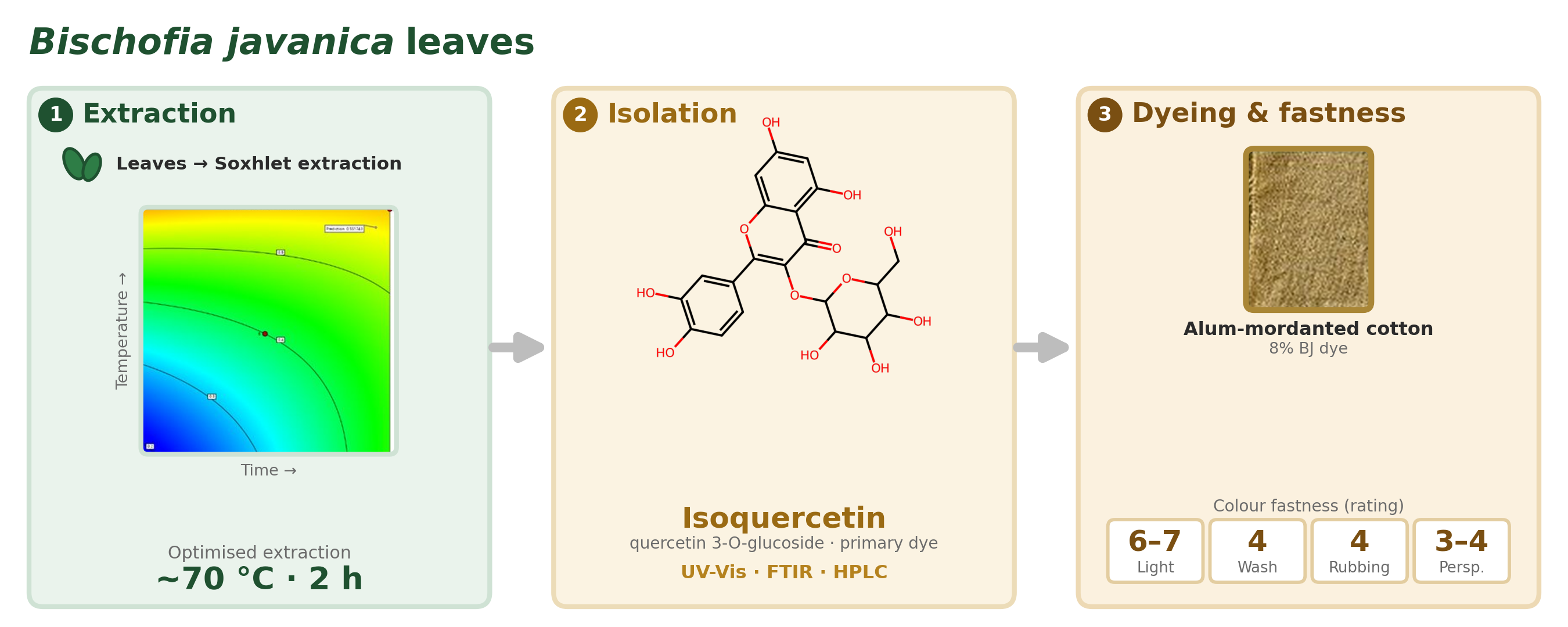
This study optimized the extraction of natural dyes from Bischofia javanica Blume leaves using a Soxhlet apparatus, with process conditions determined by response surface methodology and a central composite design (RSM-CCD). The effects of extraction temperature (46–74 °C) and time (0.6–3.4 h) were investigated over 14 experimental runs. Extraction efficiency, quantified by measuring absorbance at 430 nm using UV-Vis spectrophotometry, was maximized at optimized conditions of approximately 70 °C for 2 hours, yielding a threefold increase in absorbance compared to lower temperatures. The main dye fraction (F3) was purified and isolated using gravity column chromatography on silica gel and confirmed by TLC. The dyed cotton fabric was evaluated for its physical fastness properties (light, wash, perspiration, and rubbing). Characterization techniques, including UV-Vis, FTIR, and HPLC, identified isoquercetin as the primary dye compound along with berberine and eugenol, confirming that the extract is rich in flavonoids. At an 8% dye concentration, cotton treated with potassium aluminum sulfate mordant showed higher color strength (K/S) and exhibited excellent light fastness (grade 6–7), very good wash fastness (rating 4), and dry rubbing fastness (rating 4). Perspiration fastness was better under acidic conditions (3-4) due to stable aluminum-flavonoid complexes, which enhanced photostability and wash resistance compared to unmordanted fabric. This study demonstrates that Bischofia javanica leaves are a promising source of natural dyes for sustainable textiles and highlights how statistical optimization can significantly improve extraction efficiency, supporting potential eco-friendly industrial applications.
References
- P. D. Clark, J. O. Otutu, K. A. Asiagwu, G. I. Ndukwe, and C. A. Idibie, Investigating the feasibility of utilizing Pennisetum purpureum leaves waste as a sustainable dye: Etraction, characterization and application on textile, Sci, Afric., 2023, 22 (3), 231-246.
- D. Ardila-Leal, R. A. Poutou-Piñales, A. M. Pedroza-Rodríguez, and B. E. Quevedo-Hidalgo, A brief history of colour, the environmental impact of synthetic dyes and removal by using laccases, Molecules, 2021, 26 (13), 2-40.
- S. Lee, A. J. H, J. Park, E. Kang, S.-H. Jeon, S. B. Han, S. Ningsih, J. H. Paik, and S. Cho, Antioxidant and anti-inflammatory effects of Bischofia javanica (Blume) leaf methanol extracts through the regulation of Nrf2 and TAK1, Antioxidants, 2021, 10(8), 2-18.
- J. Gao, Y. Zhao, F. Ni, M. Gao, L. Wu, Z. Yu, Y. Chen, and Y. Wang, Polyphenol metabolomics reveals the applications and prospects of polyphenol-rich plants in natural dyes, Forestry Research, 2024, 4, e035.
- I. Risnasari, N. N. Solihat, R. Rambey, R. Purnawati, M. Ismayati, and F. P. Sari et al., Characterization and application of Sikkam (Bischofia javanica Blume) as a natural dye and antibacterial agent for eco-printing textiles, Waste Biomass Valor, 2025, 16, 4863-4878.
- S. Jabeen, S. Ali, M. Nadeem, K. Arif, N. Qureshi, G. A. Shar, G. A. Soomro, M. Iqbal, A. Nazir, and U. H. Siddiqua, Statistical modeling for the extraction of dye from natural source and industrial applications, Pol J Environ Stud, 2019, 28(4), 2145-2150.
- N. Amin, F.-U. Rehman, S. Adeel, M. Ibrahim, and R. Mia, Eco-friendly extraction and utilization of agro crop wastes based natural dye for textile dyeing, Energy Sci Eng, 2025, 13(1), e2067.
- V. Rotich, P. Wangila, and J. Cherutoi, FT-IR analysis of Beta vulgaris peels and pomace dye extracts and surface analysis of optimally dyed-mordanted cellulosic fabrics, J Chem, 2022, 2022(1), 2233414.
- V. Popescu, A. C. Blaga, M. Pruneanu, I. N. Cristian, M. Pisiaru, A. Popescu, V. Rotaru, I. Cretescu and D. Cascaval, Green chemistry in the extraction of natural dyes from colored food waste, for dyeing protein textile materials, Polymers, 2021, 13(22), 3867.
- P. D. Clark and L. D. Ekpekpo, Maceration-based extraction and spectroscopic characterisation of Sorghum bicolor leaves extract as a natural dye on cotton fabric, J Chem Soc Nigeria, 2025,
- 50(4), 775-786.
- J. O. Otutu, P. D. Clark, M. E. Osharode, E. C. Otutu, and G. I. Ndukwe, Extraction, characterization, and application of a polyphenolic compound as a natural dye for polyamide fabrics, J Chem Lett, vol., 2025, 6, 68-78.
- P. D. Clark, J. O. Otutu, K. A. Asiagwu, G. I. Ndukwe, E. C. Otutu, and C. A. Idibie, Isolation and characterization of natural dyes from Persea americana leaves and their application on polyamide fabrics, Ovidius Univ Ann Chem., 2025, 36(2), 91-102.
- G. I. Ndukwe, J. G. Tetam, and P. D. Clark, Phytochemical screening and in vitro antioxidant assessment of Cassia alata (Linn) leaf extracts, ChemSearch J., 2020, 11(2), 64-72.
- G. I. Ndukwe, P. D. Clark, and I. R. Jack, In vitro antioxidant and antimicrobial potentials of three extracts of Amaranthus hybridus L. leaf and their phytochemicals, Eur Chem Bull., 2020, 9(7), 164-173.
- P. D. Clark and E. Omo-Udoyo, A comparative assessment on antioxidant and phytochemical of Trichilia monadelpha (Thonn) J.J. De Wilde (Meliaceae) plant extracts, Chem Sci Int J., 2021, 30(10), 24-33.
- ISO 105-C10:2006 Textiles: Tests for colour fastness. Part C10. Colour fastness to washing, ISO, Basel, 2006.
- ISO 105-B01:2014 Textiles: Tests for colour fastness. Part B01. Colour fastness to light, ISO, Basel, 2014.
- ISO 105-X12:2013 Textiles: Tests for colour fastness. Part X12. Colour fastness to rubbing, ISO, Basel, 2013.
- ISO 105-E04:2013 Textiles: Tests for colour fastness. Part E04. Colour fastness to perspiration, ISO, Basel, 2013.
- C. E. Ochoa-Velasco and I. I. Ruiz-López, Mass transfer modeling of the antioxidant extraction of roselle flower (Hibiscus sabdariffa), J Food Sci Technol., 2019, 56(2), 1008–1015
- Q. W. Zhang, L. G. Lin, and W. C. Ye, Techniques for extraction and solation of natural products: A comprehensive review, Chin Med., 2018, 13(20), 2-26.
- S. Carpentieri, G. Ferrari, and G. Pataro, Optimization of pulsed electric fields-assisted extraction of phenolic compounds from white grape pomace using response surface methodology, Front Sustain Food Syst., 2022, 6, 854968.
- I. S. C. Sulaiman, M. Basri, H. R. Fard Masoumi, W. J. Chee, S. E. Ashari, and M. Ismail, Effects of temperature, time, and solvent ratio on the extraction of phenolic compounds and the anti-radical activity of Clinacanthus nutans Lindau leaves by response surface methodology, BMC Chem., 2017, 11, 2-11.
- A. Antony and M. Farid, Effect of temperatures on polyphenols during extraction, Appl Sci., 2022, 12 (4), 2107.
- M. Cano-Lamadrid, L. Martínez-Zamora, L. Mozafari, M. C. Bueso, M. Kessler, and F. Artés-Hernández, Response surface methodology to optimize the extraction of carotenoids from horticultural by-products: A systematic review, Foods., 2023, 12 (24), 4456.
- A. Escobar-Ortiz, Y. Salinas-Moreno, J. Jiménez-Hernández, and J. A. Gutierrez-Uribe, Effect of extraction temperature on anthocyanin yield and stability from Hibiscus calyx, Ind Crops Prod., 2021, 171, 113916.
- K. Ameer, H. M. Shahbaz, J. H. Kwon, and Y. Jo, Green extraction methods for polyphenols from plant matrices and their byproducts: A review, Compr Rev Food Sci Food Saf., 2017, 16(2), 295-315.
- S. Yadav, K. S. Tiwari, C. Gupta, M. K. Tiwari, A. Khan, and S. P. Sonkar, A brief review on natural dyes, pigments: Recent advances and future perspectives, 2023, Results Chem., 5, 100733.
- E. O. Alegbe and T. O. Uthman, A review of history, properties, classification, applications and challenges of natural and synthetic dyes, Heliyon, 2024, 10(13), 33646.
- H. Benli, Bio-mordants: A review, Environ Sci Pollut Res., 2024, 31, 20714-20771.
- M. Taniguchi, C. A. Larocca, J. D. Bernat, and J. S. Lindsey, Digital database of absorption spectra of diverse flavonoids enables structural comparisons and quantitative evaluations, J Nat Prod., 2023, 86 (4), 1087-1119.
- A. Pękal and K. Pyrzynska, Evaluation of aluminium complexation reaction for flavonoid content assay, Food Anal Methods., 2014, 7(8), 1776-1782.
- S. Haar, E. Schrader, and B. M. Gatewood, Comparison of aluminum mordants on the colorfastness of natural dyes on cotton, Clothing and Textiles Research Journal, 2013, 31(2), 97-108.
- A. Rehman, M. Irfan, A. Hameed, M. J. Saif, M. A. Qayyum, and T. Farooq, Chemical-free dyeing of cotton with functional natural dye: A pollution-free and cleaner production approach, Front Environ Sci., 2022, 10, 848245.
- P. D. Clark, J. O. Otutu, K. A. Asiagwu, and G. I. Ndukwe, Exploring the potential of Dacryodes edulis leaf extract as natural colourant on polyamide fabrics: Extraction, characterization and application, Substantia, 2024, 8(2), 103-118.
- G. Ramratan and J. Rani, Optimization rubbing fastness in Lyocell and silk fabric dyeing with Tinospora cordifolia using Box-Behnken design and Citrus limon extract with potassium aluminium sulfate mordants, Text Leather Rev., 2023, 6, 475-497.