

The Molecule as an Epistemic Object: An Ontosemiotic Perspective on Its Historical Emergence
 Juan D. Godino
Published 2026-11-11
Keywords
- Ontosemiotic approach,
- concept of molecule,
- holistic meaning,
- history of chemistry,
- epistemology
How to Cite
Copyright (c) 2026 Juan D. Godino

This work is licensed under a Creative Commons Attribution 4.0 International License.




Abstract
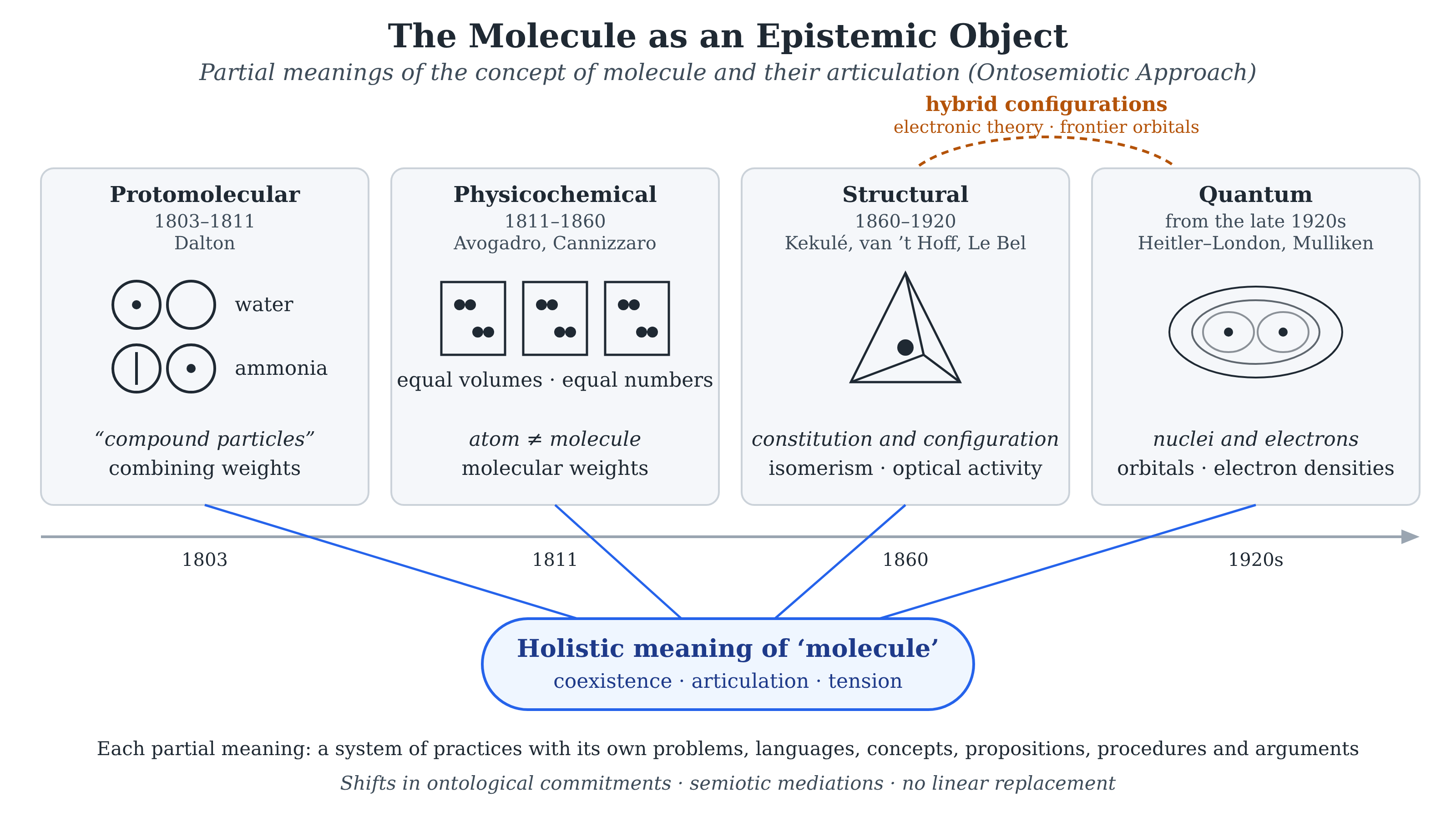
This article presents an epistemological and historical analysis of the emergence and evolution of the concept of molecule, using the Ontosemiotic Approach to knowledge and instruction as its theoretical framework. From this perspective, the meaning of the term ‘molecule’ is understood not as a fixed definition but pragmatically: as a system of operative and discursive practices directed towards solving specific problems in historically situated contexts. Through a diachronic study, the paper identifies and characterizes a series of partial meanings of the concept, from Dalton’s compound particles and the Avogadro–Cannizzaro distinction between atoms and molecules to the structural representations of organic chemistry and contemporary quantum-mechanical treatments, together with the hybrid configurations that connect the last two. It then examines how these partial meanings are articulated into a holistic meaning of the concept, bringing out the discontinuities, semiotic mediations and shifts in ontological commitments that have shaped its development. The study thus shows how the Ontosemiotic Approach can be used to analyse the plurality of meanings of chemical concepts and their coexistence in practice, and it suggests hypotheses for teaching the concept of molecule that remain to be tested empirically.
References
- R. G. Woolley, Is There a Quantum Definition of a Molecule?, J. Math. Chem. 1998, 23, 3–12.
- J. Hunger, How Classical Models of Explanation Fail to Cope with Chemistry—The Case of Molecular Modeling, in Philosophy of Chemistry: Synthesis of a New Discipline (Eds.: D. Baird, E. Scerri, L. McIntyre), Springer, Dordrecht, 2006, pp. 129–155.
- E. Scerri, E. Ghibaudi (Eds.), What Is a Chemical Element? A Collection of Essays by Chemists, Philosophers, Historians, and Educators, Oxford University Press, New York, 2020.
- B. Bensaude-Vincent, Atomism and Positivism: A Legend about French Chemistry, Ann. Sci. 1999, 56, 81–94.
- J. D. Godino, Ontosemiotic Approach in Mathematics Education: Foundations, Tools, and Applications, Author edition (DIGIBUG, Universidad de Granada), Granada, 2024. https://hdl.handle.net/10481/93738
- J. D. Godino, C. Batanero, V. Font, The Onto-semiotic Approach to Research in Mathematics Education, ZDM Int. J. Math. Educ. 2007, 39, 127–135. https://doi.org/10.1007/s11858-006-0004-1
- H.-J. Rheinberger, Toward a History of Epistemic Things: Synthesizing Proteins in the Test Tube, Stanford University Press, Stanford, 1997.
- J. D. Godino, C. Batanero, Clarifying the Meaning of Mathematical Objects as a Priority Area of Research in Mathematics Education, in Mathematics Education as a Research Domain: A Search for Identity (Eds.: A. Sierpinska, J. Kilpatrick), Kluwer, Dordrecht, 1998, pp. 177–195.
- C. S. Peirce, Collected Papers of Charles Sanders Peirce, Vols. 1–8 (Eds.: C. Hartshorne, P. Weiss, A. W. Burks), Harvard University Press, Cambridge, MA, 1931–1958. Cited as CP followed by volume and paragraph number.
- L. Wittgenstein, Philosophical Investigations, Basil Blackwell, Oxford, 1953.
- L. Laudan, Progress and Its Problems: Towards a Theory of Scientific Growth, University of California Press, Berkeley, 1977.
- V. Font, J. D. Godino, J. Gallardo, The Emergence of Objects from Mathematical Practices, Educ. Stud. Math. 2013, 82, 97–124. https://doi.org/10.1007/s10649-012-9411-0
- H. Putnam, Reason, Truth and History, Cambridge University Press, Cambridge, 1981.
- R. Torretti, Objectivity: A Kantian Perspective, in Kant and Philosophy of Science Today (Ed.: M. Massimi), Cambridge University Press, Cambridge, 2008, pp. 81–95.
- O. Lombardi, A Kantian-Rooted Pluralist Realism for Science, in Current Debates in Philosophy of Science (Ed.: C. Soto), Springer, Cham, 2023, pp. 81–101.
- J. D. Godino, M. Burgos, M. R. Wilhelmi, Onto-semiotic Analysis of the Emergence and Evolution of Functional Reasoning, Revista de Investigación en Matemática y su Enseñanza (RIME) 2024, 1, 9–37. https://doi.org/10.32735/S2810-7187202400013181
- S. J. Weininger, Contemplating the Finger: Visuality and the Semiotics of Chemistry, HYLE 1998, 4, 3–27. https://www.hyle.org/journal/issues/4/weinin.htm
- G. N. Lewis, The Atom and the Molecule, J. Am. Chem. Soc. 1916, 38, 762–785.
- W. Heitler, F. London, Wechselwirkung neutraler Atome und homöopolare Bindung nach der Quantenmechanik, Z. Phys. 1927, 44, 455–472.
- R. S. Mulliken, Electronic Structures of Polyatomic Molecules and Valence, Phys. Rev. 1932, 40, 55–62.
- C. K. Ingold, Structure and Mechanism in Organic Chemistry, Cornell University Press, Ithaca, 1953.
- R. B. Woodward, R. Hoffmann, The Conservation of Orbital Symmetry, Verlag Chemie/Academic Press, Weinheim/New York, 1970.
- H. M. Leicester, H. S. Klickstein (Eds.), A Source Book in Chemistry, 1400–1900, Harvard University Press, Cambridge, MA, 1952.
- A. J. Rocke, Image and Reality: Kekulé, Kopp, and the Scientific Imagination, University of Chicago Press, Chicago, 2010.
- C. A. Russell, The History of Valency, Leicester University Press, Leicester, 1971.
- A. J. Rocke, Chemical Atomism in the Nineteenth Century: From Dalton to Cannizzaro, Ohio State University Press, Columbus, 1984.
- M. J. Nye, From Chemical Philosophy to Theoretical Chemistry: Dynamics of Matter and Dynamics of Disciplines, 1800–1950, University of California Press, Berkeley, 1993.
- P. J. Ramberg, Chemical Structure, Spatial Arrangement: The Early History of Stereochemistry, 1874–1914, Ashgate, Aldershot, 2003.
- J. Dalton, A New System of Chemical Philosophy, Part I, R. Bickerstaff, Manchester, 1808; reprint: Citadel Press, New York, 1964 (page numbers refer to the reprint).
- A. Avogadro, Essai d’une manière de déterminer les masses relatives des molécules élémentaires des corps, et les proportions selon lesquelles elles entrent dans ces combinaisons, J. Phys. Chim. Hist. Nat. 1811, 73, 58–76; Engl. transl. (Alembic Club Reprints, No. 4) in ref. 23, pp. 231–238.
- S. Cannizzaro, Sunto di un corso di filosofia chimica fatto nella Reale Università di Genova, Il Nuovo Cimento 1858, 7, 321–366; Engl. transl. (Alembic Club Reprints, No. 18) in ref. 23, pp. 407–417.
- A. Kekulé, Ueber die Constitution und die Metamorphosen der chemischen Verbindungen und über die chemische Natur des Kohlenstoffs, Ann. Chem. Pharm. 1858, 106, 129–159; partial Engl. transl. in ref. 23, pp. 418–420.
- J. H. van ’t Hoff, Sur les formules de structure dans l’espace, Arch. Néerl. Sci. Exactes Nat. 1874, 9, 445–454; Engl. transl. in ref. 23, pp. 445–452.
- J. A. Le Bel, Sur les relations qui existent entre les formules atomiques des corps organiques et le pouvoir rotatoire de leurs dissolutions, Bull. Soc. Chim. Paris 1874, 22, 337–347; Engl. transl. in ref. 23, pp. 459–462.
- C. Meinel, Molecules and Croquet Balls, in Models: The Third Dimension of Science (Eds.: S. de Chadarevian, N. Hopwood), Stanford University Press, Stanford, 2004, pp. 242–275.
- M. Chioccioli, An Investigation into the Role and Importance of Three-Dimensional Representations through an Analysis of Late 19th and Early 20th Century Chemistry Textbooks, Substantia 2025, 9, 99–109. https://doi.org/10.36253/Substantia-3430
- B. T. Sutcliffe, R. G. Woolley, On the Quantum Theory of Molecules, J. Chem. Phys. 2012, 137, 22A544.
- B. T. Sutcliffe, R. G. Woolley, Is Chemistry Really Founded in Quantum Mechanics?, in Quantum Chemistry: Philosophical Perspectives in Modern Chemistry (Eds.: O. Lombardi, J. C. Martínez González, S. Fortin), Springer, Cham, 2022, pp. 173–202.
- R. F. Hendry, Two Conceptions of the Chemical Bond, Philos. Sci. 2008, 75, 909–920.
- H. Chang, Reductionism and the Relation between Chemistry and Physics, in Relocating the History of Science: Essays in Honor of Kostas Gavroglu (Eds.: T. Arabatzis, J. Renn, A. Simões), Springer, Cham, 2015, pp. 193–209.
- N. Cartwright, A Philosopher Looks at Science, Cambridge University Press, Cambridge, 2022.
- H. Ochiai, Why Do Prima Facie Intuitive Theories Work in Organic Chemistry?, Found. Chem. 2023, 25, 359–367. https://doi.org/10.1007/s10698-023-09470-1
- E. M. Ghibaudi, An Exercise of Applied Epistemology: Peirce’s Semiosis Implemented in the Representation of Protein Molecules, Substantia 2024, 8, 45–56. https://doi.org/10.36253/substantia-2558
- M. Weisberg, Water Is Not H2O, in Philosophy of Chemistry: Synthesis of a New Discipline (Eds.: D. Baird, E. Scerri, L. McIntyre), Springer, Dordrecht, 2006, pp. 337–345.
- P. Needham, Microessentialism: What Is the Argument?, Noûs 2011, 45, 1–21.
- P. Needham, Determining Sameness of Substance, Br. J. Philos. Sci. 2017, 68, 953–979.
- J. Bursten, Microstructure without Essentialism: A New Perspective on Chemical Classification, Philos. Sci. 2014, 81, 633–653.
- J. C. Havstad, Messy Chemical Kinds, Br. J. Philos. Sci. 2018, 69, 719–743.
- J. Seibt, Forms of Emergent Interaction in General Process Theory, Synthese 2009, 166, 479–512.
- R. Hoffmann, The Same and Not the Same, Columbia University Press, New York, 1995.
- B. Bensaude-Vincent, Matière à penser: Essais d’histoire et de philosophie de la chimie, Presses universitaires de Paris Ouest, Nanterre, 2008.
- H. Chang, Is Water H2O? Evidence, Realism and Pluralism, Springer, Dordrecht, 2012.
- R. Harré, The Materiality of Instruments in a Metaphysics for Experiments, in The Philosophy of Scientific Experimentation (Ed.: H. Radder), University of Pittsburgh Press, Pittsburgh, 2003, pp. 19–38.
- R. Harré, J.-P. Llored, Mereologies as the Grammars of Chemical Discourses, Found. Chem. 2011, 13, 63–76.
- M. Izquierdo-Aymerich, A. Adúriz-Bravo, Epistemological Foundations of School Science, Sci. Educ. 2003, 12, 27–43. https://doi.org/10.1023/A:1022698205904
- J. K. Gilbert, D. F. Treagust (Eds.), Multiple Representations in Chemical Education, Springer, Dordrecht, 2009.
- R. C. Mocellin, M. Labarca, For a Dialogue between the Teaching of Chemistry and the History and Philosophy of Chemistry: The Case of the Concept of ‘Chemical Element’, Substantia 2024, 8, 81–89. https://doi.org/10.36253/substantia-2324