


Pubblicato 2026-07-02
Parole chiave
- Geometric abstraction,
- Unit of meaning,
- Artificial intelligence,
- Zanis Waldheims,
- Cybernetics
Come citare
Copyright (c) 2026 Raymond Guy

TQuesto lavoro è fornito con la licenza Creative Commons Attribuzione 4.0 Internazionale.
Abstract
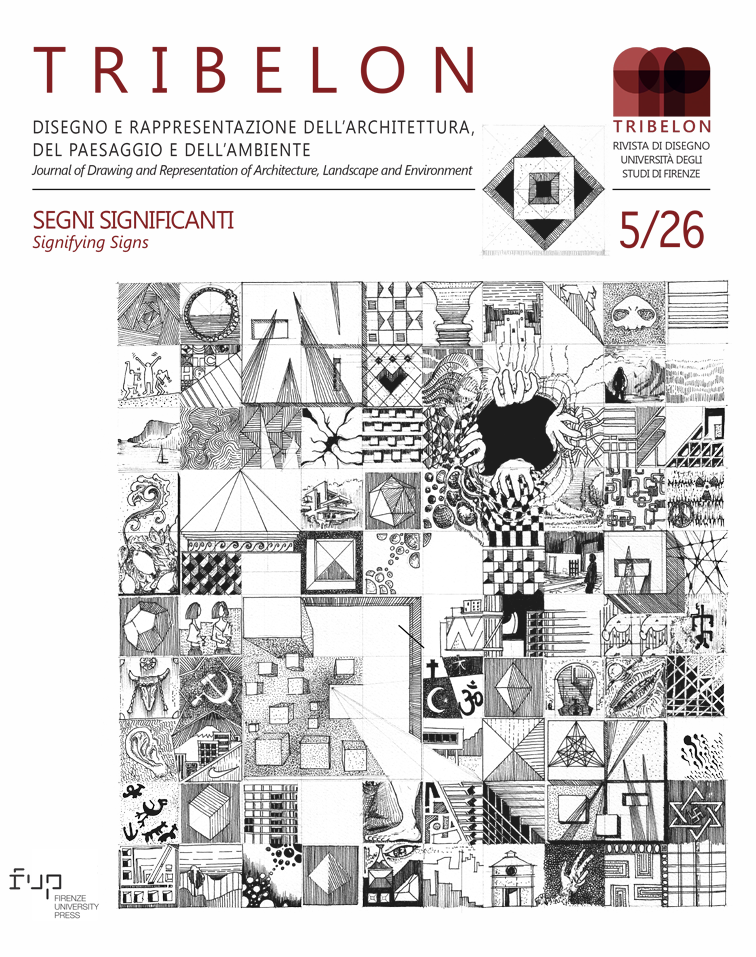
Zanis Waldheims (1909–1993) devised a system of geometric abstraction to create units of meaning that together form an architecture of the mind. His geometrization of thinking is grounded in five geometric shapes that function as signifiers, encoding words and their conceptual meanings. Units of meaning emerge through the convergence and synthesis of opposing or complementary concepts, which are unified in a central thematic meaning represented by a third geometric shape. Waldheims assembled these triadic combinations as building blocks of a two-dimensional map designed to orient thought. The sample unit of meaning – Art + Science = Knowledge – represents one of many such building blocks for mutual understanding. Drawing on both Euclidean and non-Euclidean geometries, he developed the flexibility required to construct the Noosphere: an architectural model of the mind, its thinking processes, and the evolution of consciousness. When first conceived in the late 1950s, Waldheims intended this geometrization of thought as the basis of a cybernetic system , that can retrospectively be read as anticipating aspects of contemporary artificial intelligence. The project quickly evolved into a distinctive art form. He claimed that for such a system to genuinely benefit society, it must rest on firm foundations in ethics and aesthetics. To this day, his art challenges viewers to move beyond the limits of personal perspective and to explore geometric pathways through the dilemmas generated by disinformation.
Riferimenti bibliografici
- W. Abler, The Human Mind. Origin in Geometry, in Science Progress, XCIII, 2010, 4, pp. 403-427. DOI: https://doi.org/10.3184/003685010X12871603572249
- G. Aiello, Visual Semiotics. Key Concepts and New Directions, in L. Pauwels, D. Mannay (eds.), The SAGE Handbook of Visual Research Methods, SAGE, London 2020, pp. 367-380. DOI: https://doi.org/10.4135/9781529721485.n23
- W.R. Ashby et al., Perspectives cybernétiques en psychologie, Presses universitaires de France, Paris 1951.
- S. Baris, Geometric Abstraction and Visual Metaphor (A Thought Experiment), in Discursive Geometry and More, Goldenmark Publications, Poland 2023.
- L. Couturat, La logique de Leibniz, Ancienne librairie Germer, Baillière et Cie, Paris 1901.
- W. Duch, Concept Representation and The Geometric Model of Mind, in Studies in Logic, Grammar and Rhetoric, LXVII, 2022, 80, pp. 151-167. DOI: https://doi.org/10.2478/slgr-2022-0009
- M. Fowler, A Taxonomy of the Greimas Square, in Axioms, XIV, 2025, 3, art. 207, 24 pp. DOI: https://doi.org/10.3390/axioms14030207
- S. Freud, Métapsychologie (1915), Gallimard, Paris 1940.
- P. Gärdenfors, The Geometry of Meaning. Semantics Based on Conceptual Spaces, The MIT Press, Massachusetts 2014. DOI: https://doi.org/10.7551/mitpress/9629.001.0001
- R. Guy, Zanis Waldheims. Une interprétation géométrique de la société, in M@GM@. Revue Internationale en Sciences Humaines et Sociales, XVII, 2020, 2.
- R. Guy, Une pensée exhaustive dans un monde binaire, in M@GM@. Revue Internationale en Sciences Humaines et Sociales, XIX, 2021, 3.
- R. Guy, La montée de conscience d’une intelligence artificielle, in M@GM@. Revue Internationale en Sciences Humaines et Sociales, XXI, 2023, 3.
- L.D. Henderson, The Fourth Dimension and Non-Euclidean Geometry in Modern Art, MIT Press, Massachusetts 2013.
- L. Hjelmslev, Prolegomena to a Theory of Language, The University of Wisconsin Press, Madison 1969.
- K. Lewin, Principles of Topological Psychology, McGraw-Hill, New York 1936. DOI: https://doi.org/10.1037/10019-000
- S. Lupasco, Logique et contradiction, Presses Universitaires de France, Paris 1947.
- V.V. Malloy, Dimensionism. Modern Art in the Age of Einstein, Mead Art Museum and MIT Press, Massachusetts 2018.
- A. Marotta et al., Visual Images and Language in Architecture. Signifier Semiotics and Meaning Semiotics, in IMMAGINI? Image and Imagination. International and Interdisciplinary Conference, Italy, November 2017. DOI: https://doi.org/10.3390/proceedings1090964
- R. Ruyer, La cybernétique et l’origine de l’information, Flammarion, Paris 1954.
- F. de Saussure, Cours de linguistique générale, Grande Bibliothèque Payot, Paris 1916.
- G. Sonesson, Greimasean Phenomenology and Beyond. From Isotopy to Time Consciousness, in Semiotica. Journal of the International Association for Semiotic Studies, 2017, 219, 21 pp. DOI: https://doi.org/10.1515/sem-2017-0084
- E. Tarasti, The Semiotics of A.J. Greimas. A Eu¬ropean Intellectual Heritage Seen from the Inside and the Outside, in Sign System Studies, XLV, 2017, 1/2, pp. 33-53. DOI: https://doi.org/10.12697/SSS.2017.45.1-2.03
- P. Teilhard de Chardin, Le phénomène humain, Éditions du Seuil, Paris 1955.
- Z. Waldheims, Description du schéma de l’entendement, unpublished manuscript, Montréal 1963.
- Z. Waldheims, Introduction au schéma de l’entendement. L’art topique ou l’art de penser, proposal for patent application, unpublished manuscript, Montréal 1966.
- Z. Waldheims, La géométrisation de la pensée exhaustive, unpublished manuscript certified by the Copyright Office at Ottawa, Canada 1970.
- Z. Waldheims, 1975-1981 Sketchbook, unpublished manuscript, Montréal 1980.
- Z. Waldheims, La philosophie plastique, unpublished manuscript, Montréal 1993.