

Published 2026-07-02
Keywords
- Protography,
- Sign,
- Drawing,
- Graphisms
How to Cite
Copyright (c) 2026 Enrico Cicalò

This work is licensed under a Creative Commons Attribution 4.0 International License.
Abstract
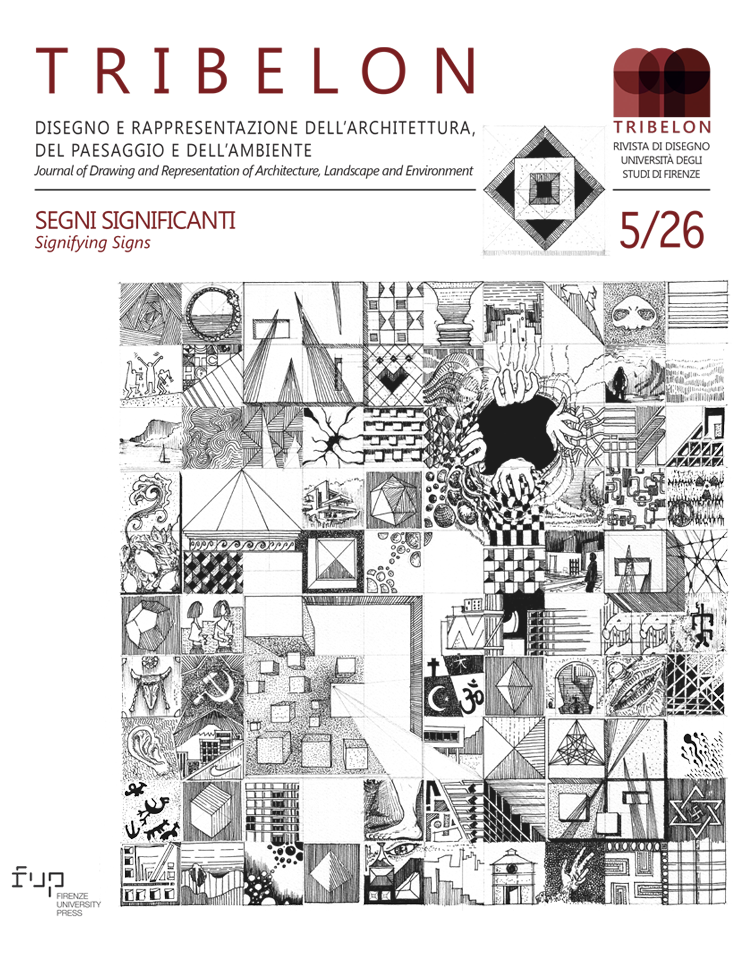
This essay introduces the concept of protography in order to investigate the origin of the graphic sign understood as drawing: the primordial act of tracing, impressing, and generating marks through bodily gesture. Protography is a neologism that does not point towards linguistic, scriptural, or figurative forms, but rather explores the production of lines and forms as archaic or spontaneous tactile and spatial imprints.If, for anthropology, the graphic sign is a techno-motor extension of the body; if, for semiotics, it is the causal trace of a gesture and, at the same time, a motivated figural possibility; if, for archaeology, it is evidence of the technical skills and knowledge of the past, then for the graphic sciences it is instead the origin of drawing, images, and graphic languages. Through this latter approach, the essay aims to outline the origins of the graphic sign by considering the human being as homo graphens, with their natural tendency towards graphic expression, whose technical-operational, neurocognitive, and psycho-emotional implications characterize the entire history of art, science, and technology.
References
- R. Arnheim, Art and Visual Perception: A Psychology of the Creative Eye, University of California Press, Berkeley-Los Angeles 1954.
- R. G. Bednarik, Aniconism and the Origins of Palaeoart, in Religion, XLVII, 2017, 3, pp. 353- 365. DOI: https://doi.org/10.1080/0048721X.2017.1288785
- C. Bentz, E. Dutkiewicz, Humans 40,000 y ago Developed a System of Conventional Signs, in Proceedings of the National Academy of Sciences, CXXIII, 2026, 9. DOI: https://doi.org/10.1073/pnas.2520385123
- G. Brusa Zappellini, Il linguaggio delle immagini. Contributi della linguistica e delle neuroscienze alla comprensione dell’arte delle origini, in Preistoria Alpina, XLVI, 2012, I, pp. 305-312.
- M. Budja, The Transition to Farming and the “Revolution” of Symbols in the Balkans. From Ornament to Entoptic and External Symbolic Storage, in Documenta Praehistorica, XXXI, 2004, pp. 59-81. DOI: https://doi.org/10.4312/dp.31.5
- E. Cicalò, Graphic Intelligence, Springer, Cham 2020. DOI: https://doi.org/10.1007/978-3-030-45244-5
- F. d’Errico, C. Henshilwood, G. Lawson, M. Vanhaeren, A. M. Tillier, M. Soressi et al., Archaeological Evidence for the Emergence of Language, Symbolism, and Music, in Journal of World Prehistory, XVII, 2003, 1, pp. 1-70. DOI: https://doi.org/10.1023/A:1023980201043
- J. Dewey, The School and Society, University of Chicago Press, Chicago 1899.
- D. Freedberg, V. Gallese, Motion, Emotion and Empathy in Esthetic Experience, in Trends in Cognitive Sciences, XI, 2007, 5, pp. 197-203. DOI: https://doi.org/10.1016/j.tics.2007.02.003
- G. Di Napoli, Disegnare e conoscere. La mano, l’occhio, il segno, Einaudi, Torino 2004.
- E. Furter, Mindprint, the Subconscious Art Code, Lulu, Raleigh 2014.
- I. J. Gelb, A Study of Writing, University of Chicago Press, Chicago 1963.
- N. Goodman, Ways of Worldmaking, Hackett, Indianapolis 1978. DOI: https://doi.org/10.5040/9781350928558
- C. S. Henshilwood, F. d’Errico, R. Yates, Z. Jacobs, C. Tribolo, G. A. Duller et al., Emergence of Modern Human Behavior: Middle Stone Age Engravings from South Africa, in Science, CCXCV, 2004, 5558, pp. 1278-1280. DOI: https://doi.org/10.1126/science.1067575
- C. S. Henshilwood, F. d’Errico, K. L. van Niekerk et al., An Abstract Drawing from the 73,000-Year-Old Levels at Blombos Cave, South Africa, in Nature, DLXII, 2018, pp. 115-118. DOI: https://doi.org/10.1038/s41586-018-0514-3
- T. Ingold, Lines: A brief history, Routledge, 2007. DOI: https://doi.org/10.4324/9780203961155
- M. Jeannerod, The Cognitive Neuroscience of Action, Blackwell, Oxford 1997.
- G. Kaimal, K. Ray, J. Muniz, Functional Near- Infrared Spectroscopy Assessment of Reward During Creative Tasks, in Art Therapy, XXXIV, 2017, 3, pp. 138-146. DOI: https://doi.org/10.1080/07421656.2017.1343072
- E. R. Kandel, J. H. Schwartz, T. M. Jessell, S. A. Siegelbaum, A. J. Hudspeth, Principles of Neural Science, 5ª ed., McGraw-Hill, New York 2013.
- R. Kellogg, Analisi dell’arte infantile: una fondamentale ricerca sugli scarabocchi e i disegni dei bambini dai due agli otto anni, Emme Edizioni, Milano 1979.
- A. Leroi-Gourhan, Le geste et la parole, Albin Michel, Paris 1964.
- J. D. Lewis-Williams, T. A. Dowson, The Signs of All Times: Entoptic Phenomena in Upper Palaeolithic Art, in Current Anthropology, XXIX, 1988, 2, pp. 201-245. DOI: https://doi.org/10.1086/203629
- V. Lowenfeld, W. L. Brittain, Creative and Mental Growth, 8ª ed., Macmillan, New York 1987.
- G. H. Luquet, Le dessin enfantin, Alcan, Paris 1927.
- F. Martini et al., Incisioni neandertaliane, in Rivista di Scienze Preistoriche, LIV, 2004, pp. 123-145.
- F. Martini, L’arte preistorica, Giunti, Firenze 2008.
- F. Martini, Prima e al di là dell’arte: origine dei segni e delle figurazioni nell’arte paleolitica, in Aisthesis. Pratiche, linguaggi e saperi dell’estetico, VI, 2013, 2, pp. 49-60. DOI: https://doi.org/10.13128/Aisthesis-13768
- G. M. Morriss‐Kay, The evolution of human artistic creativity, in Journal of Anatomy, CCXVI, 2010, 2, pp. 158-176. DOI: https://doi.org/10.1111/j.1469-7580.2009.01160.x
- J. R. Napier, Hands, Princeton University Press, Princeton 1980.
- B. Tversky, Cognitive Origins of Graphic Productions, in Understanding Images: Finding Meaning in Digital Imagery, pp. 29- 53. DOI: https://doi.org/10.1007/978-1-4613-8380-2_4
- L. S. Vygotsky, Mind in Society: The Development of Higher Psychological Processes, Harvard University Press, Cambridge (MA) 1978.
- G. von Petzinger, The First Signs: Unlocking the Mysteries of the World’s Oldest Symbols, Atria Books, New York 2016.