

Expanded Materiality in the RHITA Ecosystem: Towards a Manifesto for Intra-Active Fashion
 Chiara Scarpitti
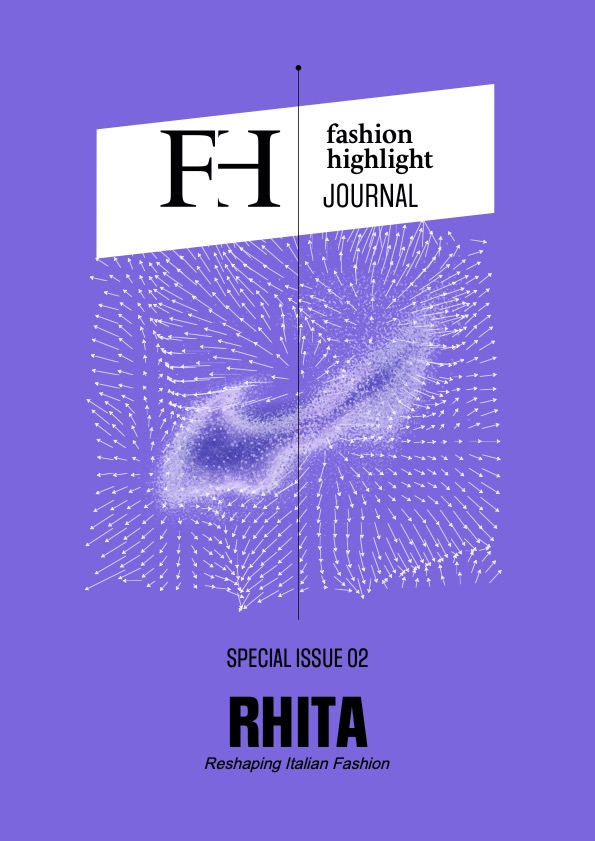
Published 09-03-2026
Keywords
- fashion theory,
- fashion practices,
- neo-materialism,
- quantum physics,
- digital technologies
How to Cite
Copyright (c) 2026 Chiara Scarpitti

This work is licensed under a Creative Commons Attribution 4.0 International License.
Abstract
This paper analyses the RHITA (ResHaping made in ITAly) project, presenting it as both a theoretical and operational laboratory for structurally rethinking the fashion system through the paradigm of expanded materiality. Drawing on Spinoza’s immanentist materialism and Barad’s agential realism, the essay describes fashion as an interactive system in which matter, bodies, technologies, and territories are interconnected and constantly evolving. In this perspective, the fashion product is no longer a stable object but a temporary assemblage of heterogeneous forces and dimensions, both physical and digital.
The visual identity of the RHITA project is based on broader reflections arising from two phenomena observable in quantum physics – the entanglement and the gravitational field - used as metaphors for the ability to attract and connect elements that appear distant or unrelated. Digital technologies are not understood as tools of dematerialisation, but rather as devices that enrich matter by multiplying its levels of existence. Sustainability, instead, is reinterpreted not only as a necessary condition for the project’s existence and for optimizing a drifting system, but also as a form of systemic friction.
The paper concludes with a draft manifesto of ten principles proposing an intra-active fashion approach oriented toward ecological co-responsibility, co-evolution with the digital realm, and the construction of sustainable plural futures.
References
- Barad, K. (2007). Meeting the Universe Halfway: Quantum Physics and the Entanglement of Matter and Meaning. Duke University Press.
- Barad, K. (2017). Performativa nella natura. Quanto e Queer. (p. 40). (R. Castiello Trans.) ETS Editions. (Original Work published 2003).
- Bennett, J. (2010). Vibrant matter: A political ecology of things. (p. 35). Duke University Press.
- Braidotti, R. (2014). The Posthuman: Life Beyond the Individual, Beyond the Species, Beyond Death. (pp. 57; pp.196) DeriveApprodi.
- Deleuze, G., & Guattari, F. (2006). A Thousand Plateaus [Mille plateaux] (V. Morabito, Trans.). Castelvecchi. (Original work published 1980).
- De Landa, M. (2006). A new philosophy of society: Assemblage theory and social complexity. Continuum.
- Escobar, A. (2018). Designs for the Pluriverse: Radical Interdependence, Autonomy, and the Making of Worlds. Duke University Press.
- Ferrando, F. (2016). Philosophical post-humanism and its otherness. (pp. 143). ETS.
- Fiorani, E. (2006). Abitare il corpo: La moda. Lupetti.
- Fletcher, K. (2014). Sustainable Fashion and Textiles: Design Journeys (2nd ed.). (p.22). Routledge.
- Glissant, É. (2019). Poetics of Relation. Poetics III. Quodlibet.
- Haraway, D. J. (2016). Staying with the trouble: Making kin in the Chthulucene. Duke University Press.
- Hui, Y. (2016). On the existence of digital objects. University of Minnesota Press.
- Heidegger, M. (1991). The Question Concerning Technology. In Essays and Discourses (pp. 9–11). Mursia. (Original work published 1954)
- Kothari, A., Salleh, A., Escobar, A., Demaria, F. & Acosta, A. (2019). Pluriverse. Dictionary of Post-Development. Orthotes.
- Jaque, A., Otero Verzier, M., Pietroiusti, L. (2019). More- than-Human. Het Nieuwe Instituut.
- Latouche, S. (2012). The Limit. From Unlimited Growth to Degrowth. Bollati Boringhieri.
- Marcadent & Scarpitti (2025). Plural Theories. Towards a manifesto of theoretical sources in design and fashion. Design and Research: Sources and Resources. Proceedings of the Annual Conference of the Italian Design Society, Venice,
- 4-5 July 2024. IUAV University of Venice. SID Italian Design Society. https://www.societaitalianadesign.it/wp-content/ uploads/2025/11/Design-e-Ricerca-Atti-di-convegno_HD.pdf
- Marotta F. & Scarpitti, C. (2025). Bodies, Technologies and Matter for a Relational Design. (Morone, A). Plural Design. Cases and alternative models for innovation. FedOAPress. https://dx.doi.org/10.6093/978-88-6887-385-1
- Manzini, E. (2015). Design, when everybody designs: An introduction to design for social innovation. MIT Press.
- Morton, T. (2021). Dark ecology: Logic of future coexistence. Luiss University Press.
- Ranzo, P. & Scarpitti, C. (2023). The Posthuman and the Destiny of Beauty. (pp. 30-43). Dune. Writings on Fashion, Design and Visual Culture, Vol. 004 n. 001, Biosphere, December 2023. Flash Art Editions.
- Ranzo & Scarpitti, C. (2024). Towards a more-than-human design: the digital condition and post-anthropocentric aesthetics. GUD Journal, vol. no. 9. Stefano Termanini Editore. https://www.stefanotermaninieditore.it/portale/wp-content/ uploads/2024/08/GUD9_IperumanoHyperHuman_012024_ ISSN1720-075X_OpenAccess_online_compressed.pdf
- Rocamora, A. & Smelik, A. (2022). Thinking through fashion. Meltemi.
- Rovelli, C. (2014). Seven Brief Lessons on Physics. Adelphi.
- Scarpitti, C. (2019). Singular Multiples. Contemporary jewellery beyond digital. ListLab.
- Spinoza, B. (1996). Ethics (E. Curley, Trans.). Penguin Classics. (Original work published 1677).