


Published 2026-09-29
How to Cite
Copyright (c) 2026 Sandro Parrinello

This work is licensed under a Creative Commons Attribution 4.0 International License.
Abstract
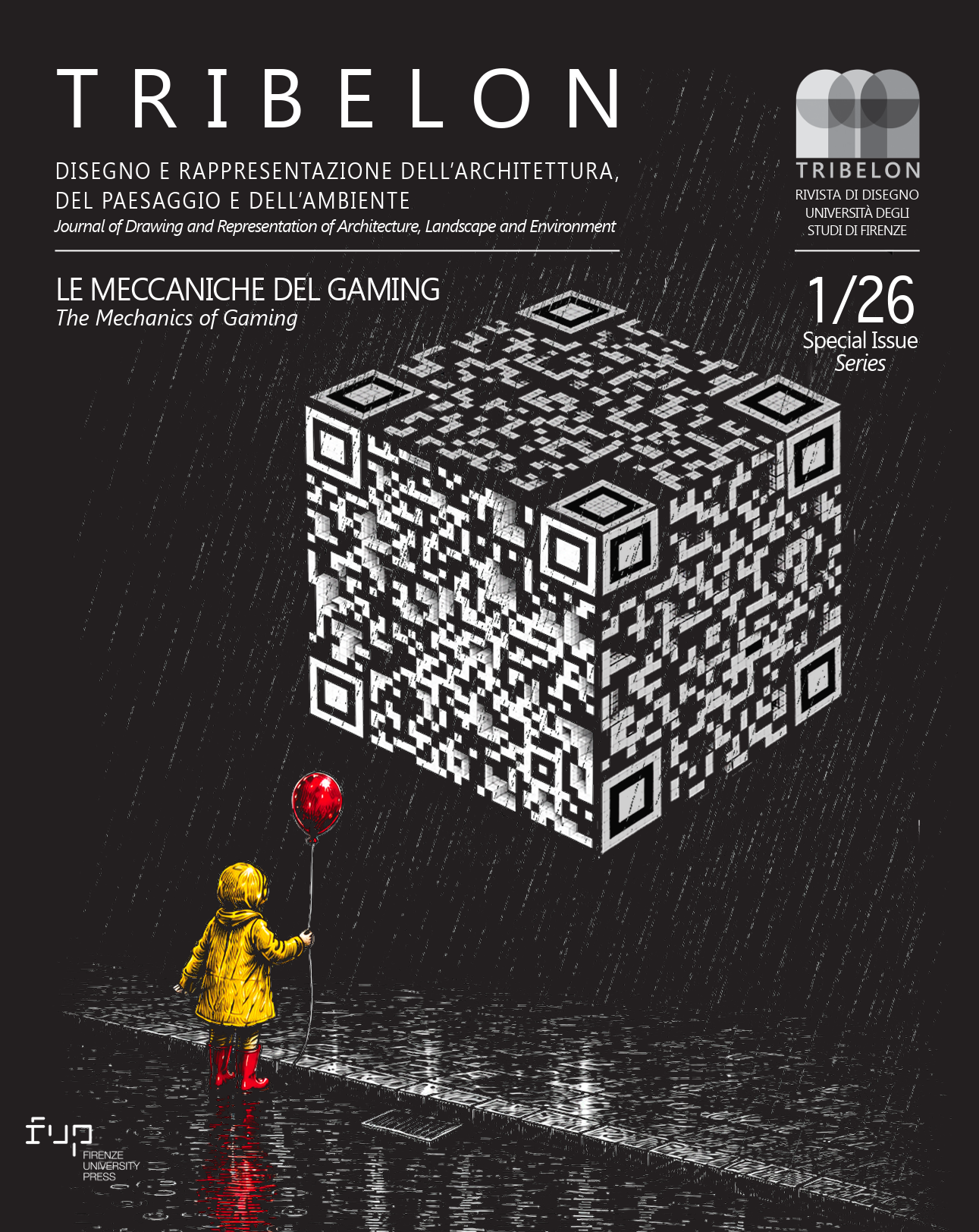
Play constitutes a space for interpretation, knowledge, and experimentation through which individuals construct worlds, engage with reality, and explore alternative possibilities. Starting from its aesthetic, cultural, and anthropological dimensions, this editorial examines the relationship between play and Drawing, considering ludic practice as a form of abstraction capable of organising rules, behaviours, narratives, and modes of interaction. Yet this same capacity to construct possible realities reveals an ambivalent nature, in which simulation and fiction may become instruments of knowledge or produce forms of detachment from and simplification of reality. Within this framework, gaming mechanics acquire particular relevance to contemporary cultures of design and representation. The contributions collected in this issue investigate play as a design device applied to education, cultural heritage, immersive environments, therapy, training, and the construction of interactive digital experiences. Drawing thus emerges as a practice capable of translating the ludic dimension into systems of relationships, choices, and actions, transforming the digital model from a static representation into an experiential space where knowledge, creativity, and simulation can converge.