

Vol 3, No 5 (2026): Signifying Signs

Issue Description

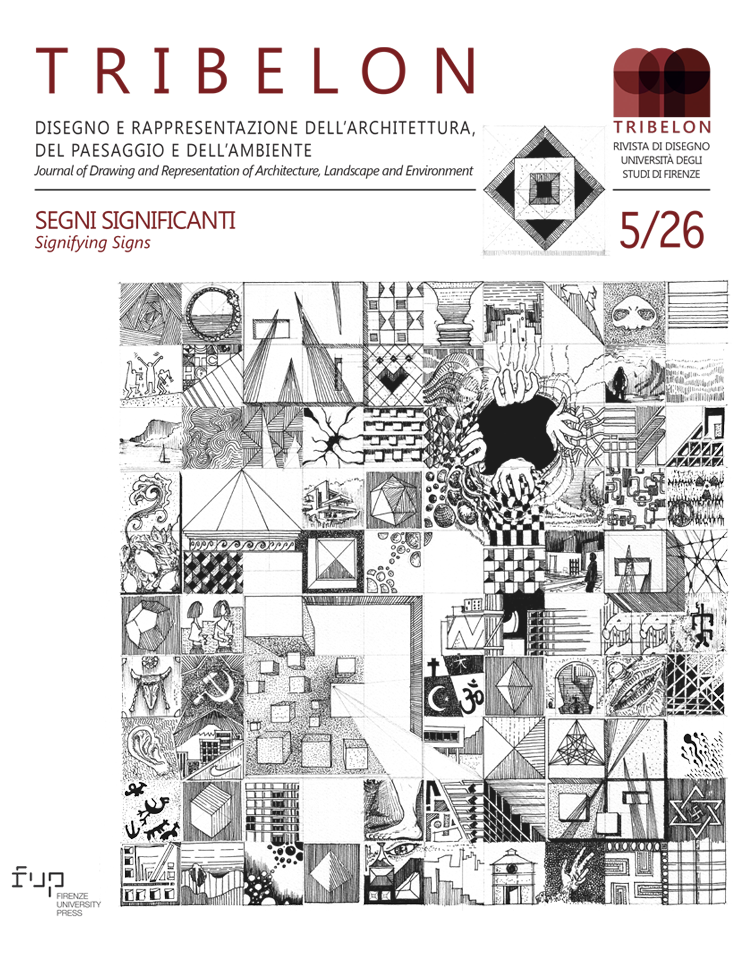
This journal issue proposes a reflection on drawing as expression, language, and a critical device for constructing meaning. Each line, mark, or graphic variation is understood not as a neutral trace, but as the result of a tension between intention, gesture, and significance. From this perspective, the sign transcends its material condition to become a semantic element, capable of activating imagination, organising thought, and generating new readings of represented reality. In an age dominated by digital drawing, where software produces perfect, repeatable, and modifiable signs, the volume questions the value of intentionality and the interpretative capacity of drawing. What emerges is a conception of drawing as a critical space of design: a place of synthesis, doubt, and resistance to simplification, where the pursuit of clarity coexists with the complexity of meaning.
##issue.tableOfContents##

Table of Contents

Editorial

In the Mountain's Shadow. On the Drift of the Signifier in Contemporary Visual Hypertrophy
Sandro Parrinello
4-9
DOI: https://doi.org/10.36253/tribelon-4224

Articles

Intellectual habit. Some notes on Drawing
Fabrizio Arrigoni
12-23
DOI: https://doi.org/10.36253/tribelon-4009
The rêverie of the trait: Giambattista Tiepolo's Capricci and Scherzi di fantasia
Emanuele Garbin
24-33
DOI: https://doi.org/10.36253/tribelon-3974
Architectural design between reality and idealism: Palladio and Canaletto
Alberto Sdegno
34-43
DOI: https://doi.org/10.36253/tribelon-4002
Protography, or on the Origin of the Graphic Sign
Enrico Cicalò
44-51
DOI: https://doi.org/10.36253/tribelon-3972
Signs, Memory and Medieval Funerary Stone Carvings in the Lake Sevan Basin
Avetis Grigoryan, Nelli Petrosyan, Artyom Ananyan, Sevak Arevshatyan
52-59
DOI: https://doi.org/10.36253/tribelon-4151
Meta-Design, Figure and Style between Drawing and Generative AI
Fabrizio Gay, Irene Cazzaro
60-69
DOI: https://doi.org/10.36253/tribelon-4007
Geometry for an Architecture of the Mind
Raymond Guy
70-79
DOI: https://doi.org/10.36253/tribelon-4070
The evolution of language in italian advertising posters of the 20th Century
Marcello Scalzo
80-91
DOI: https://doi.org/10.36253/tribelon-4095
Co-creation in Sketching Space
Simon Twose
92-101
DOI: https://doi.org/10.36253/tribelon-4091

A Drawing from the Past

Drawings by Roberto Segoni for the Design of a Recreational Centre in Compiobbi (Fiesole)
Marco Bini
104-106
DOI: https://doi.org/10.36253/tribelon-4264
The David beneath the Loggia dei Lanzi in Pasquale Poccianti’s Hypothesis
Roberto Lembo
107-109
DOI: https://doi.org/10.36253/tribelon-4263

A Drawing from the Present

Painted Architecture and the Drawing of Space in the Cycle of the Stories of Saint Francis in Assisi
Roberta Ferretti
110-112
DOI: https://doi.org/10.36253/tribelon-4262

Graphic Codes

The Role of the Point in the Parametric Drawing of Conics between Geometry and Computational Topology
Giovanni Anzani
113-118
DOI: https://doi.org/10.36253/tribelon-4265

Lines of Inspiration. Conversations with Drawing Masters

A Conversation with Franco Purini
a cura di Sandro Parrinello
119-127
DOI: https://doi.org/10.36253/tribelon-4266
View All Issues